Alabama Science P.3.d
The Standard
- P.3
- Design and carry out experiments to verify that energy and momentum are conserved in closed systems.
Qualitatively and quantitatively evaluate the relationship among the force acting on an object, the time of interaction, and the change in linear momentum (impulse) of the object.
2023 Alabama Course of Study: Science · Energy
Teacher's field guide
What This Standard Means
What Students Need to Do
- Students connect a force acting over time to a change in an object’s momentum. They calculate impulse from average force and contact time, and use direction to describe the momentum change.
What Mastery Looks Like
- A student can find that a 6 N forward force applied for 0.5 s changes momentum by 3 kg·m/s forward. They can explain why a longer stopping time means less average force when the momentum change stays the same.
Common Misconceptions
- Students may think a larger force always causes a larger momentum change, even when it acts for less time. They may ignore direction or treat the force during a collision as constant.
How to Assess It
- Exit ticket: A ball’s momentum changes by 4 kg·m/s backward during a 0.2 s collision. What average force acts on it, including direction?
Lesson moves
Ways to Teach It
Pull a toy cart with a spring scale at 2 N for one second, then two seconds, starting from rest and filming its motion.
Ask: Why does a catcher move a glove backward while catching a ball, and what happens to the average force?
Give pairs force and contact-time cards; have them match equal impulses and explain any differences in direction.
Calculate average force for a 60 kg passenger stopping from 10 m/s in 0.1 s versus 0.5 s.
Free download
Printable P.3.d Worksheet
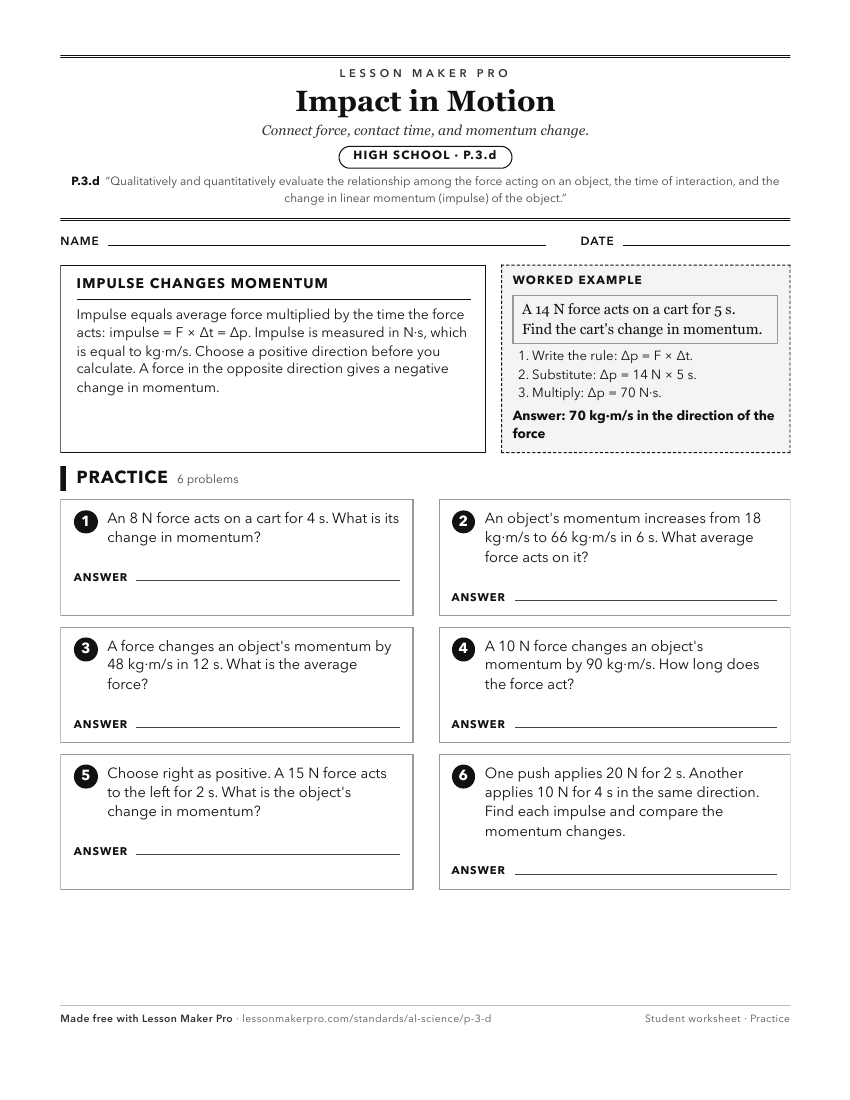
A ready-to-print activity worksheet aligned to P.3.d, with an answer key for the teacher on its own page. No account needed.
PDF, US Letter, prints cleanly in black and white.
Download the worksheetKeep exploring
Related Standards
- PS.1.d
Investigate collisions and other real-world situations to evaluate the effects of impulse on changes in momentum.
- P.3.e
Obtain, evaluate, and interpret data related to collisions (both elastic and inelastic) and their effects on both linear momentum and energy conservation.
- P.2.b
Use mathematical, graphical, and narrative methods to explain the relationships among net force, mass, and acceleration of a single object.
- P.2.a
Evaluate the effects of balanced and unbalanced forces on an object’s motion.
Turn this exact standard into a lesson
Grade, subject, topic, and the complete standard are prefilled. Create one free, no account needed.
Also for this standard:Make a WorksheetMake a QuizMake a Sub Lesson