Alabama Science ESS.7.a
The Standard
- ESS.7
- Obtain, evaluate, and communicate information about the role of energy transfer in wind, precipitation, cloud formation, and front formation.
Obtain and communicate information to explain how water cycles through the atmosphere, including condensation, evaporation, clouds, types of precipitation, relative humidity, and dew point.
2023 Alabama Course of Study: Science
Teacher's field guide
What This Standard Means
What Students Need to Do
- Students use diagrams and weather reports to trace water from evaporation to clouds and precipitation. They explain how cooling to the dew point causes condensation and raises relative humidity. They distinguish rain, snow, sleet, freezing rain, and hail.
What Mastery Looks Like
- A student can explain why rising, cooling air forms clouds and how precipitation may follow. They identify water vapor, liquid droplets, and ice at the right points in the cycle. They can explain why a cloud does not always produce rain.
Common Misconceptions
- Students may think clouds are water vapor, but clouds contain tiny droplets or ice crystals. They may read 70% relative humidity as air that is 70% water, or think reaching the dew point guarantees rain. Some confuse sleet, which freezes before landing, with freezing rain, which freezes on contact.
How to Assess It
- Give this exit prompt: “Water evaporates from a lake into air at 24°C. Its dew point is 18°C. If the air rises and cools to 18°C, explain what happens to relative humidity and how a cloud forms.”
Lesson moves
Ways to Teach It
Set out a cold glass, observe droplets on its outside, and have students sketch where that water came from.
Ask students to write why a cloud can form when moist air rises but may not produce rain.
Sort snow, sleet, and freezing rain cards against descriptions of ice crystals, refrozen drops, and drops freezing on contact.
Compare tonight’s forecast low with the dew point on a weather app, then predict whether dew may form on grass.
Free download
Printable ESS.7.a Worksheet
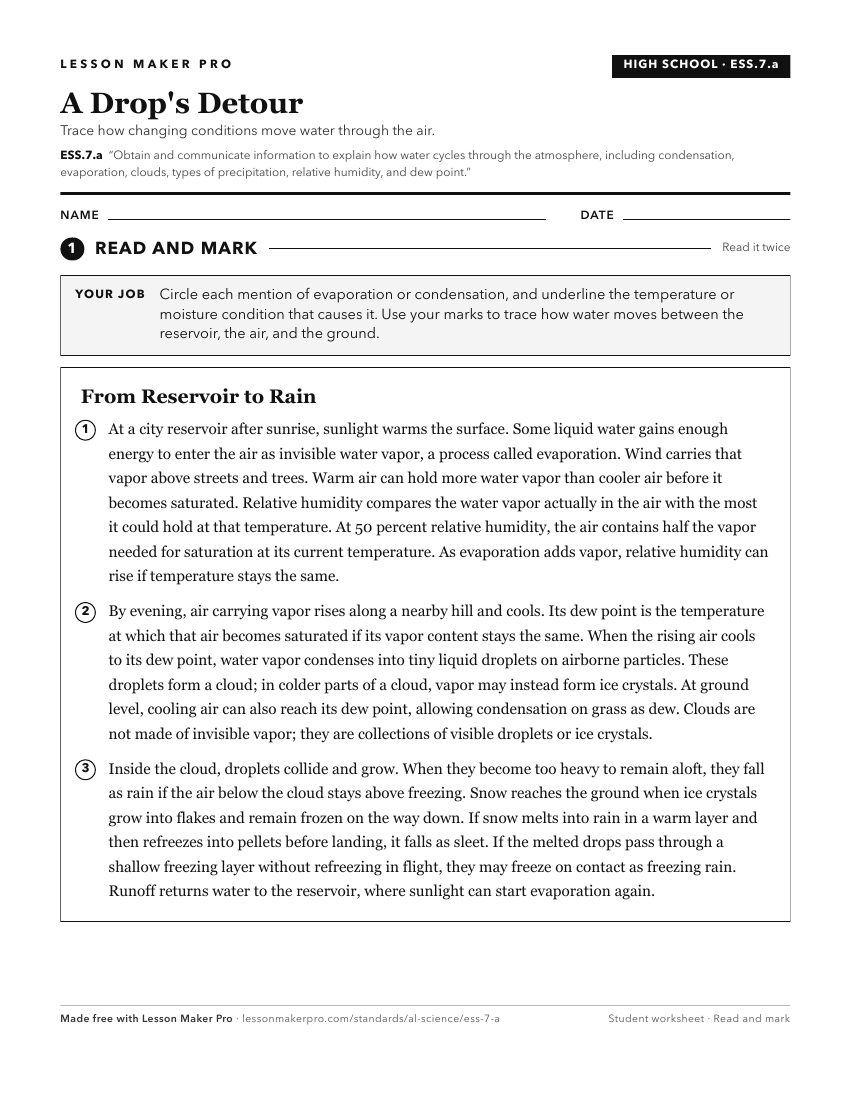
A ready-to-print activity worksheet aligned to ESS.7.a, with an answer key for the teacher on its own page. No account needed.
PDF, US Letter, prints cleanly in black and white.
Download the worksheetKeep exploring
Related Standards
- 4.10
Develop and use a model to describe how water moves through Earth’s systems by the processes of evaporation, condensation, and precipitation.
- ESS.7
Obtain, evaluate, and communicate information about the role of energy transfer in wind, precipitation, cloud formation, and front formation.
- 6.9.a
Obtain, evaluate, and communicate data that describes characteristics of air masses, including temperature, pressure, and humidity.
- ESS.8
Obtain and communicate information to explain different climate regions and their impact on patterns of severe weather.
Turn this exact standard into a lesson
Grade, subject, topic, and the complete standard are prefilled. Create one free, no account needed.
Also for this standard:Make a WorksheetMake a QuizMake a Sub Lesson