Alabama Science 4.10
The Standard
Develop and use a model to describe how water moves through Earth’s systems by the processes of evaporation, condensation, and precipitation.
2023 Alabama Course of Study: Science · Earth’s Systems
Teacher's field guide
What This Standard Means
What Students Need to Do
- Students draw or build a model that tracks water from the ground into the air and back. They show water evaporating, forming cloud droplets, and falling as rain or snow.
What Mastery Looks Like
- A student draws arrows in the right direction and labels evaporation, condensation, and precipitation. They explain that water vapor cools to form cloud droplets and that water returns to the ground.
Common Misconceptions
- Students may think water vanishes when a puddle dries or that evaporation happens only when water boils. They may confuse condensation, which forms droplets, with precipitation, which falls to the ground.
How to Assess It
- Ask students to draw how water from a puddle could end up as rain. Have them label each process and explain what happens at each arrow.
Lesson moves
Ways to Teach It
Stretch plastic wrap over a clear bowl of warm water, set ice on top, and sketch droplets forming and falling inside.
Have partners explain where a sunlit puddle's water goes and how it could return as rain, using arrows on a sketch.
Give pairs cards labeled ocean, water vapor, cloud droplets, and rain; have them order the cards and name each process between them.
Check tomorrow's rain forecast and draw how water from a local puddle could evaporate, form cloud droplets, and fall again.
Free download
Printable 4.10 Worksheet
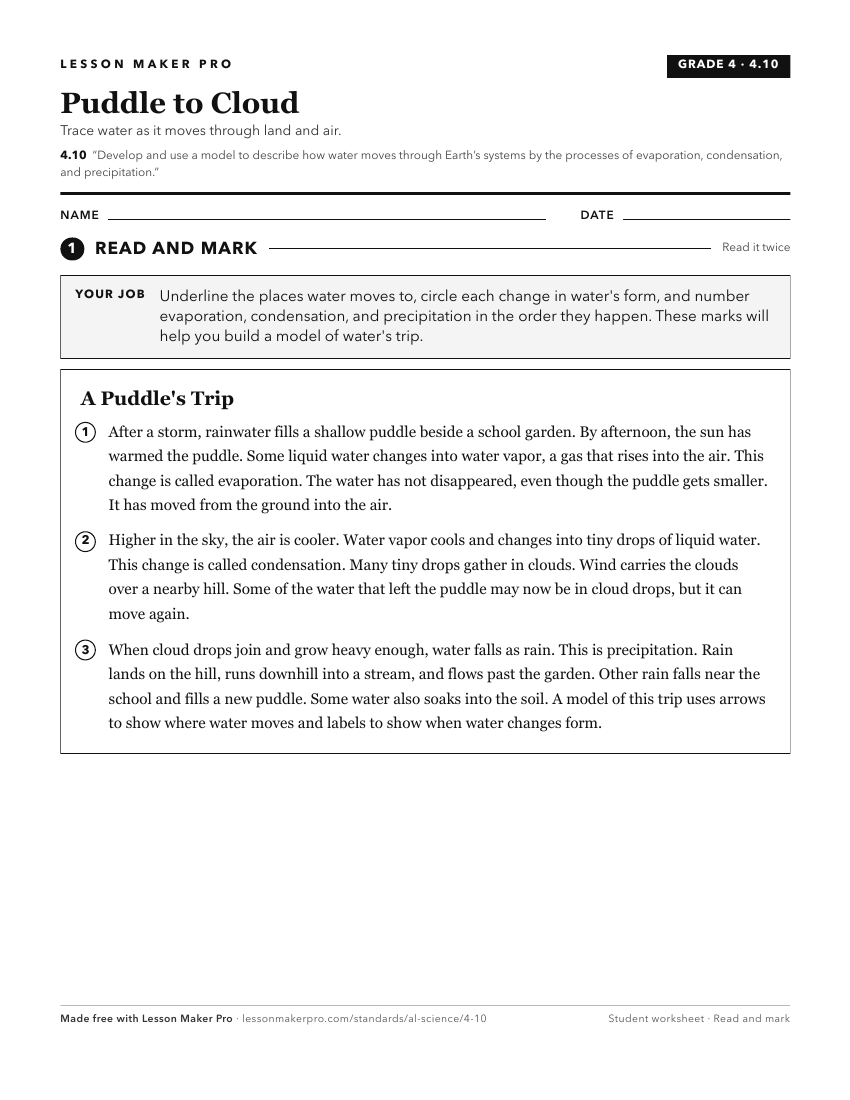
A ready-to-print activity worksheet aligned to 4.10, with an answer key for the teacher on its own page. No account needed.
PDF, US Letter, prints cleanly in black and white.
Download the worksheetKeep exploring
Related Standards
- ESS.7.a
Obtain and communicate information to explain how water cycles through the atmosphere, including condensation, evaporation, clouds, types of precipitation, rela...
- 6.5.a
Develop and use models to demonstrate the processes that form rocks and cycle Earth’s materials.
- 5.12
Use a model to represent how any two of Earth's systems (atmosphere, biosphere, geosphere, and hydrosphere) interact and support life.
- 6.5.c
Develop and use models to demonstrate types of weathering, effects of agents of erosion and transportation, and the formation of environments of deposition.
Turn this exact standard into a lesson
Grade, subject, topic, and the complete standard are prefilled. Create one free, no account needed.
Also for this standard:Make a WorksheetMake a QuizMake a Sub Lesson