Alabama Science 6.5.c
The Standard
- 6.5
- Obtain, evaluate, and communicate evidence that explains how constructive and destructive processes shape Earth’s surface.
Develop and use models to demonstrate types of weathering, effects of agents of erosion and transportation, and the formation of environments of deposition.
2023 Alabama Course of Study: Science
Teacher's field guide
What This Standard Means
What Students Need to Do
- Students make models showing how rocks break apart or change chemically. They show how water, wind, ice, or gravity moves sediment and builds places such as deltas or dunes.
What Mastery Looks Like
- A student can label physical weathering, chemical weathering, sediment movement, and deposition on a model. They can explain why a slowing river leaves sediment in a delta.
Common Misconceptions
- Students often call moving sediment weathering instead of erosion. Some think sediment disappears when water slows. Others think weathering only breaks rock into smaller pieces.
How to Assess It
- Exit ticket: Draw a stream entering a lake. Label where rock breaks, where sediment moves, and where it settles. Explain how acid can change rock and why a delta forms.
Lesson moves
Ways to Teach It
Shake sugar cubes, drip vinegar on chalk, then pour water down a sand tray; label weathering, erosion, transport, and deposition.
Ask, 'Why does a river build a delta when it reaches a lake, while wind piles sand into dunes?'
Give pairs cards showing cracked rock, dissolving limestone, blowing sand, and a growing delta; sort them by process.
Use a map of the Mississippi River delta; students trace sediment from upriver erosion to land built where the river meets the gulf.
Free download
Printable 6.5.c Worksheet
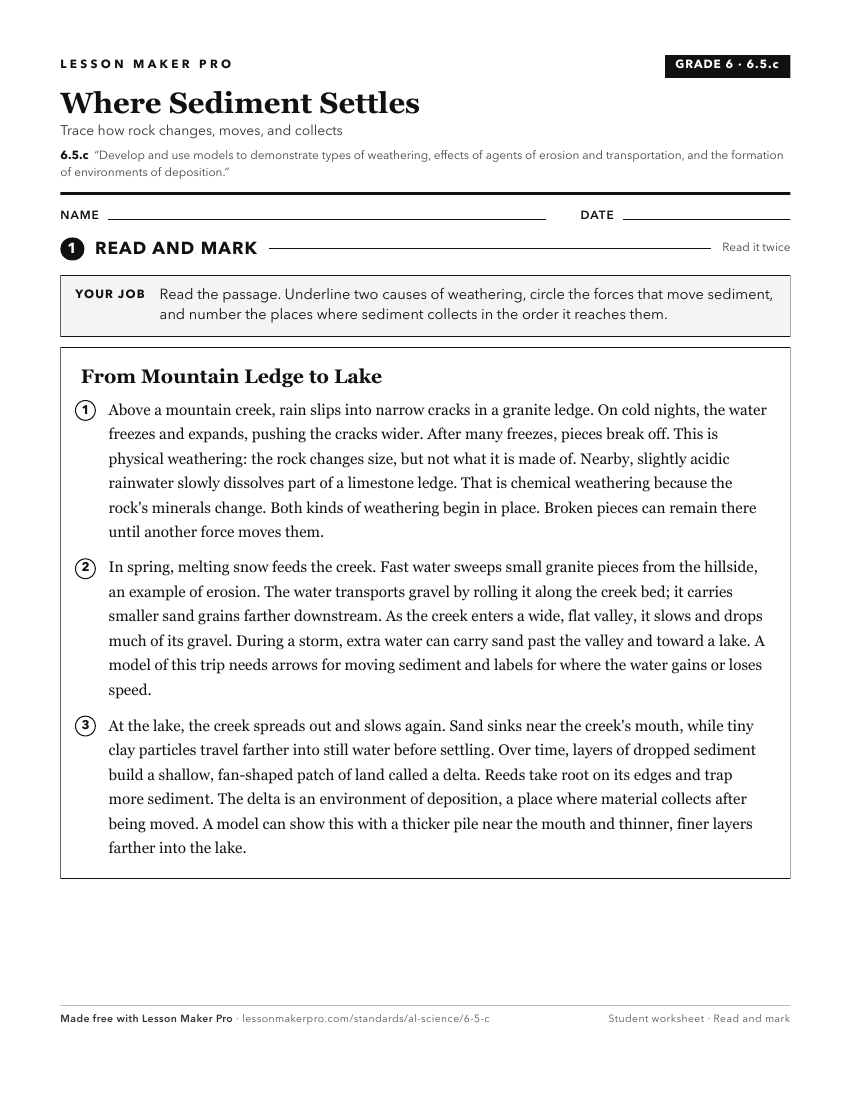
A ready-to-print activity worksheet aligned to 6.5.c, with an answer key for the teacher on its own page. No account needed.
PDF, US Letter, prints cleanly in black and white.
Download the worksheetKeep exploring
Related Standards
- 6.5.a
Develop and use models to demonstrate the processes that form rocks and cycle Earth’s materials.
- ESS.4.b
Analyze and interpret data to explain the effects of mechanical and chemical weathering and erosion on Earth’s materials by wind, water, ice, and gravity.
- 4.12
Plan and carry out investigations to provide evidence of the effects of weathering or the rate of erosion by water, ice, wind, and vegetation, investigating a s...
- 4.10
Develop and use a model to describe how water moves through Earth’s systems by the processes of evaporation, condensation, and precipitation.
Turn this exact standard into a lesson
Grade, subject, topic, and the complete standard are prefilled. Create one free, no account needed.
Also for this standard:Make a WorksheetMake a QuizMake a Sub Lesson