Alabama Science 4.12
The Standard
Plan and carry out investigations to provide evidence of the effects of weathering or the rate of erosion by water, ice, wind, and vegetation, investigating a single form of weathering or erosion at a time.
2023 Alabama Course of Study: Science · Earth’s Systems
Teacher's field guide
What This Standard Means
What Students Need to Do
- Students test one cause of weathering or erosion at a time, such as freezing or moving water. They keep other conditions the same and record changes to rock or soil, or measure how much soil moves over time.
What Mastery Looks Like
- A student can compare soil lost from two trays with different slopes after each gets the same amount of water. They use the measurements to explain which tray eroded faster and name what stayed the same.
Common Misconceptions
- Students may call a rock breaking apart erosion, even if none of it moves. They may compare two trays using different amounts of water and treat the result as a fair test. Some think plant roots make soil erode faster rather than help hold it in place.
How to Assess It
- Exit ticket: Two soil trays get 100 mL of water each for 30 seconds. One loses 8 g of soil and the other loses 2 g. Which eroded faster, what is your evidence, and what stayed the same?
Lesson moves
Ways to Teach It
Pour equal amounts of water over two soil trays with different slopes, then collect and weigh the soil washed off each.
Draw a cracked rock and a stream carrying sand; ask students which shows weathering, which shows erosion, and why.
Use a hand fan to blow paper dots across a desk for ten seconds; count how many cross a tape line.
Show a photo of a muddy roadside ditch after rain; ask students to mark where soil moved and suggest where plants could help.
Free download
Printable 4.12 Worksheet
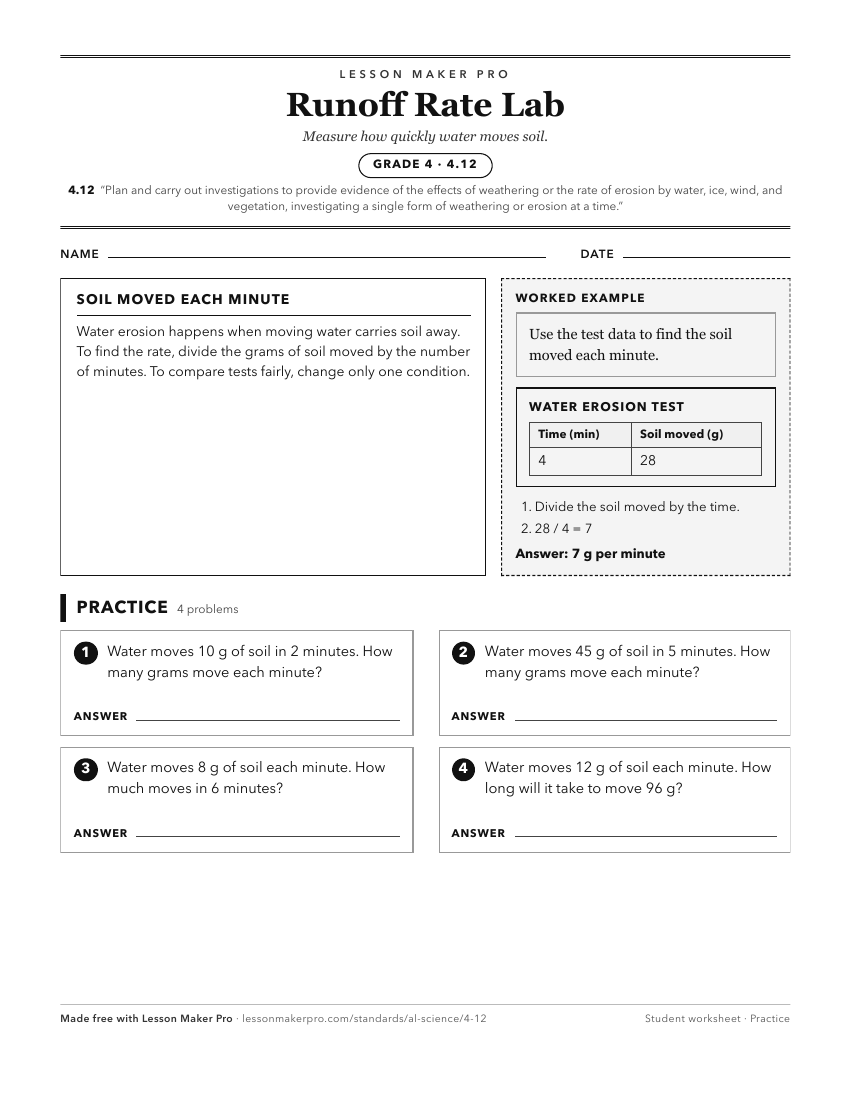
A ready-to-print activity worksheet aligned to 4.12, with an answer key for the teacher on its own page. No account needed.
PDF, US Letter, prints cleanly in black and white.
Download the worksheetKeep exploring
Related Standards
- ESS.4.b
Analyze and interpret data to explain the effects of mechanical and chemical weathering and erosion on Earth’s materials by wind, water, ice, and gravity.
- 6.5.c
Develop and use models to demonstrate types of weathering, effects of agents of erosion and transportation, and the formation of environments of deposition.
- 6.5
Obtain, evaluate, and communicate evidence that explains how constructive and destructive processes shape Earth’s surface.
- ESS.7.b
Plan and carry out an investigation to determine the differential heating of land and water and explain how these differences create changes in local and global...
Turn this exact standard into a lesson
Grade, subject, topic, and the complete standard are prefilled. Create one free, no account needed.
Also for this standard:Make a WorksheetMake a QuizMake a Sub Lesson