Alabama Science ESS.1.b
The Standard
- ESS.1
- Obtain, evaluate, and communicate information about the connections among mass, gravity, and fusion in the life cycle of stars.
Interpret the Hertzsprung-Russell diagram to analyze the properties of stars, including density, magnitude, temperature, rates of fusion, and spectral class.
2023 Alabama Course of Study: Science · Earth’s Place in the Universe
Teacher's field guide
What This Standard Means
What Students Need to Do
- Students read temperature, absolute magnitude, and spectral class from a star's position on a Hertzsprung-Russell diagram. They use the star's position and group to compare size, density, and likely fusion rate.
What Mastery Looks Like
- They place a blue main-sequence star, a red giant, and a white dwarf in the right regions. They explain that a hot white dwarf is faint because it is small, and identify it as dense. They identify which of two main-sequence stars fuses fuel faster.
Common Misconceptions
- Students often read temperature as increasing to the right and treat higher absolute-magnitude numbers as brighter. They may assume every hot star is bright. Some think red giants are dense because they are large, or that white dwarfs still fuse hydrogen.
How to Assess It
- Give students a labeled diagram with two main-sequence stars and a white dwarf. Ask them to record each star's temperature, spectral class, and absolute magnitude, then identify the densest star and the main-sequence star that fuses fuel faster.
Lesson moves
Ways to Teach It
Give pairs star cards with temperature and absolute magnitude; have them plot the stars on paper and mark each spectral class.
Ask: Why can a white dwarf be hotter than a red giant but much fainter? Have students explain using size.
Play star sort: teams match temperature, magnitude, and spectral class cards, then rank main-sequence stars by likely fusion rate.
Use a sky map to find Betelgeuse and Sirius, then compare their colors and locate both on a printed diagram.
Free download
Printable ESS.1.b Worksheet
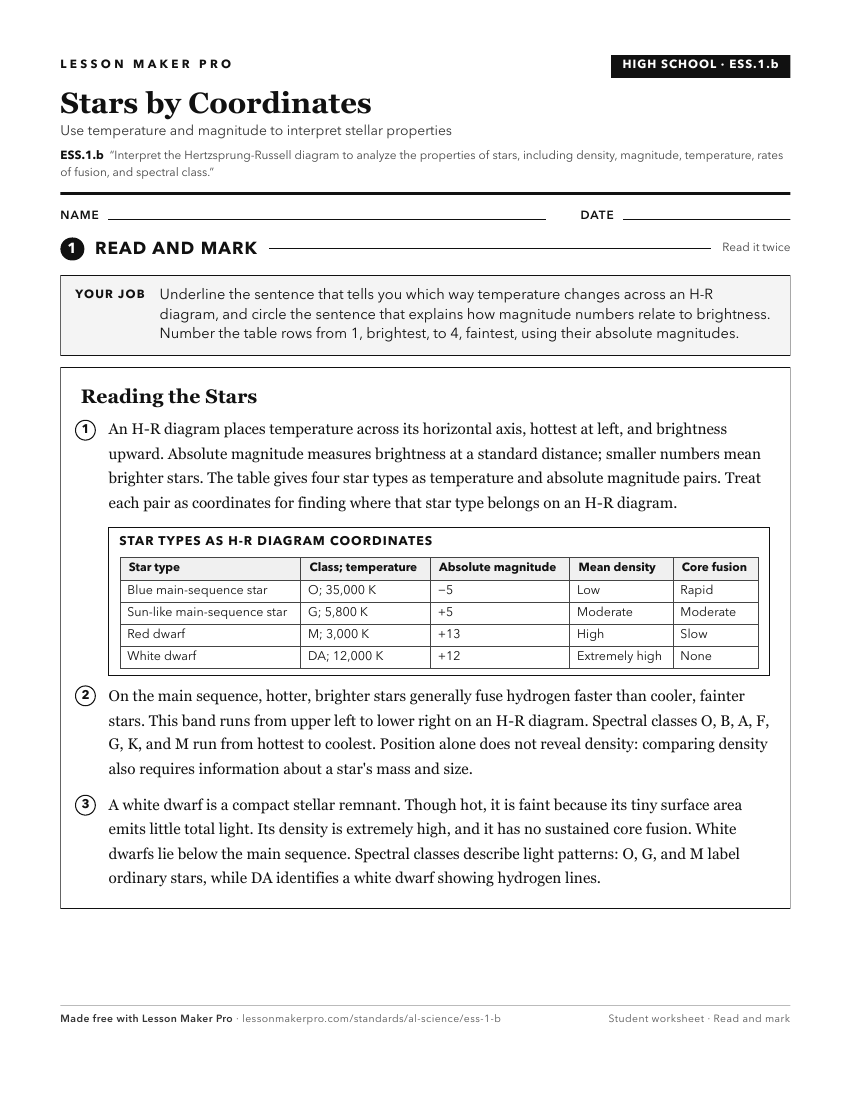
A ready-to-print activity worksheet aligned to ESS.1.b, with an answer key for the teacher on its own page. No account needed.
PDF, US Letter, prints cleanly in black and white.
Download the worksheetKeep exploring
Related Standards
- ESS.1.d
Analyze and interpret data to quantify the energy produced in stars, using Einstein’s theory of general relativity by applying E=mc2 to show that the small amou...
- ESS.2.c
Analyze spectroscopic data to determine the properties and motion of objects in space.
- CHE.1.c
Analyze and interpret data to identify or describe an element based on its number of protons, its relative abundance of isotopes, its organization and placement...
- ESS.1
Obtain, evaluate, and communicate information about the connections among mass, gravity, and fusion in the life cycle of stars.
Turn this exact standard into a lesson
Grade, subject, topic, and the complete standard are prefilled. Create one free, no account needed.
Also for this standard:Make a WorksheetMake a QuizMake a Sub Lesson