Alabama Science ESS.1.d
The Standard
- ESS.1
- Obtain, evaluate, and communicate information about the connections among mass, gravity, and fusion in the life cycle of stars.
Analyze and interpret data to quantify the energy produced in stars, using Einstein’s theory of general relativity by applying E=mc2 to show that the small amount of mass produced during hydrogen fusion produces a large amount of energy.
2023 Alabama Course of Study: Science · Earth’s Place in the Universe
Teacher's field guide
What This Standard Means
What Students Need to Do
- Students compare the mass of hydrogen atoms before fusion with the mass of the helium atom formed. They calculate the mass lost, then use E = mc² to find the energy released.
What Mastery Looks Like
- Given mass data in kilograms, students subtract in the right order and square the speed of light before multiplying. They report energy in joules and explain that some mass changed into energy.
Common Misconceptions
- Students may add the masses instead of subtracting them, or think helium gains mass during fusion. Some forget to square the speed of light or use grams without converting to kilograms.
How to Assess It
- Exit ticket: Four hydrogen atoms have a total mass of 6.69 × 10^-27 kg, and the helium atom formed has a mass of 6.64 × 10^-27 kg. Using c = 3.0 × 10^8 m/s, find the mass lost, calculate the energy released in joules, and explain what happened to the missing mass.
Lesson moves
Ways to Teach It
Give pairs four hydrogen mass cards and one helium mass card; have them arrange the fusion inputs and output, then subtract their masses.
Ask students to write an answer to: Why can the Sun release so much energy when each fusion event loses so little mass?
Run a three-round calculation relay with fusion mass cards; teams find the missing mass, square c, and report the energy in joules.
Give students the Sun's one-day energy output, 3.3 × 10^31 J, and have them calculate the mass converted using m = E/c².
Free download
Printable ESS.1.d Worksheet
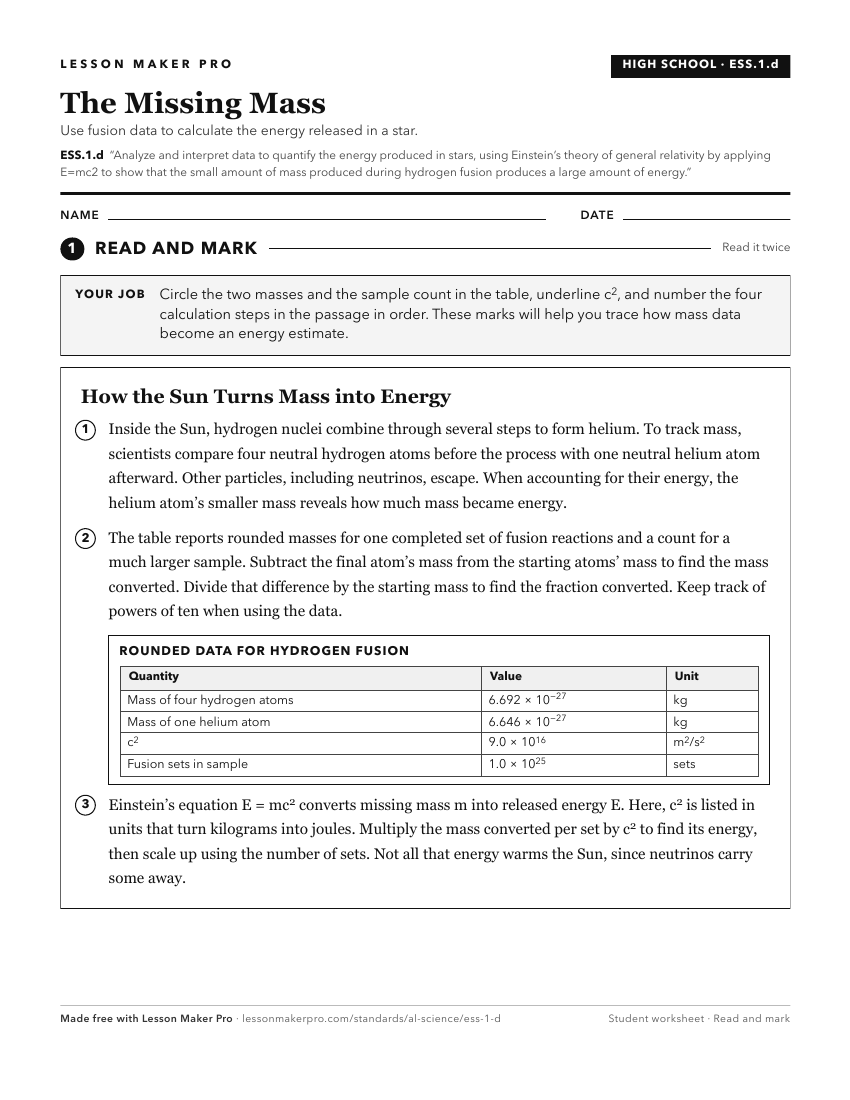
A ready-to-print activity worksheet aligned to ESS.1.d, with an answer key for the teacher on its own page. No account needed.
PDF, US Letter, prints cleanly in black and white.
Download the worksheetKeep exploring
Related Standards
- ESS.1.c
Obtain, evaluate, and communicate information about how nuclear fusion in stars and supernovas leads to the formation of all other elements.
- ESS.1
Obtain, evaluate, and communicate information about the connections among mass, gravity, and fusion in the life cycle of stars.
- ESS.1.b
Interpret the Hertzsprung-Russell diagram to analyze the properties of stars, including density, magnitude, temperature, rates of fusion, and spectral class.
- PS.4.g
Use models to explain how nuclear fission and fusion reactions can be used as energy sources.
Turn this exact standard into a lesson
Grade, subject, topic, and the complete standard are prefilled. Create one free, no account needed.
Also for this standard:Make a WorksheetMake a QuizMake a Sub Lesson