Alabama Science ESS.1
Standard Cluster
Obtain, evaluate, and communicate information about the connections among mass, gravity, and fusion in the life cycle of stars. a. Utilize models to explain the process of stellar evolution from star birth to star death. b. Interpret the Hertzsprung-Russell diagram to analyze the properties of stars, including density, magnitude, temperature, rates of fusion, and spectral class. c. Obtain, evaluate, and communicate information about how nuclear fusion in stars and supernovas leads to the formation of all other elements. d. Analyze and interpret data to quantify the energy produced in stars, using Einstein’s theory of general relativity by applying E=mc2 to show that the small amount of mass produced during hydrogen fusion produces a large amount of energy.
2023 Alabama Course of Study: Science · Earth’s Place in the Universe
Cluster contents
Standards in This Cluster
ESS.1 is a cluster heading. These are the individual standards under it.
- ESS.1.a
Utilize models to explain the process of stellar evolution from star birth to star death.
- ESS.1.b
Interpret the Hertzsprung-Russell diagram to analyze the properties of stars, including density, magnitude, temperature, rates of fusion, and spectral class.
- ESS.1.c
Obtain, evaluate, and communicate information about how nuclear fusion in stars and supernovas leads to the formation of all other elements.
- ESS.1.d
Analyze and interpret data to quantify the energy produced in stars, using Einstein’s theory of general relativity by applying E=mc2 to show that the small amou...
Teacher's field guide
What This Cluster Means
What Students Need to Do
- Students model how a star's mass affects its fusion and final stage. They use an H-R diagram and star data to compare temperature, absolute magnitude, spectral class, density, and likely fusion rate. They explain where elements form and calculate fusion energy from lost mass using E = mc².
What Mastery Looks Like
- A student can trace the different paths of a low-mass star and a massive star. They can locate hot and cool stars on an H-R diagram and use mass and size data to compare density. They can explain why heavier elements need more than ordinary stellar fusion and calculate energy from a given mass loss.
Common Misconceptions
- Students may think every star ends in a supernova or that blue stars are cooler than red stars. They may assume brightness alone reveals temperature or that every element forms by fusion inside a star. Some think the missing mass in fusion vanishes instead of becoming energy.
How to Assess It
- Give students an H-R diagram and these figures: 1.000 kg of hydrogen yields 0.993 kg of helium, and c = 3.0 × 10⁸ m/s. Ask them to mark a hot, bright main-sequence star and calculate the energy released.
Lesson moves
Ways to Teach It
Have pairs use clay and arrow cards to build two star life cycles, one ending as a white dwarf and one as a neutron star.
Ask, 'Why can a cool red giant outshine a hot white dwarf?' Have students support answers with positions on an H-R diagram.
Teams race to place star cards labeled temperature, absolute magnitude, mass, and radius on an H-R diagram, then compare estimated densities.
Show a gold ring photo and an element-origin chart; ask where its gold formed and why ordinary stellar fusion stops near iron.
Free download
Printable ESS.1 Worksheet
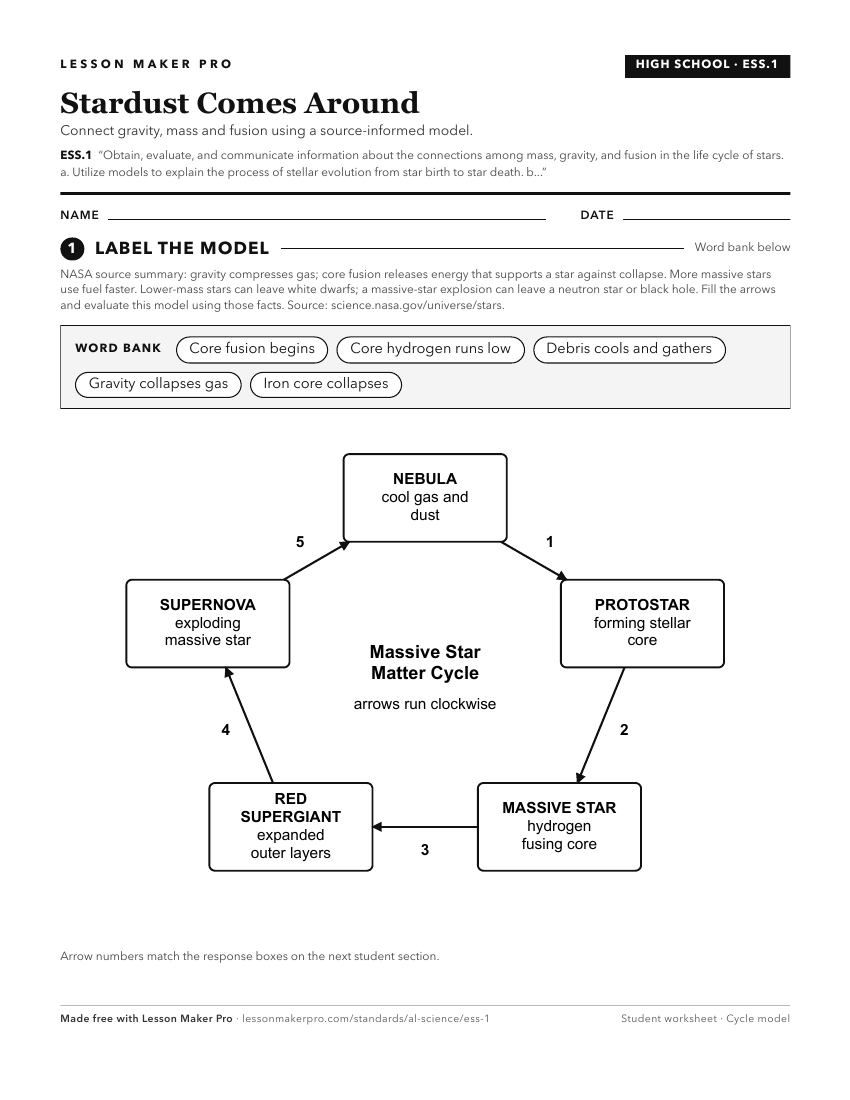
A ready-to-print activity worksheet aligned to ESS.1, with an answer key for the teacher on its own page. No account needed.
PDF, US Letter, prints cleanly in black and white.
Download the worksheetKeep exploring
Related Standards
Turn this cluster into a lesson
Grade, subject, topic, and the complete cluster are prefilled. Create one free, no account needed.
Also for this cluster:Make a WorksheetMake a QuizMake a Sub Lesson