Alabama Science ESS.1.a
The Standard
- ESS.1
- Obtain, evaluate, and communicate information about the connections among mass, gravity, and fusion in the life cycle of stars.
Utilize models to explain the process of stellar evolution from star birth to star death.
2023 Alabama Course of Study: Science · Earth’s Place in the Universe
Teacher's field guide
What This Standard Means
What Students Need to Do
- Students use a branching model to trace a star from a collapsing gas cloud to its final remnant. They explain how a star’s starting mass changes the path it takes.
What Mastery Looks Like
- Students place a protostar before a main-sequence star and mark where fusion starts. They show a Sun-like star becoming a red giant, shedding a planetary nebula, and ending as a white dwarf. They show a massive star becoming a red supergiant, then exploding and leaving a neutron star or black hole.
Common Misconceptions
- Students often think every star explodes as a supernova or becomes a black hole. Some draw one path for all stars instead of branching by starting mass. Others confuse the gas cloud where a star forms with the planetary nebula it may shed near the end.
How to Assess It
- Exit ticket: Draw two paths from a gas cloud, one for a Sun-like star and one for a massive star. Label where fusion starts, the later stages, and the possible final remnants.
Lesson moves
Ways to Teach It
Give pairs stage cards and yarn; have them build two paths from a gas cloud, with starting mass marking the fork.
Ask students to write two sentences explaining why the Sun will not explode as a supernova, using their model as evidence.
Read stage clues such as “fusion begins”; students point to the matching stage on a printed life-cycle diagram.
Compare the Sun and Betelgeuse on printed star data cards, then predict how each star’s life will end.
Free download
Printable ESS.1.a Worksheet
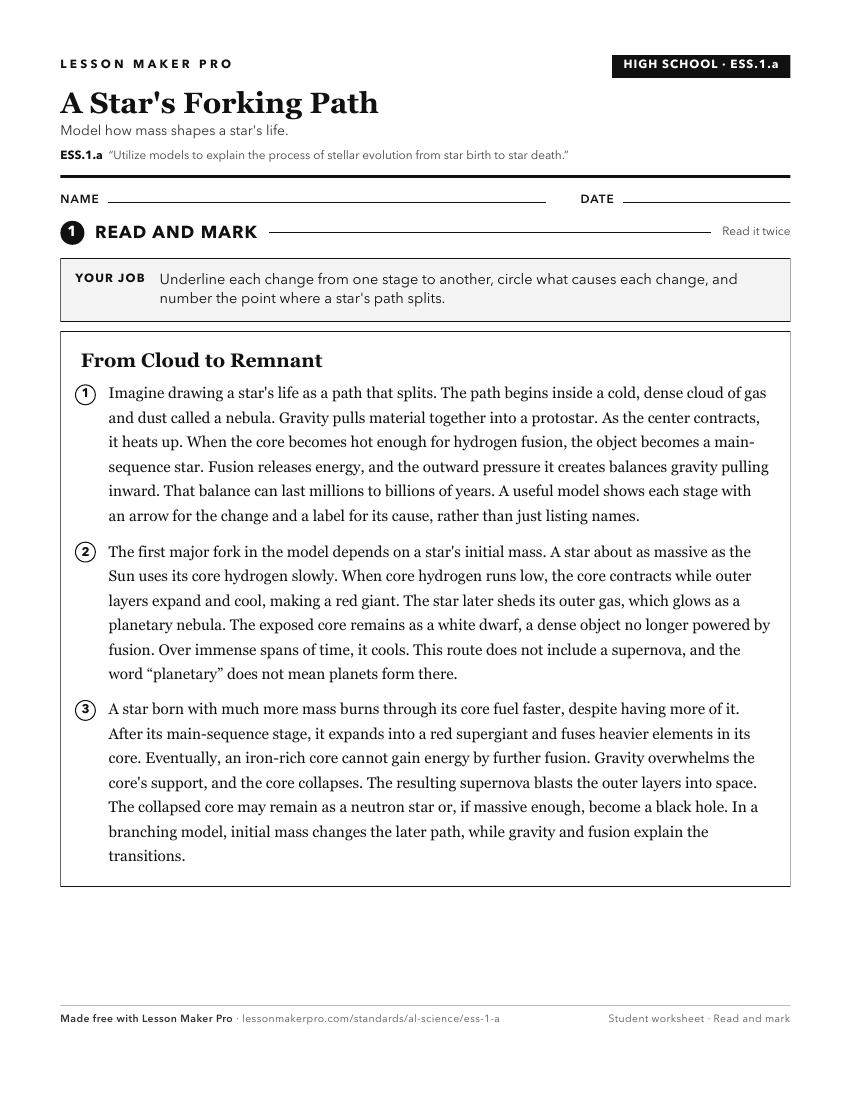
A ready-to-print activity worksheet aligned to ESS.1.a, with an answer key for the teacher on its own page. No account needed.
PDF, US Letter, prints cleanly in black and white.
Download the worksheetKeep exploring
Related Standards
- ESS.1
Obtain, evaluate, and communicate information about the connections among mass, gravity, and fusion in the life cycle of stars.
- 3.5
Develop and use models to compare the diverse life cycles of organisms other than humans, including birth, growth, reproduction, and death.
- ESS.1.d
Analyze and interpret data to quantify the energy produced in stars, using Einstein’s theory of general relativity by applying E=mc2 to show that the small amou...
- PS.4.g
Use models to explain how nuclear fission and fusion reactions can be used as energy sources.
Turn this exact standard into a lesson
Grade, subject, topic, and the complete standard are prefilled. Create one free, no account needed.
Also for this standard:Make a WorksheetMake a QuizMake a Sub Lesson