Alabama Science ES.10
The Standard
Use mathematics and graphic models to communicate how human activity may affect genetic variation in organism populations, including threatened and endangered species.
2023 Alabama Course of Study: Science · Earth and Human Activity
Teacher's field guide
What This Standard Means
What Students Need to Do
- Students calculate allele percentages before and after a human change, such as habitat loss. They graph the results and explain how a smaller or isolated population may lose genetic variation.
What Mastery Looks Like
- Given allele counts, students calculate percentages and label a before-and-after bar graph. They explain how alleles can disappear by chance in a small population and how animal movement between populations can bring them back.
Common Misconceptions
- Students may treat a drop in population size as proof that every gene has lost variation. They may think a road changes an animal's genes directly, rather than limiting mating between groups. Some confuse allele counts with allele percentages.
How to Assess It
- A threatened frog population has 20 copies of allele A and 20 of B; after wetland drainage, 9 A and 1 B remain. Have students calculate percentages, draw paired bars, and write what the graph suggests about genetic variation.
Lesson moves
Ways to Teach It
Use three bead colors as alleles, draw five beads from a bag of twenty, and graph each color's frequency before and after.
Give pairs bar graphs of bear allele frequencies before and after a highway splits their habitat; ask, "What changed, and how might the highway be involved?"
Give teams allele-count cards for four threatened species; have them calculate percentages and match each card to its bar graph.
Project a map of a nearby highway and habitat patches; students mark a wildlife crossing and explain how animal movement could change allele frequencies.
Free download
Printable ES.10 Worksheet
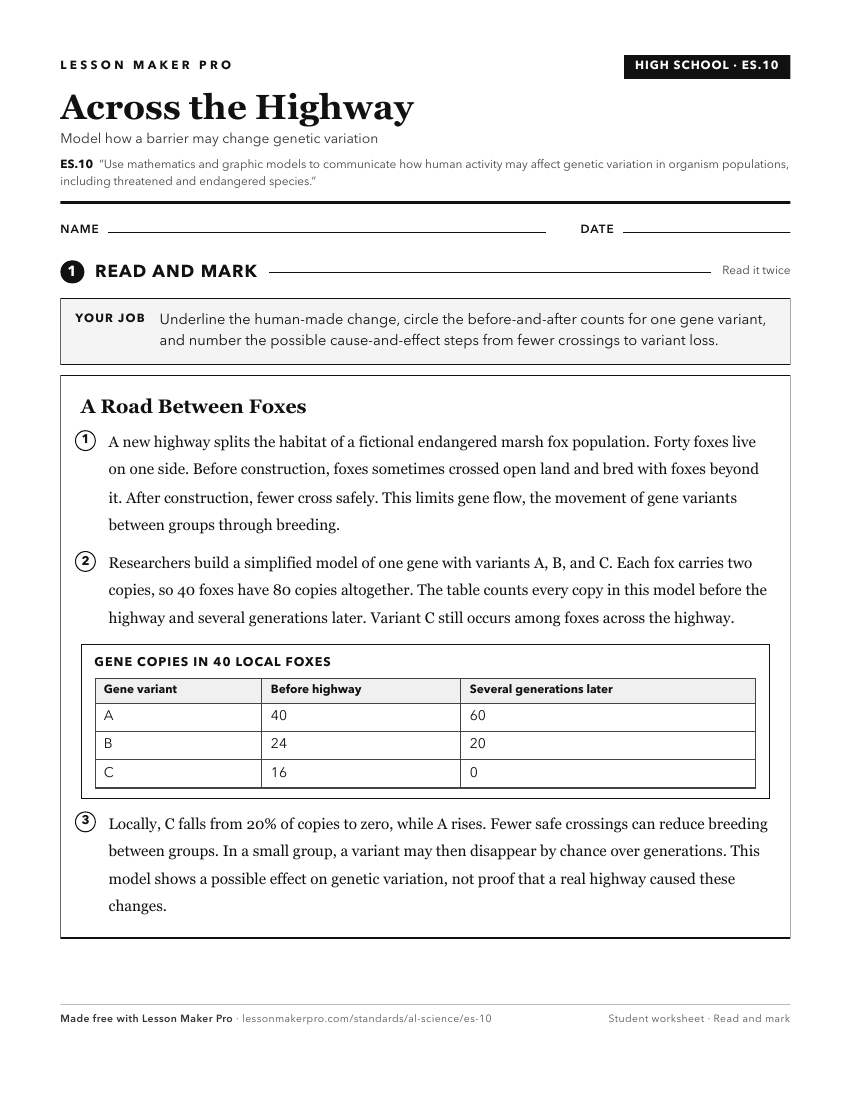
A ready-to-print activity worksheet aligned to ES.10, with an answer key for the teacher on its own page. No account needed.
PDF, US Letter, prints cleanly in black and white.
Download the worksheetKeep exploring
Related Standards
- BIO.11
Use probability and statistical models to explain the variation of expressed traits within a population.
- 7.13
Develop and use models to explain that meiosis results in new genetic combinations with increased variation.
- 7.6
Analyze and interpret data to predict how environmental conditions, genetic factors, and resource availability will impact the growth of individual organisms an...
- BIO.15
Engage in argument from evidence to explain how populations respond to changes in the environment that can lead to speciation or extinction.
Turn this exact standard into a lesson
Grade, subject, topic, and the complete standard are prefilled. Create one free, no account needed.
Also for this standard:Make a WorksheetMake a QuizMake a Sub Lesson