Alabama Science BIO.15
The Standard
Engage in argument from evidence to explain how populations respond to changes in the environment that can lead to speciation or extinction.
2023 Alabama Course of Study: Science · Unity and Diversity
Teacher's field guide
What This Standard Means
What Students Need to Do
- Students use population data to explain how an environmental change affects survival and reproduction. They explain why inherited traits may become more common over generations, or why a population may die out. They distinguish a population shift from the reproductive isolation needed for a new species to form.
What Mastery Looks Like
- Given finch data from before and after a drought, a student identifies which beak size became more common and uses the numbers to support a claim. They explain that a new species would require evidence that groups no longer interbreed. They can also explain how a population could go extinct if it cannot survive and reproduce.
Common Misconceptions
- Students may say individual birds grow new beaks because they need them. They may call any change in trait frequency a new species, even when the groups can still interbreed. Some assume one harsh season always causes extinction.
How to Assess It
- Write on the board: Before a drought, there are 20 small-beaked and 20 large-beaked finches. Afterward, there are 5 small-beaked and 15 large-beaked finches. Ask students which trait became more common, which numbers support their claim, and why the counts do not prove speciation.
Lesson moves
Ways to Teach It
Place two colors of paper beetles on a green sheet, then a brown sheet; have students act as predators and count which color survives.
Ask: If a drought leaves mostly large-beaked finches, what further evidence would show a new species formed rather than a population shift?
Give pairs cards with survival counts and mating data; have them sort each as population shift, speciation, or extinction and defend one choice.
Compare photos of a forest before and after clearing; ask how fewer nesting trees could affect a local woodpecker population.
Free download
Printable BIO.15 Worksheet
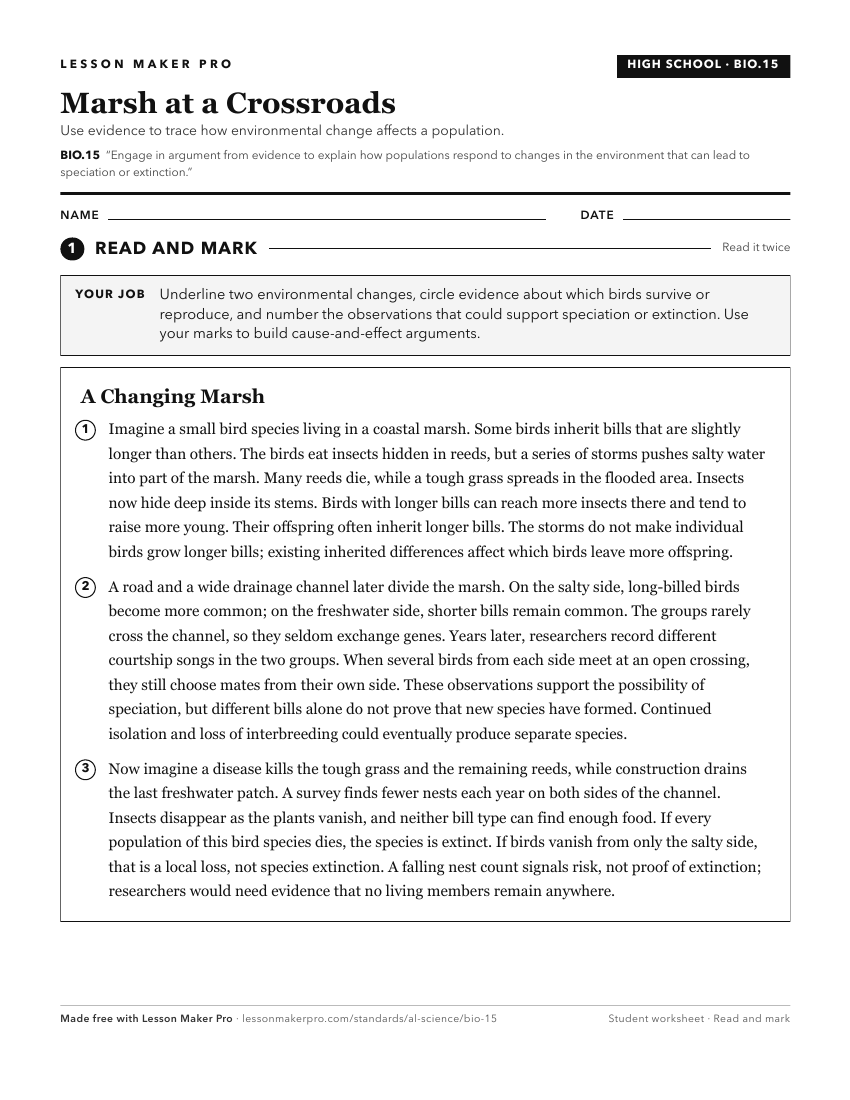
A ready-to-print activity worksheet aligned to BIO.15, with an answer key for the teacher on its own page. No account needed.
PDF, US Letter, prints cleanly in black and white.
Download the worksheetKeep exploring
Related Standards
- BIO.10
Engage in argument from evidence to support the claim that characteristics of an ecosystem contribute to its resilience and stability, including ecological succ...
- ES.4
Engage in an evidence-based argument to explain how Earth’s systems affect the biosphere and the biosphere affects Earth’s systems over various amounts of time.
- ESS.5.b
Construct an explanation based on evidence of how catastrophic and long-term events have impacted life on Earth, including mass extinctions.
Turn this exact standard into a lesson
Grade, subject, topic, and the complete standard are prefilled. Create one free, no account needed.
Also for this standard:Make a WorksheetMake a QuizMake a Sub Lesson