Alabama Science BIO.11
Standard Cluster
Use probability and statistical models to explain the variation of expressed traits within a population. a. Use mathematics and computational thinking to predict patterns of inheritance, including dominance, recessiveness, codominance, and incomplete dominance. b. Obtain, evaluate, and communicate information about how the interplay of heritable risk factors, somatic mutations, and environment influences human disease.
2023 Alabama Course of Study: Science · Heredity: Inheritance and Variation of Traits
Cluster contents
Standards in This Cluster
BIO.11 is a cluster heading. These are the individual standards under it.
- BIO.11.a
Use mathematics and computational thinking to predict patterns of inheritance, including dominance, recessiveness, codominance, and incomplete dominance.
- BIO.11.b
Obtain, evaluate, and communicate information about how the interplay of heritable risk factors, somatic mutations, and environment influences human disease.
Teacher's field guide
What This Cluster Means
What Students Need to Do
- Students use probability and sample counts to predict how often traits appear in a group of offspring. They compare expected and observed results for dominant, recessive, codominant, and incomplete dominance patterns. They explain how inherited risk, mutations acquired during life, and environment can affect disease.
What Mastery Looks Like
- Given parent genotypes, a student calculates expected trait percentages and explains why a small sample may differ. They tell codominance from incomplete dominance by looking at the heterozygote's trait. They explain how inherited risk and UV exposure can affect skin cancer risk without making disease certain.
Common Misconceptions
- Students may think a 25% chance means exactly one in four children will have a trait. They may confuse codominance, where both traits show, with incomplete dominance, where the trait is intermediate. They may assume a mutation in a skin cell can be passed to a child, or that an inherited risk allele guarantees disease.
How to Assess It
- Exit ticket: Cross two pink flowers whose red and white alleles show incomplete dominance. Give the expected numbers of red, pink, and white flowers among 40 offspring, explain why actual counts might differ, and name one way UV exposure could affect skin cancer risk.
Lesson moves
Ways to Teach It
Have pairs draw one bead from each of two cups containing equal red and white beads, then graph 40 offspring by flower color.
Ask, "Why might 40 offspring from pink flowers show 8 red flowers instead of the predicted 10?"
Deal genotype cards for four inheritance patterns; students match parent pairs to offspring trait probabilities and check answers with a key.
Give students a skin cancer case card with family risk, UV exposure, and a skin-cell mutation; ask which factors are inherited.
Free download
Printable BIO.11 Worksheet
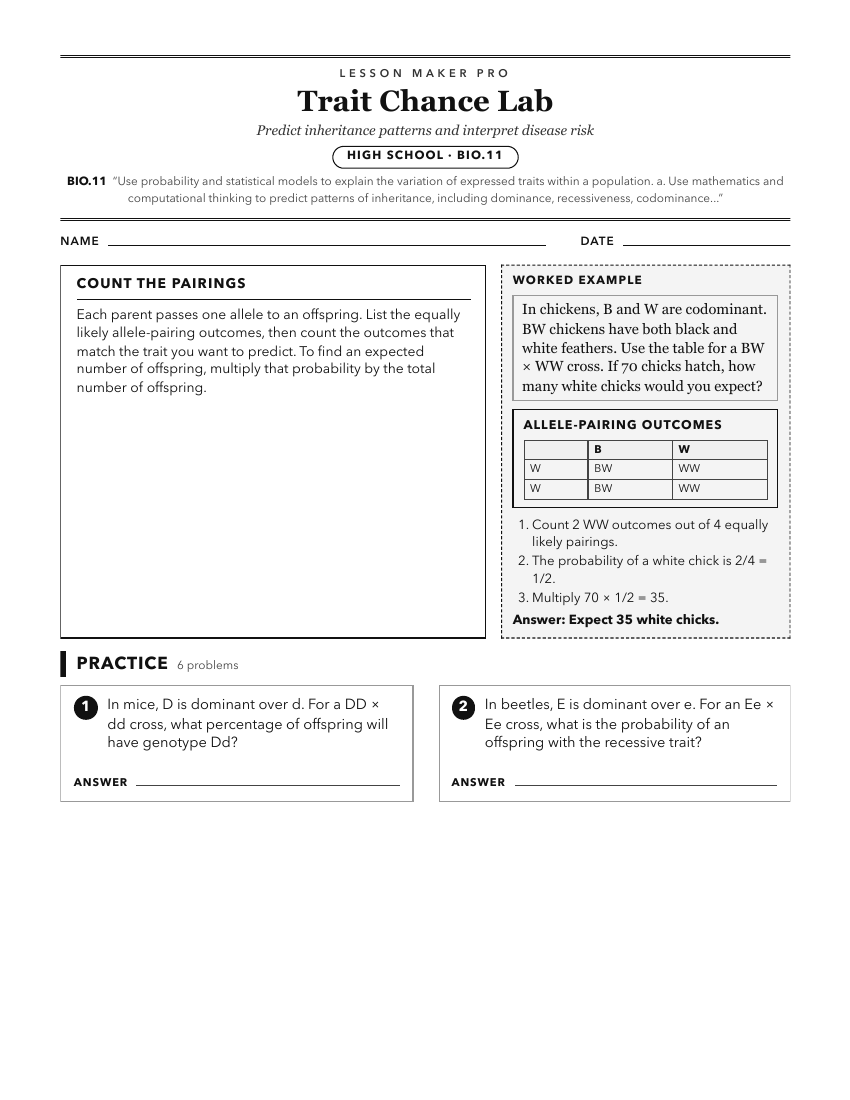
A ready-to-print activity worksheet aligned to BIO.11, with an answer key for the teacher on its own page. No account needed.
PDF, US Letter, prints cleanly in black and white.
Download the worksheetKeep exploring
Related Standards
- 7.13
Develop and use models to explain that meiosis results in new genetic combinations with increased variation.
- 7.11
Develop and use models to demonstrate how genetic variations between parents and offspring result from differences in inherited genes located on chromosomes.
- ES.10
Use mathematics and graphic models to communicate how human activity may affect genetic variation in organism populations, including threatened and endangered s...
- 7.12
Develop and use models to explain how genes are expressed through the flow of genetic information from DNA to RNA to a functional protein.
Turn this cluster into a lesson
Grade, subject, topic, and the complete cluster are prefilled. Create one free, no account needed.
Also for this cluster:Make a WorksheetMake a QuizMake a Sub Lesson