Alabama Science BIO.11.a
The Standard
- BIO.11
- Use probability and statistical models to explain the variation of expressed traits within a population.
Use mathematics and computational thinking to predict patterns of inheritance, including dominance, recessiveness, codominance, and incomplete dominance.
2023 Alabama Course of Study: Science · Heredity: Inheritance and Variation of Traits
Teacher's field guide
What This Standard Means
What Students Need to Do
- Students list the allele combinations offspring could inherit and calculate how likely each trait is. They use a Punnett square or spreadsheet to compare dominance, recessiveness, codominance, and incomplete dominance.
What Mastery Looks Like
- Given parent genotypes, a student lists all possible offspring genotypes and gives the probability of each trait. They can explain why pink snapdragons show incomplete dominance while AB blood shows codominance.
Common Misconceptions
- Students may think a dominant allele is always more common. They may predict that two pink flowers can produce only pink offspring, or mistake AB blood for a blend of A and B.
How to Assess It
- Exit ticket: Cross two pink snapdragons (RW × RW). Draw a Punnett square, give each flower color's probability, and explain why pink is not codominance.
Lesson moves
Ways to Teach It
Give pairs one R and one W card for each pink snapdragon parent; arrange four offspring pairings and tally the flower colors.
Ask students to write: Why is a pink snapdragon not an example of codominance, while AB blood is?
Have students enter the four pairings for Aa × Aa and RW × RW in a spreadsheet, then calculate each trait's percentage.
Give students parent blood-type cards labeled Iᴬi and Iᴮi; ask which child blood types are possible and their probabilities.
Free download
Printable BIO.11.a Worksheet
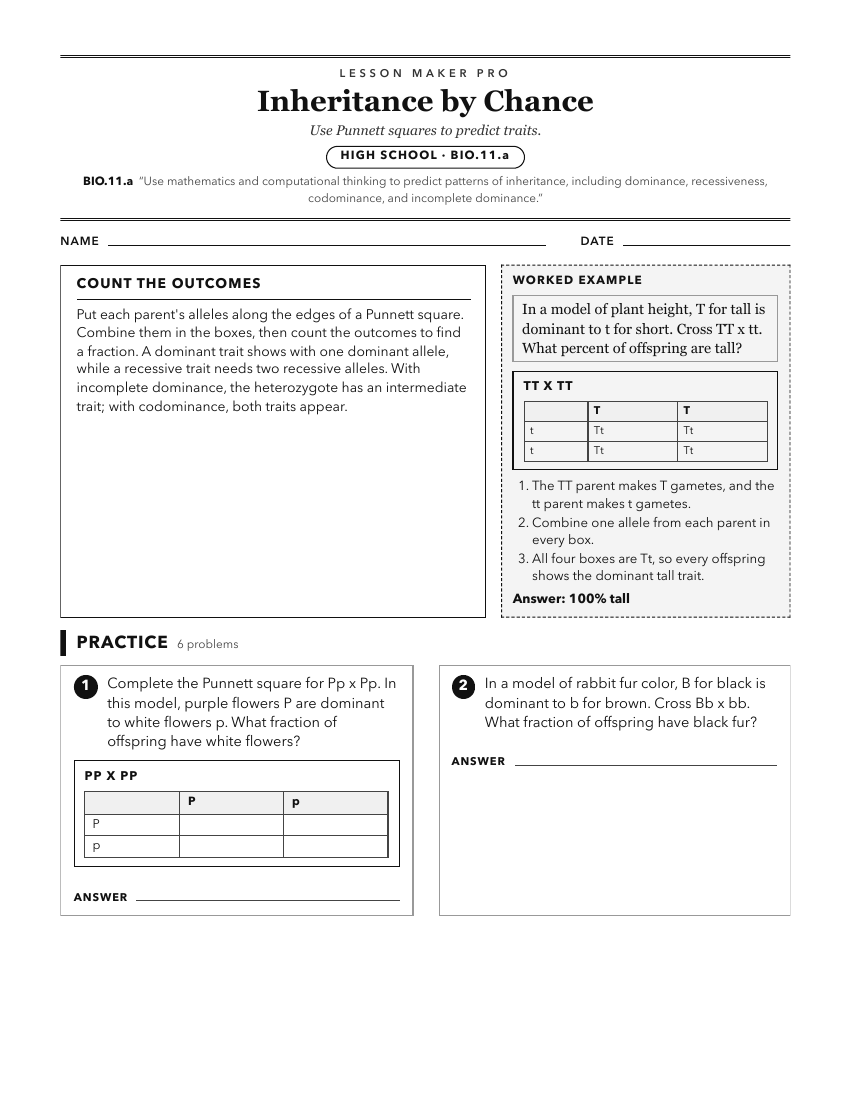
A ready-to-print activity worksheet aligned to BIO.11.a, with an answer key for the teacher on its own page. No account needed.
PDF, US Letter, prints cleanly in black and white.
Download the worksheetKeep exploring
Related Standards
- 7.14
Obtain, evaluate, and communicate information on the use of technologies that impact the inheritance and appearance of traits in organisms.
- 7.11
Develop and use models to demonstrate how genetic variations between parents and offspring result from differences in inherited genes located on chromosomes.
- BIO.11
Use probability and statistical models to explain the variation of expressed traits within a population.
- ES.10
Use mathematics and graphic models to communicate how human activity may affect genetic variation in organism populations, including threatened and endangered s...
Turn this exact standard into a lesson
Grade, subject, topic, and the complete standard are prefilled. Create one free, no account needed.
Also for this standard:Make a WorksheetMake a QuizMake a Sub Lesson