Alabama Science BIO.8
The Standard
Construct an evidence-based explanation of how density-dependent and density-independent factors affect population growth.
2023 Alabama Course of Study: Science · Ecosystems: Interactions, Energy, and Dynamics
Teacher's field guide
What This Standard Means
What Students Need to Do
- Students read population data and identify what caused growth to slow or numbers to drop. They explain why competition has a stronger effect in crowded populations, while a freeze can affect populations at any density. They use numbers to support their explanation.
What Mastery Looks Like
- A student can use a graph to show growth slowing as a population gets crowded or a drop following a freeze. They can explain why crowding matters in the first case but not the second.
Common Misconceptions
- Students may call a drought density-dependent because many animals die. They may think disease spreads just as easily in small and crowded groups. They may confuse the number of deaths with the fraction of the population that died.
How to Assess It
- Exit ticket: With 20 food portions, all 10 rabbits eat, but only 20 of 30 rabbits eat; after a freeze, half of each group survives. Name which factor depends on density and cite one number for each.
Lesson moves
Ways to Teach It
Place 10, then 30, rabbit counters beside 20 paper food squares; match one square per rabbit and count those left unfed.
Ask: Why does the same food supply leave more rabbits unfed in a group of 30 than 10, while a freeze can affect both groups?
Give pairs cards labeled drought, parasites, freeze, and limited nest sites; have them sort the cards and defend one choice.
Check a local rainfall chart, then explain how an unusually dry month could affect grass in crowded and sparse schoolyard patches.
Free download
Printable BIO.8 Worksheet
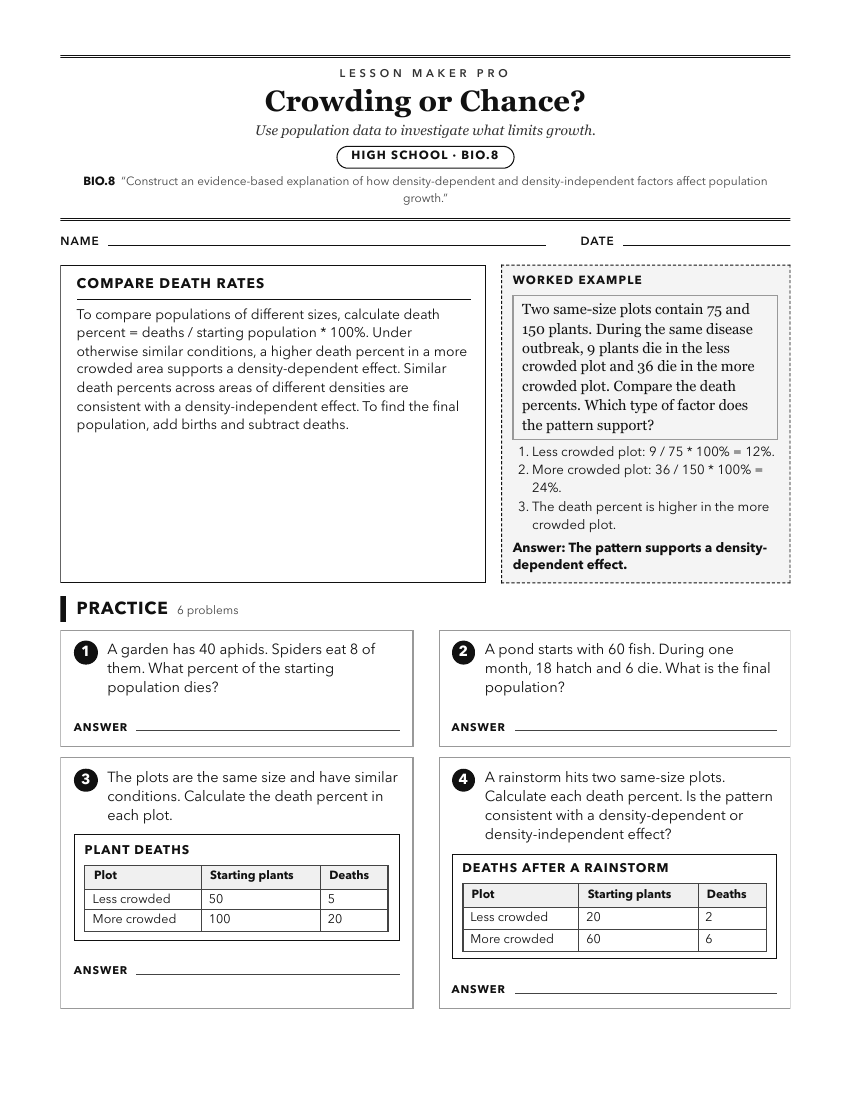
A ready-to-print activity worksheet aligned to BIO.8, with an answer key for the teacher on its own page. No account needed.
PDF, US Letter, prints cleanly in black and white.
Download the worksheetKeep exploring
Related Standards
- 7.7
Analyze and interpret data to explain how density-independent and density-dependent limiting factors in an ecosystem can lead to shifts in populations.
- ES.11
Construct an explanation of how human populations undergo growth and decline.
- ES.3
Construct an explanation of how biotic and abiotic factors affect biodiversity and populations in ecosystems.
- BIO.15
Engage in argument from evidence to explain how populations respond to changes in the environment that can lead to speciation or extinction.
Turn this exact standard into a lesson
Grade, subject, topic, and the complete standard are prefilled. Create one free, no account needed.
Also for this standard:Make a WorksheetMake a QuizMake a Sub Lesson