Alabama Science 7.7
The Standard
Analyze and interpret data to explain how density-independent and density-dependent limiting factors in an ecosystem can lead to shifts in populations.
2023 Alabama Course of Study: Science · Ecosystems: Interactions, Energy, and Dynamics
Teacher's field guide
What This Standard Means
What Students Need to Do
- Students read population counts alongside records of food, disease, and weather. They compare survival rates in small and crowded groups. They use the patterns to explain why a population changed.
What Mastery Looks Like
- Students compare the fraction that survived in each group, not just the number lost. They use those fractions to show when crowding increased the effect of disease or food shortages. They recognize that a storm can affect groups regardless of crowding.
Common Misconceptions
- Students may call a storm density-dependent because it kills more animals in a larger herd, even when the loss rates match. They may call a food shortage density-independent because the amount of food stays fixed.
How to Assess It
- Exit ticket: In separate trials, herds of 10 and 20 deer have 9 and 12 survivors after disease, but 5 and 10 after a storm. Which factor is density-dependent? Use survival fractions to explain.
Lesson moves
Ways to Teach It
Give cups of 10 and 20 paper rabbits eight food tokens each; feed one token per rabbit and compare survival fractions.
Show two herd graphs with equal percentage losses after a flood; ask why the herd with more deaths was not necessarily more affected.
Give pairs four cards listing herd size and disease or storm survival counts; have them sort cards by whether survival rates change with crowding.
Use a mock park report with deer counts of 80 before a wildfire and 44 after; ask what else could explain the drop.
Free download
Printable 7.7 Worksheet
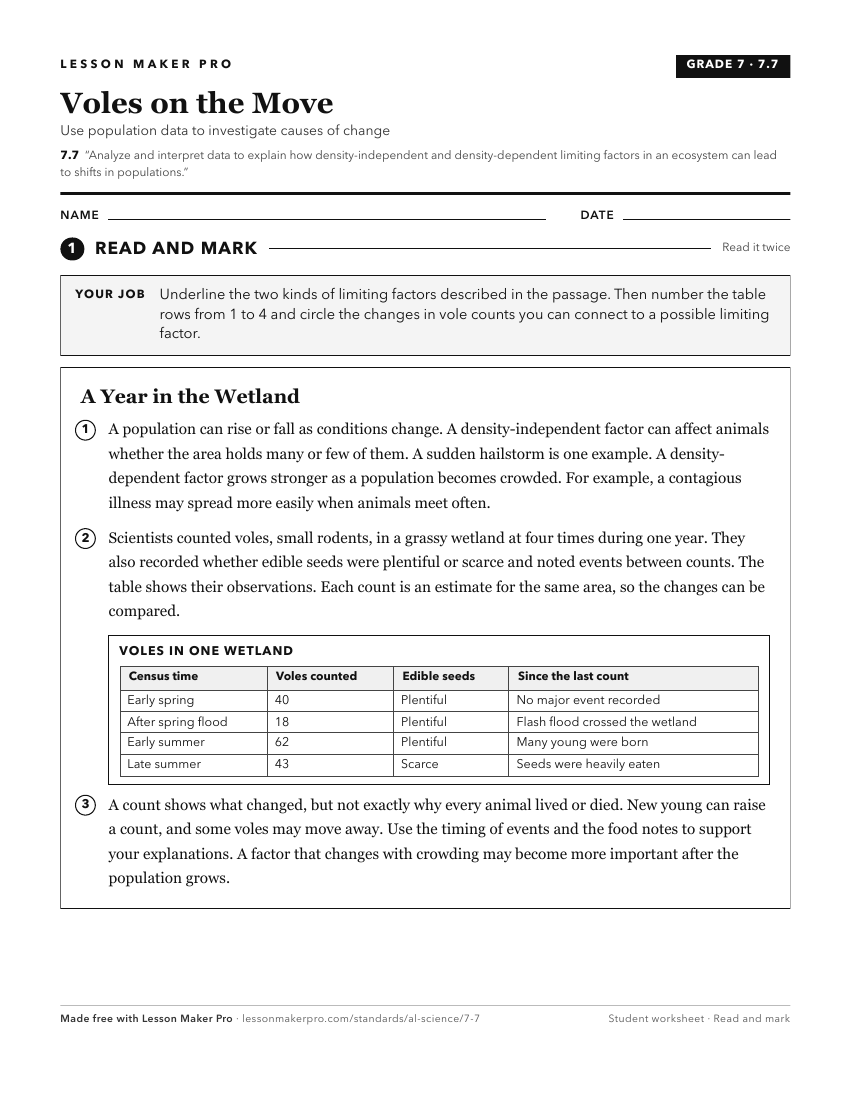
A ready-to-print activity worksheet aligned to 7.7, with an answer key for the teacher on its own page. No account needed.
PDF, US Letter, prints cleanly in black and white.
Download the worksheetKeep exploring
Related Standards
- BIO.8
Construct an evidence-based explanation of how density-dependent and density-independent factors affect population growth.
- 7.6
Analyze and interpret data to predict how environmental conditions, genetic factors, and resource availability will impact the growth of individual organisms an...
- ES.3
Construct an explanation of how biotic and abiotic factors affect biodiversity and populations in ecosystems.
- BIO.14
Analyze and interpret data pertaining to adaptations resulting from natural and artificial selection to explain the evolution of populations.
Turn this exact standard into a lesson
Grade, subject, topic, and the complete standard are prefilled. Create one free, no account needed.
Also for this standard:Make a WorksheetMake a QuizMake a Sub Lesson