Alabama Science BIO.14
The Standard
Analyze and interpret data pertaining to adaptations resulting from natural and artificial selection to explain the evolution of populations.
2023 Alabama Course of Study: Science · Unity and Diversity
Teacher's field guide
What This Standard Means
What Students Need to Do
- Students read tables and graphs showing how inherited traits change in a population over generations. They use survival data or breeding records to explain why a trait became more common.
What Mastery Looks Like
- A student can calculate how a trait's frequency changed and point to evidence that its carriers left more offspring. They can tell whether predators or breeders drove the change.
Common Misconceptions
- Students may think an individual animal changes its traits because it needs to survive. They may also assume that a trait becoming more common proves selection occurred, even without evidence that the trait is inherited.
How to Assess It
- Give students this exit ticket: Dark beetles rose from 20 of 100 to 70 of 100 over five generations. Birds catch more light beetles on dark bark. Explain the change in two sentences.
Lesson moves
Ways to Teach It
Spread 20 light and 20 dark paper beetles on black paper; partners remove visible beetles, double the survivors, and repeat.
Write moth-color counts from two generations on the board; ask which moths likely left more offspring after tree bark darkened.
Hand out data cards with moth counts after predation and corn cob sizes after farmers choose seeds; pairs sort and defend each match.
Compare photos of wild mustard and broccoli; ask which plant part growers selected and what measurements across generations would show the change.
Free download
Printable BIO.14 Worksheet
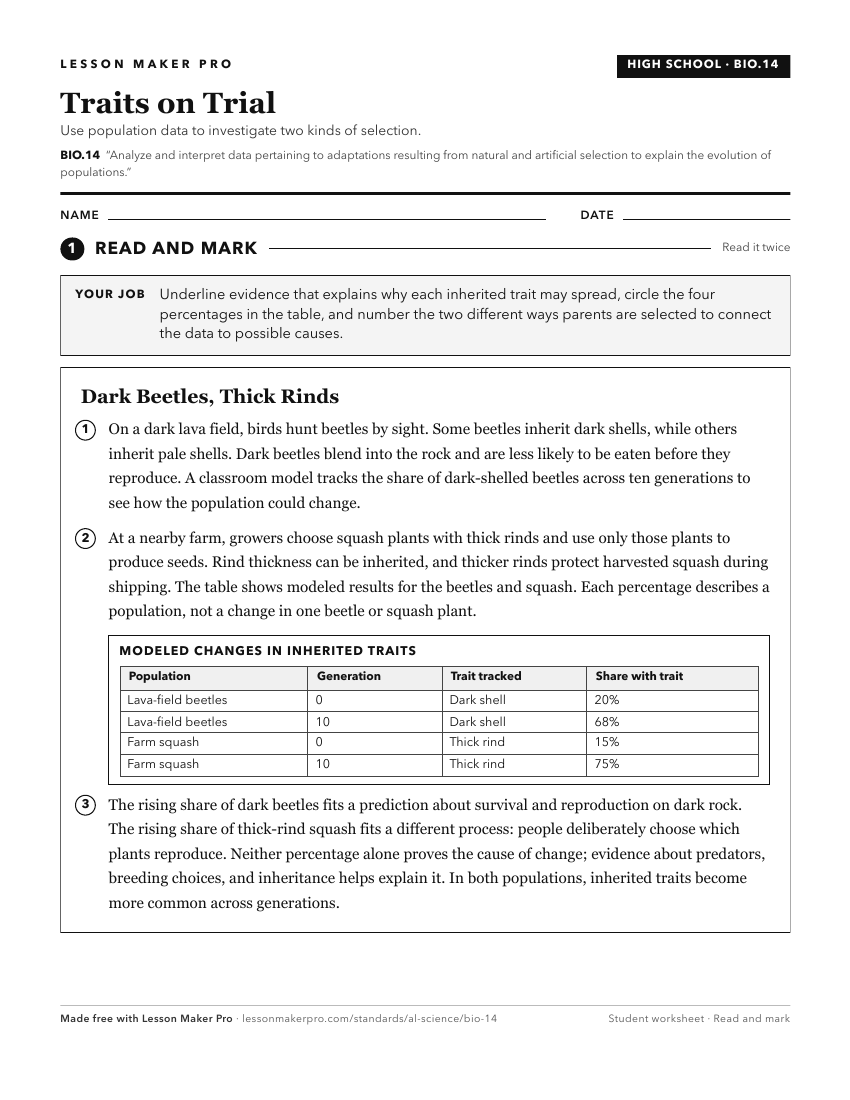
A ready-to-print activity worksheet aligned to BIO.14, with an answer key for the teacher on its own page. No account needed.
PDF, US Letter, prints cleanly in black and white.
Download the worksheetKeep exploring
Related Standards
- BIO.13
Analyze and interpret data to support hypotheses of common ancestry and biological evolution illustrated by cladograms and phylogenetic trees.
- 7.17
Ask questions to clarify how natural selection over generations may lead to changes in the frequency of specific traits to enhance survival and reproduction of ...
- 7.6
Analyze and interpret data to predict how environmental conditions, genetic factors, and resource availability will impact the growth of individual organisms an...
Turn this exact standard into a lesson
Grade, subject, topic, and the complete standard are prefilled. Create one free, no account needed.
Also for this standard:Make a WorksheetMake a QuizMake a Sub Lesson