Alabama Science BIO.13
Standard Cluster
Analyze and interpret data to support hypotheses of common ancestry and biological evolution illustrated by cladograms and phylogenetic trees. a. Evaluate evidence supporting claims that viruses should be placed in a separate category from living things.
2023 Alabama Course of Study: Science · Unity and Diversity
Cluster contents
Standards in This Cluster
BIO.13 is a cluster heading. These are the individual standards under it.
Teacher's field guide
What This Cluster Means
What Students Need to Do
- Students use branching trees, trait data, and DNA differences to work out which organisms share a more recent ancestor. They use evidence about viral genes, cells, and reproduction to judge whether viruses belong in a separate category.
What Mastery Looks Like
- A student finds the closest relatives by locating their most recent shared branch, not by looking at how close the names appear. They cite shared traits or DNA as evidence and explain that viruses evolve but lack cells and copy themselves only inside host cells.
Common Misconceptions
- Students may think two organisms are closest relatives because their names sit next to each other on a tree. They may call viruses living because they have genes, without considering that viruses lack cells and depend on hosts to reproduce.
How to Assess It
- Draw a tree where human and chimp share a branch before mouse joins, and list these virus facts: genes, no cells, host-only replication. Ask students to name the closest relatives, point to the branch that supports their answer, and use two facts to argue whether viruses belong in a separate category.
Lesson moves
Ways to Teach It
Give pairs cards for fish, frog, lizard, and mouse, plus trait cards for four limbs, amniotic eggs, and hair; have them build a tree.
Show a virus fact card listing genes, mutation, no cells, and host-only replication; ask students to defend or challenge a separate category.
Put three small trees on the board; partners circle the closest pair on each and mark the branch point that proves it.
Compare model flu RNA snippets ACGUAC and ACGUUC; mark the change and discuss why flu shots are updated as viruses evolve.
Free download
Printable BIO.13 Worksheet
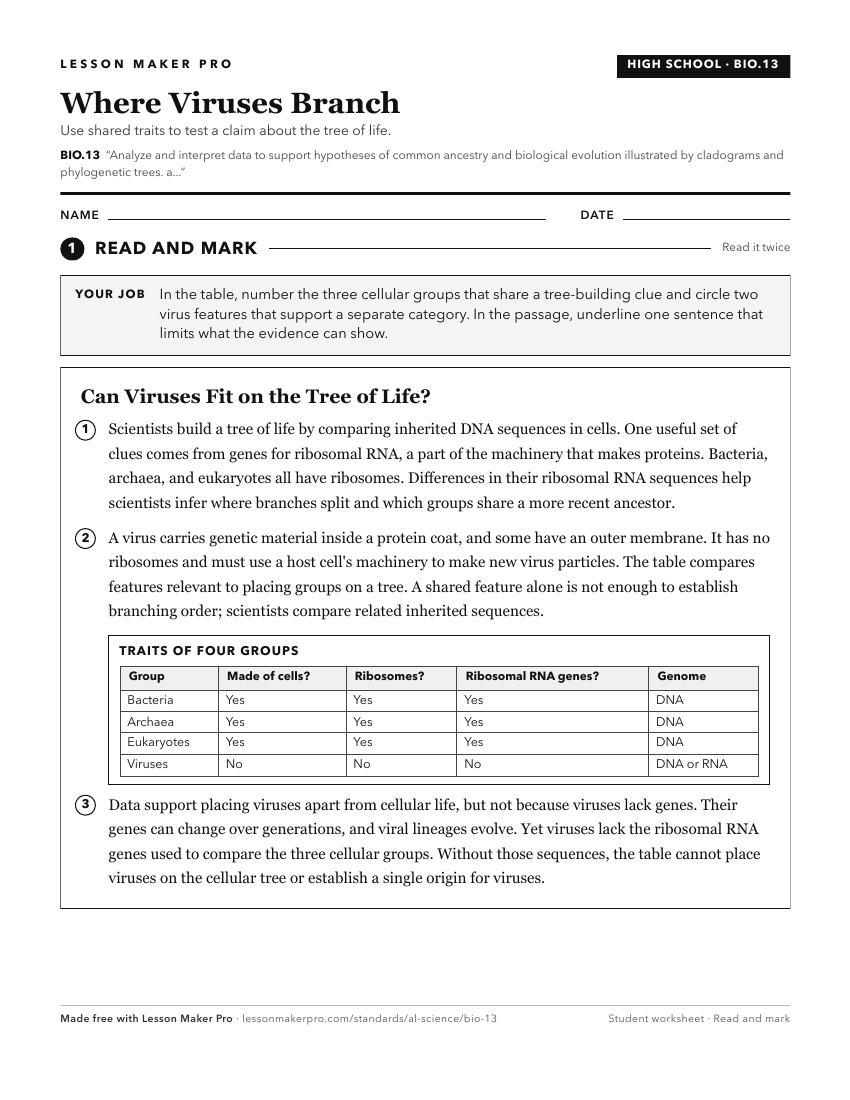
A ready-to-print activity worksheet aligned to BIO.13, with an answer key for the teacher on its own page. No account needed.
PDF, US Letter, prints cleanly in black and white.
Download the worksheetKeep exploring
Related Standards
- 7.15
Analyze and interpret data from examination of fossils, relict species, and modern organisms to determine patterns of change in anatomical structures over time.
- BIO.14
Analyze and interpret data pertaining to adaptations resulting from natural and artificial selection to explain the evolution of populations.
- 7.16
Obtain, evaluate, and communicate evidence comparing patterns in the embryological development of multiple species to identify relationships not evident in the ...
Turn this cluster into a lesson
Grade, subject, topic, and the complete cluster are prefilled. Create one free, no account needed.
Also for this cluster:Make a WorksheetMake a QuizMake a Sub Lesson