Alabama Science 6.9
Standard Cluster
Use data analysis to monitor and predict weather changes and the impact of weather events, including severe weather. a. Obtain, evaluate, and communicate data that describes characteristics of air masses, including temperature, pressure, and humidity. b. Construct an explanation of how air pressure, weather fronts, and air masses are related to weather events. c. Design solutions to mitigate the impact of severe weather.
2023 Alabama Course of Study: Science · Earth’s Systems: Energy and Weather
Cluster contents
Standards in This Cluster
6.9 is a cluster heading. These are the individual standards under it.
- 6.9.a
Obtain, evaluate, and communicate data that describes characteristics of air masses, including temperature, pressure, and humidity.
- 6.9.b
Construct an explanation of how air pressure, weather fronts, and air masses are related to weather events.
- 6.9.c
Design solutions to mitigate the impact of severe weather.
Teacher's field guide
What This Cluster Means
What Students Need to Do
- Read temperature, air pressure, and humidity data to describe air masses and track changes. Use the data and a weather front map to predict likely weather and its effects. Suggest a way to reduce harm from severe weather.
What Mastery Looks Like
- A student notices falling pressure and rising humidity ahead of a cold front and predicts possible rain or storms. They explain that cold air can push warm, moist air upward, then choose a safety step that fits the predicted hazard.
Common Misconceptions
- Students may think a front is a storm, rather than a boundary between air masses. Some think falling pressure guarantees a tornado or that high humidity always means rain. They may choose a shelter near windows during a tornado warning.
How to Assess It
- Give students these readings ahead of a cold front: pressure drops from 1012 to 1004 mb, and humidity rises from 55% to 85%. Ask them to predict possible weather, explain why, and name one safety step.
Lesson moves
Ways to Teach It
Pour blue cold water and red warm water into opposite ends of a clear tray; compare the layers to a cold front.
Post 1012 then 1004 mb and 55% then 85% humidity ahead of a cold front; ask what might happen next.
Give pairs forecast cards with temperature, pressure, humidity, and front symbols; have them match each card to rain, storms, or clearing.
Give students a sketch of your school and a tornado warning notice; have them circle an interior shelter away from windows.
Free download
Printable 6.9 Worksheet
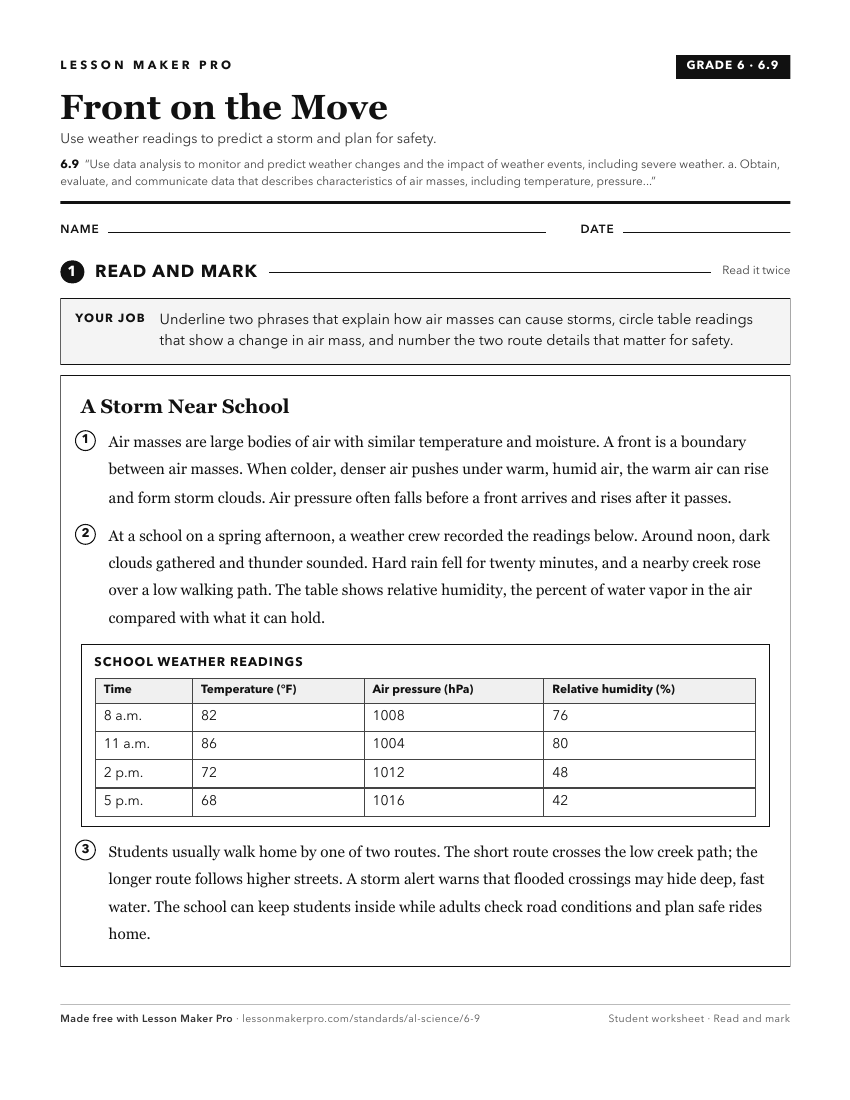
A ready-to-print activity worksheet aligned to 6.9, with an answer key for the teacher on its own page. No account needed.
PDF, US Letter, prints cleanly in black and white.
Download the worksheetKeep exploring
Related Standards
- ESS.8.b
Analyze and interpret data to develop predictions about the formation of meteorological events.
- ESS.8
Obtain and communicate information to explain different climate regions and their impact on patterns of severe weather.
- K.10
Obtain, evaluate, and communicate information about using weather forecasts to make plans and prepare for severe weather.
- 3.15
Obtain and communicate information on the effectiveness of existing solutions designed to reduce the impact of weather-related hazards.
Turn this cluster into a lesson
Grade, subject, topic, and the complete cluster are prefilled. Create one free, no account needed.
Also for this cluster:Make a WorksheetMake a QuizMake a Sub Lesson