Alabama Science ESS.8.b
The Standard
- ESS.8
- Obtain and communicate information to explain different climate regions and their impact on patterns of severe weather.
Analyze and interpret data to develop predictions about the formation of meteorological events.
2023 Alabama Course of Study: Science
Teacher's field guide
What This Standard Means
What Students Need to Do
- Read weather graphs and maps to track changes in temperature, air pressure, humidity, and wind. Use those patterns to predict where storms or fog may form. Point to the readings behind each prediction.
What Mastery Looks Like
- Given hourly readings and a front map, students spot falling pressure, rising humidity, and shifting winds. They explain how a cold front may lift warm, moist air and predict storm formation without treating it as certain.
Common Misconceptions
- Students may treat one low pressure reading as proof that a storm will form. They may mistake high humidity for rainfall or miss the role of a cold front in lifting warm air.
How to Assess It
- Exit ticket: A cold front approaches 30°C air as humidity rises from 55% to 85% and pressure falls from 1016 to 1008 hPa. Are thunderstorms becoming more likely? Cite two trends.
Lesson moves
Ways to Teach It
Give pairs printed hourly weather readings and colored pencils; have them graph pressure and humidity, then mark when thunderstorms become more likely.
Show a front map and ask students to write a forecast that names two readings supporting their prediction.
Play forecast or false alarm with three town cards showing hourly pressure, humidity, and wind; teams choose where storms are most likely to form.
Use today's local weather readings and a front map to predict whether storms could form after school, then check the evening report.
Free download
Printable ESS.8.b Worksheet
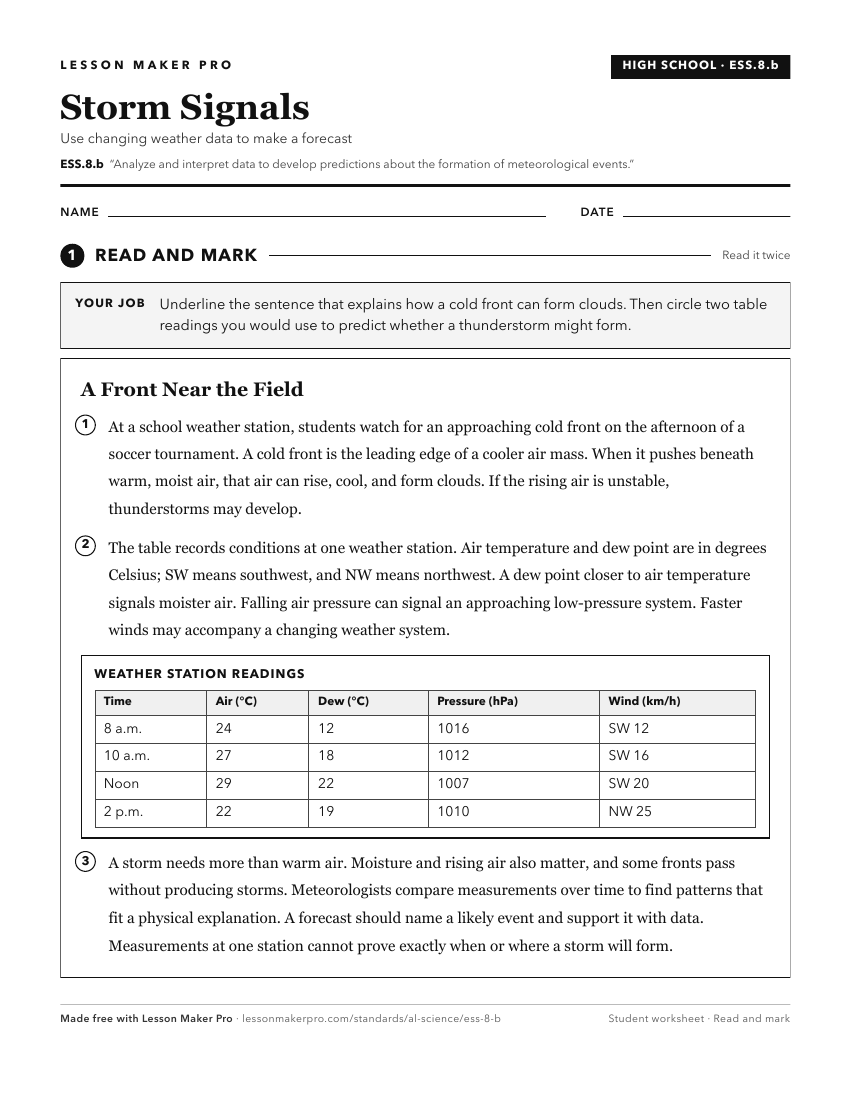
A ready-to-print activity worksheet aligned to ESS.8.b, with an answer key for the teacher on its own page. No account needed.
PDF, US Letter, prints cleanly in black and white.
Download the worksheetKeep exploring
Related Standards
- 6.9
Use data analysis to monitor and predict weather changes and the impact of weather events, including severe weather.
- K.9
Observe, record, and communicate local weather patterns over a period of time.
- 6.9.a
Obtain, evaluate, and communicate data that describes characteristics of air masses, including temperature, pressure, and humidity.
- ESS.7.e
Analyze and interpret data to create a surface map, including high-pressure and low-pressure systems, isobars, wind barbs, cloud types, precipitation, and front...
Turn this exact standard into a lesson
Grade, subject, topic, and the complete standard are prefilled. Create one free, no account needed.
Also for this standard:Make a WorksheetMake a QuizMake a Sub Lesson