Alabama Math A2S.DSP.G.30
The Standard
- A2S.DSP.G
- Bias, such as sampling, response, or nonresponse bias, may occur in surveys, yielding results that are not representative of the population of interest.
Evaluate where bias, including sampling, response, or nonresponse bias, may occur in surveys, and whether results are representative of the population of interest.
2019 Alabama Course of Study: Mathematics
Teacher's field guide
What This Standard Means
What Students Need to Do
- Students name the group a survey is meant to represent and check who was asked and who answered. They spot biased samples, leading questions, and missing replies. They decide whether the results apply to that group.
What Mastery Looks Like
- A student explains why answers from the lunch line may not describe all students. They can show how a leading question or unanswered surveys might change the results and suggest a fix.
Common Misconceptions
- Students may think a large sample represents everyone, even if all the replies come from one group. They may ignore unanswered surveys or miss how 'Don't you agree?' pushes people toward yes.
How to Assess It
- Exit ticket: A principal asks students at a basketball game, 'Don't you agree we need a better gym?' Can the answers represent all students? Name two possible biases and suggest one fix.
Lesson moves
Ways to Teach It
Put 20 lunch-preference cards in a bag; compare five drawn at random with five selected from a visible stack of pizza cards.
Ask pairs to rewrite 'Don't you agree our cafeteria food is terrible?' and explain how the first wording might change answers.
Give pairs six survey cards showing a target group, sample, question, and reply count; sort each by likely bias and defend one choice.
Bring a store receipt with a survey link; ask who might respond and whether their ratings represent every shopper.
Free download
Printable A2S.DSP.G.30 Worksheet
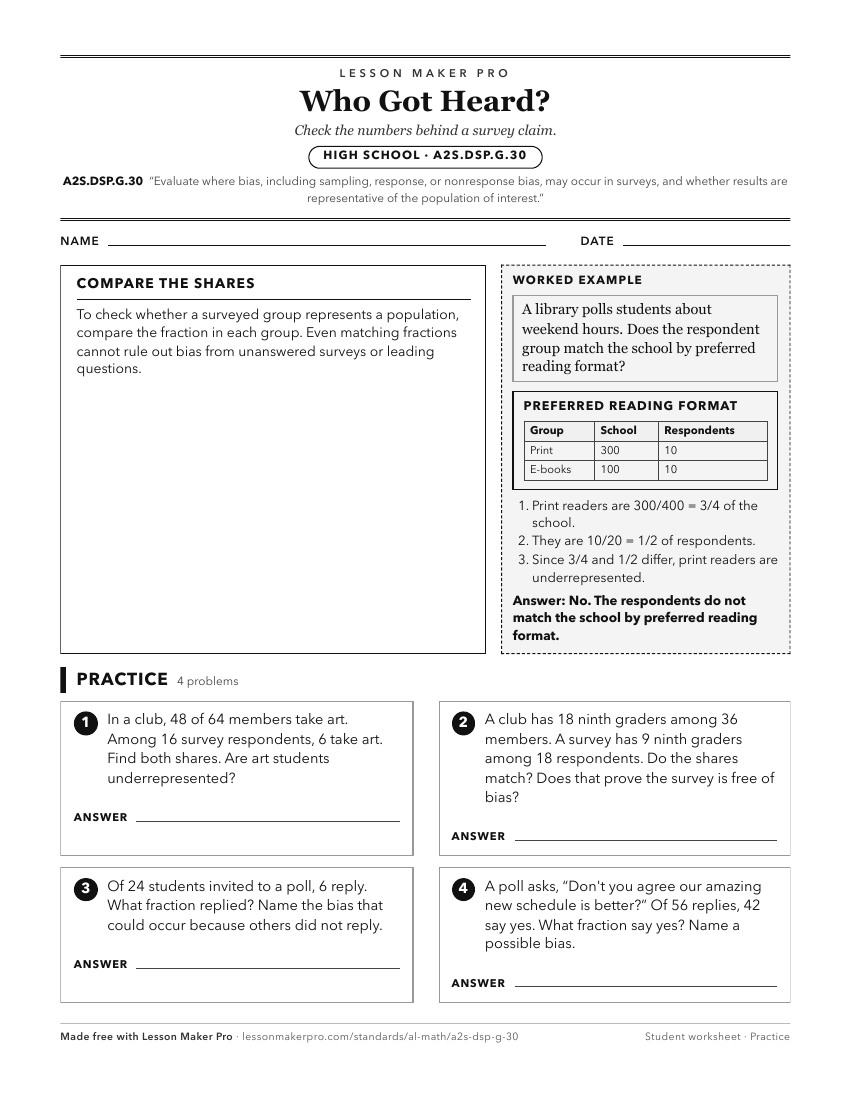
A ready-to-print activity worksheet aligned to A2S.DSP.G.30, with an answer key for the teacher on its own page. No account needed.
PDF, US Letter, prints cleanly in black and white.
Download the worksheetKeep exploring
Related Standards
- A2S.DSP.G
Bias, such as sampling, response, or nonresponse bias, may occur in surveys, yielding results that are not representative of the population of interest.
- 7A.DSP.A.26.b
Compare sampling techniques to determine whether a sample is random and thus representative of a population, explaining that random sampling tends to produce re...
- 7.DSP.A.10.b
Compare sampling techniques to determine whether a sample is random and thus representative of a population, explaining that random sampling tends to produce re...
- 7A.DSP.A.26.e
Informally explain situations in which statistical bias may exist.
Turn this exact standard into a lesson
Grade, subject, topic, and the complete standard are prefilled. Create one free, no account needed.
Also for this standard:Make a WorksheetMake a QuizMake a Sub Lesson