Alabama Math 7A.DSP.A.26.e
The Standard
- 7A.DSP.A
- Make inferences about a population using random sampling.
- 7A.DSP.A.26
- Examine a sample of a population to generalize information about the population.
Informally explain situations in which statistical bias may exist.
2019 Alabama Course of Study: Mathematics · Make inferences about a population using random sampling.
Teacher's field guide
What This Standard Means
What Students Need to Do
- Students spot when a survey may favor one answer because of who was asked or how the question was worded. They explain whose views might be missing.
What Mastery Looks Like
- A student can explain why surveying only basketball fans about sports clubs may skew the results. They can suggest choosing students at random from the whole school instead.
Common Misconceptions
- Students may think a large survey cannot be biased, even if it leaves out a group. They may also think any small sample is biased, even when people were chosen at random.
How to Assess It
- Ask: “A school surveys students at a basketball game about adding sports clubs. Who is missing, and how could the school choose a fairer sample?”
Lesson moves
Ways to Teach It
Have students compare lunch preferences from ten classmates at their table with ten names drawn from a class roster.
Show two questions, “Do you like our great lunches?” and “What do you think of school lunches?” and ask which could sway answers.
Give pairs four survey cards and have them sort each into likely biased or not, then explain one choice.
Show an online poll about bus service and ask whether people without internet access could take part.
Free download
Printable 7A.DSP.A.26.e Worksheet
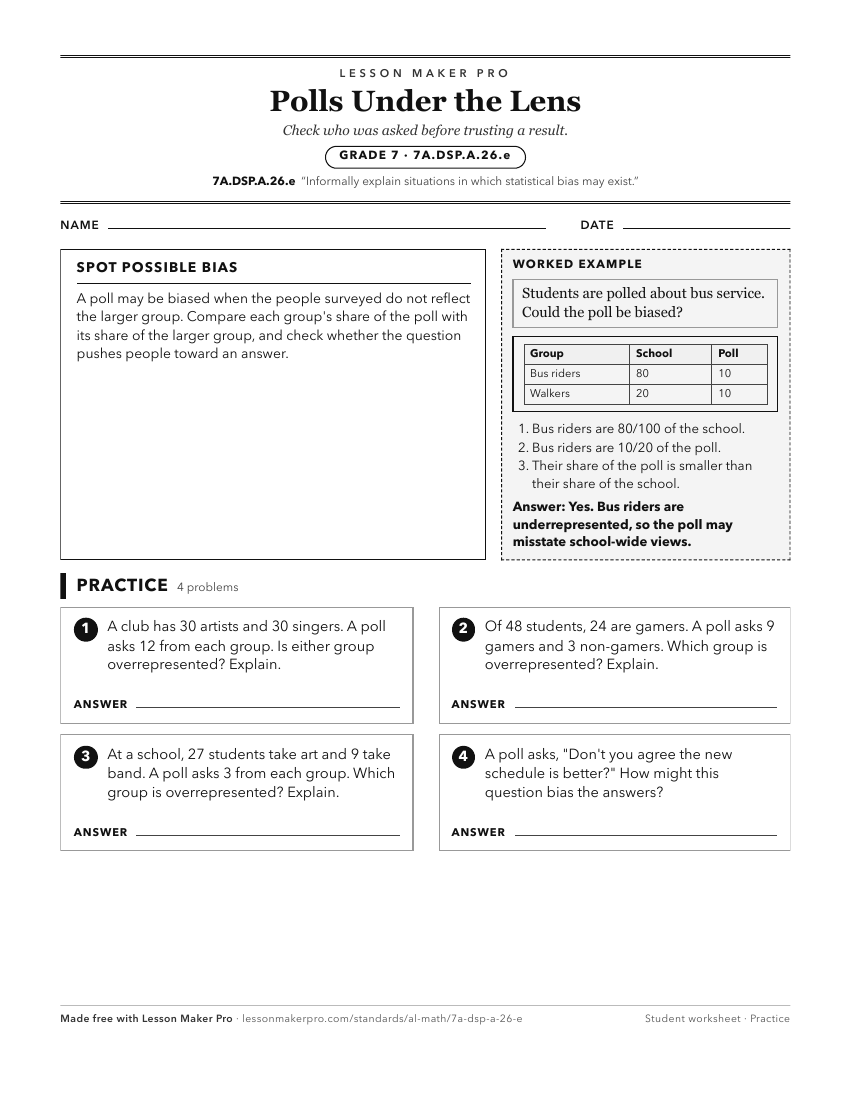
A ready-to-print activity worksheet aligned to 7A.DSP.A.26.e, with an answer key for the teacher on its own page. No account needed.
PDF, US Letter, prints cleanly in black and white.
Download the worksheetKeep exploring
Related Standards
- 7.DSP.A.10.e
Informally explain situations in which statistical bias may exist.
- MM.D3D.C.21
Critique the validity of reported conclusions from statistical studies in terms of bias and random error probabilities.
- A2S.DSP.G
Bias, such as sampling, response, or nonresponse bias, may occur in surveys, yielding results that are not representative of the population of interest.
- A2S.DSP.G.30
Evaluate where bias, including sampling, response, or nonresponse bias, may occur in surveys, and whether results are representative of the population of intere...
Turn this exact standard into a lesson
Grade, subject, topic, and the complete standard are prefilled. Create one free, no account needed.
Also for this standard:Make a WorksheetMake a QuizMake a Sub Lesson