Alabama Math A2S.DSP.G
Standard Cluster
Bias, such as sampling, response, or nonresponse bias, may occur in surveys, yielding results that are not representative of the population of interest.
2019 Alabama Course of Study: Mathematics · Algebra II With Statistics
Cluster contents
Standards in This Cluster
A2S.DSP.G is a cluster heading. These are the individual standards under it.
Teacher's field guide
What This Cluster Means
What Students Need to Do
- Students spot when a survey leaves out part of a group, uses a leading question, or gets few replies. They explain how each problem could skew the results.
What Mastery Looks Like
- Given a survey plan, students name the likely bias and point to what caused it. They suggest a better way to choose people, word the question, or collect replies.
Common Misconceptions
- Students may think a large number of replies makes a survey fair, even when everyone surveyed comes from one group. They may also assume people who did not reply would answer like those who did.
How to Assess It
- Exit ticket: A student council asks 100 cafeteria diners whether to change school lunches, but only 20 reply. Name two possible sources of bias and suggest one fix for each.
Lesson moves
Ways to Teach It
Give pairs 20 cards showing lunch type and menu opinion. Have them compare five cards drawn at random with five cafeteria-only cards.
Ask students to compare 'Should we improve our terrible lunches?' with 'Should the school change lunch options?' and write how answers might differ.
Have pairs sort three survey cards: a cafeteria-only sample, a leading question, and 80 unanswered forms. Ask them to fix each plan.
Write 'Instagram poll: 80% want later start times' on the board. Ask whether those votes represent the whole school.
Free download
Printable A2S.DSP.G Worksheet
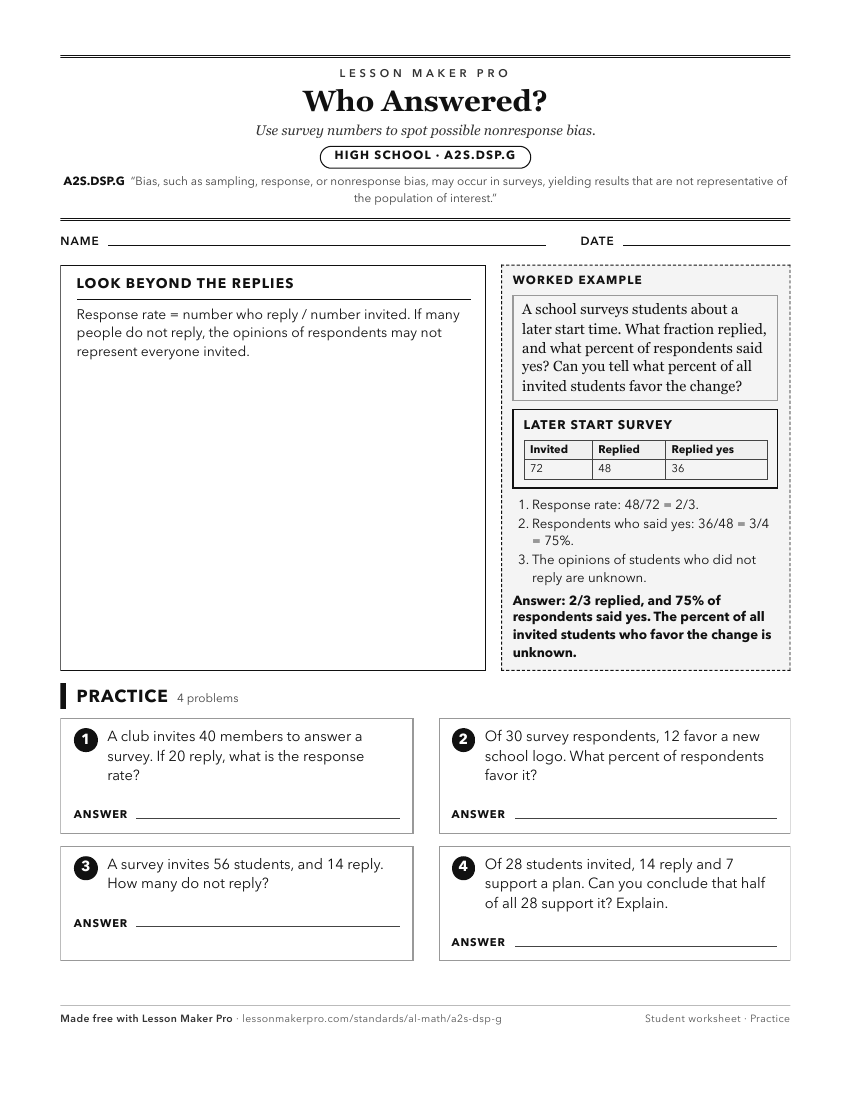
A ready-to-print activity worksheet aligned to A2S.DSP.G, with an answer key for the teacher on its own page. No account needed.
PDF, US Letter, prints cleanly in black and white.
Download the worksheetKeep exploring
Related Standards
- 7A.DSP.A.26.e
Informally explain situations in which statistical bias may exist.
- 7.DSP.A.10.e
Informally explain situations in which statistical bias may exist.
- 7A.DSP.A.26.b
Compare sampling techniques to determine whether a sample is random and thus representative of a population, explaining that random sampling tends to produce re...
Turn this cluster into a lesson
Grade, subject, topic, and the complete cluster are prefilled. Create one free, no account needed.
Also for this cluster:Make a WorksheetMake a QuizMake a Sub Lesson