Alabama Math 7.DSP.A.10.e
The Standard
- 7.DSP.A
- Make inferences about a population using random sampling.
- 7.DSP.A.10
- Examine a sample of a population to generalize information about the population.
Informally explain situations in which statistical bias may exist.
2019 Alabama Course of Study: Mathematics
Teacher's field guide
What This Standard Means
What Students Need to Do
- Students spot when a survey favors certain people or answers. They explain who is left out or pushed toward an answer, and how that could skew a claim about the whole group.
What Mastery Looks Like
- Given a lunch survey taken only in the cafeteria line, a student points out that students who bring lunch are missing. They explain why the results may not reflect every student's view. They also spot questions that nudge people toward one answer.
Common Misconceptions
- Students may think a large sample cannot be biased, even if everyone surveyed comes from one group. They may call any surprising result biased or expect a random sample to match the whole group exactly.
How to Assess It
- Exit ticket: A school asks only students leaving the cafeteria, 'Don't you love our new lunch menu?' Name two ways the results could be biased. Explain how each could affect the answers.
Lesson moves
Ways to Teach It
Place 20 red and 20 blue counters in a clear bag; compare ten eyes-closed draws with ten favorite-color picks, replacing each counter.
Ask: 'A school surveys only basketball players about buying new hoops. Whose views are missing, and what might the school wrongly conclude?'
Sort four survey cards: random roster draw, cafeteria poll, friends-only poll, and optional online poll; explain which might skew results.
Show a school lunch survey given only to cafeteria customers; have students name who is missing and what the results cannot tell us.
Free download
Printable 7.DSP.A.10.e Worksheet
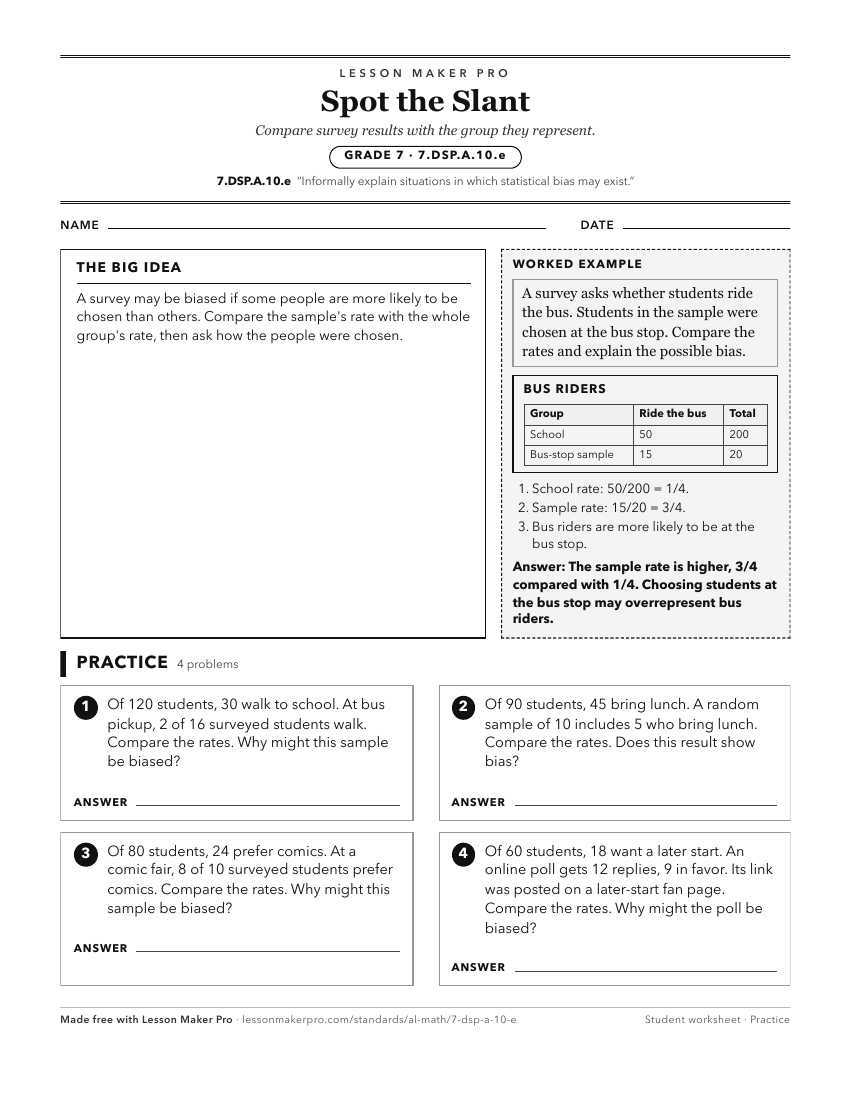
A ready-to-print activity worksheet aligned to 7.DSP.A.10.e, with an answer key for the teacher on its own page. No account needed.
PDF, US Letter, prints cleanly in black and white.
Download the worksheetKeep exploring
Related Standards
- 7A.DSP.A.26.e
Informally explain situations in which statistical bias may exist.
- MM.D3D.C.21
Critique the validity of reported conclusions from statistical studies in terms of bias and random error probabilities.
- A2S.DSP.G
Bias, such as sampling, response, or nonresponse bias, may occur in surveys, yielding results that are not representative of the population of interest.
- A2S.DSP.G.30
Evaluate where bias, including sampling, response, or nonresponse bias, may occur in surveys, and whether results are representative of the population of intere...
Turn this exact standard into a lesson
Grade, subject, topic, and the complete standard are prefilled. Create one free, no account needed.
Also for this standard:Make a WorksheetMake a QuizMake a Sub Lesson