Alabama Math MM.D3D.C.21
The Standard
- MM.D3D.C
- Statistical studies allow a conclusion to be drawn about a population that is too large to survey completely or about cause and effect in an experiment.
Critique the validity of reported conclusions from statistical studies in terms of bias and random error probabilities.
2019 Alabama Course of Study: Mathematics
Teacher's field guide
What This Standard Means
What Students Need to Do
- Students check who was studied and how the data was collected. They judge whether bias or random variation could explain a reported result. They decide whether the evidence supports the claim.
What Mastery Looks Like
- A student can explain why a survey of gym members cannot represent all teens. They can explain that a margin of error covers random variation, not a biased sample.
Common Misconceptions
- Students may think a large sample must be fair. They may read a p-value of 0.05 as a 5% chance the conclusion is wrong. They may think a margin of error covers people who were left out.
How to Assess It
- A survey of 100 teens randomly drawn from a phone list finds that 70% exercise daily, with a margin of error of 8%. Ask students whether it supports a claim about all teens, naming one possible bias and explaining what the margin covers.
Lesson moves
Ways to Teach It
Layer 40 red beans over 60 white beans, scoop 20 from the top, then mix and draw three random samples of 20.
Give students a headline claiming that 60 app users prove all teens prefer online homework; ask them to write two reasons to question it.
Give pairs four study cards: 30 volunteers, 300 random names, 30 random names, and 300 gym members; have them rank the claims.
Print an election poll showing 48% to 46% with a 4-point margin of error; ask if its headline can declare a winner.
Free download
Printable MM.D3D.C.21 Worksheet
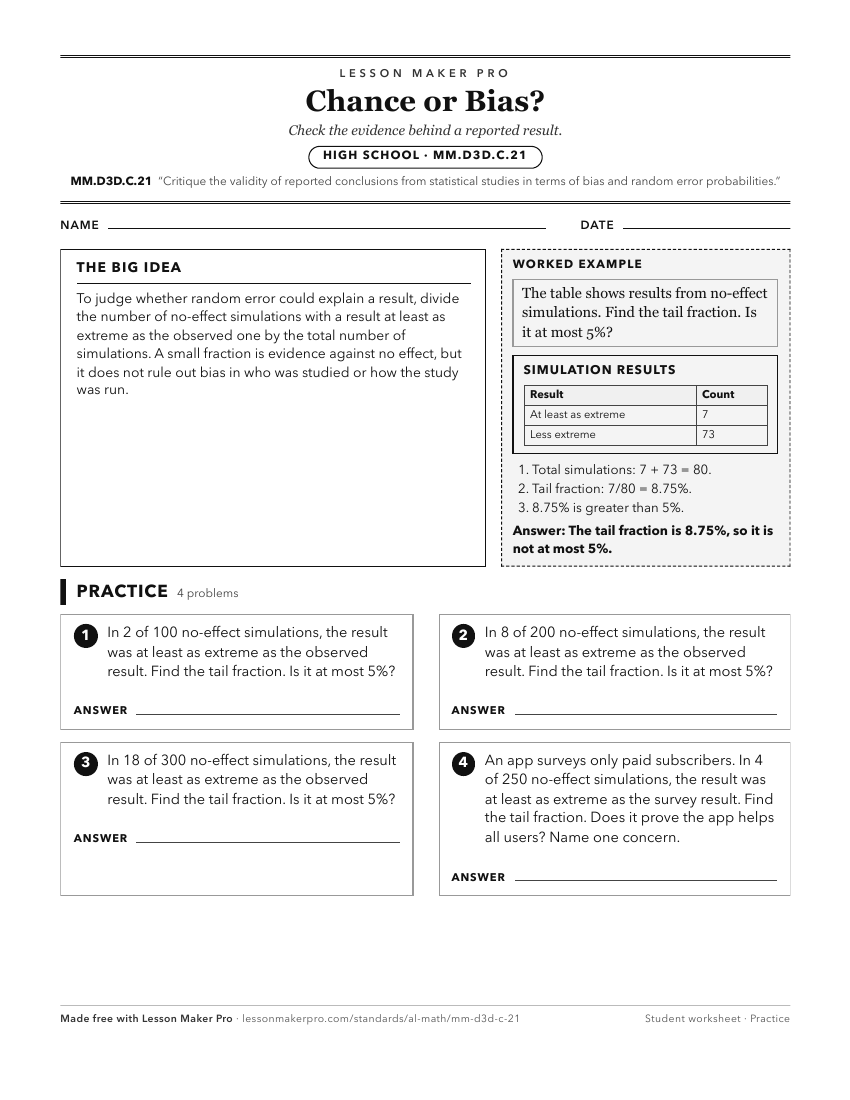
A ready-to-print activity worksheet aligned to MM.D3D.C.21, with an answer key for the teacher on its own page. No account needed.
PDF, US Letter, prints cleanly in black and white.
Download the worksheetKeep exploring
Related Standards
- 7.DSP.A.10.e
Informally explain situations in which statistical bias may exist.
- 7A.DSP.A.26.e
Informally explain situations in which statistical bias may exist.
- A2S.DSP.G.30
Evaluate where bias, including sampling, response, or nonresponse bias, may occur in surveys, and whether results are representative of the population of intere...
- A2S.DSP.F
The scope and validity of statistical inferences are dependent on the role of randomization in the study design.
Turn this exact standard into a lesson
Grade, subject, topic, and the complete standard are prefilled. Create one free, no account needed.
Also for this standard:Make a WorksheetMake a QuizMake a Sub Lesson