Virginia SOL PS.6.b
The Standard
- PS.6
- The student will investigate and understand that waves are important in the movement of energy. Key ideas include
mechanical waves need a medium to transfer energy
Virginia Standards of Learning for Science · The student will investigate and understand that waves are important in the movement of energy. Key ideas include
Teacher's field guide
What This Standard Means
What Students Need to Do
- Students identify the material that carries a mechanical wave, such as air, water, or a rope. They explain that vibrating particles pass energy to nearby particles without traveling with the wave.
What Mastery Looks Like
- Students can name the medium in sound, water, spring, and seismic wave examples. They can predict that a mechanical wave will not travel through empty space and explain why.
Common Misconceptions
- Students may think the medium moves from the source to the receiver or that waves carry matter. They may also believe sound can travel through empty space or that every wave needs a medium.
How to Assess It
- Ask students: A buzzer rings inside a sealed jar as the air is removed. Predict what happens to the sound and explain why in two sentences.
Lesson moves
Ways to Teach It
Stretch a Slinky between two students, mark one coil with tape, and observe how the pulse moves while the marked coil stays nearby.
Ask students to explain why astronauts cannot hear each other speak directly outside their spacesuits.
Sort cards showing sound, water, light, rope, and seismic waves into groups based on whether each needs a medium.
Trace how vibrations from a phone speaker move through air and cause the eardrum to vibrate.
Free download
Printable PS.6.b Worksheet
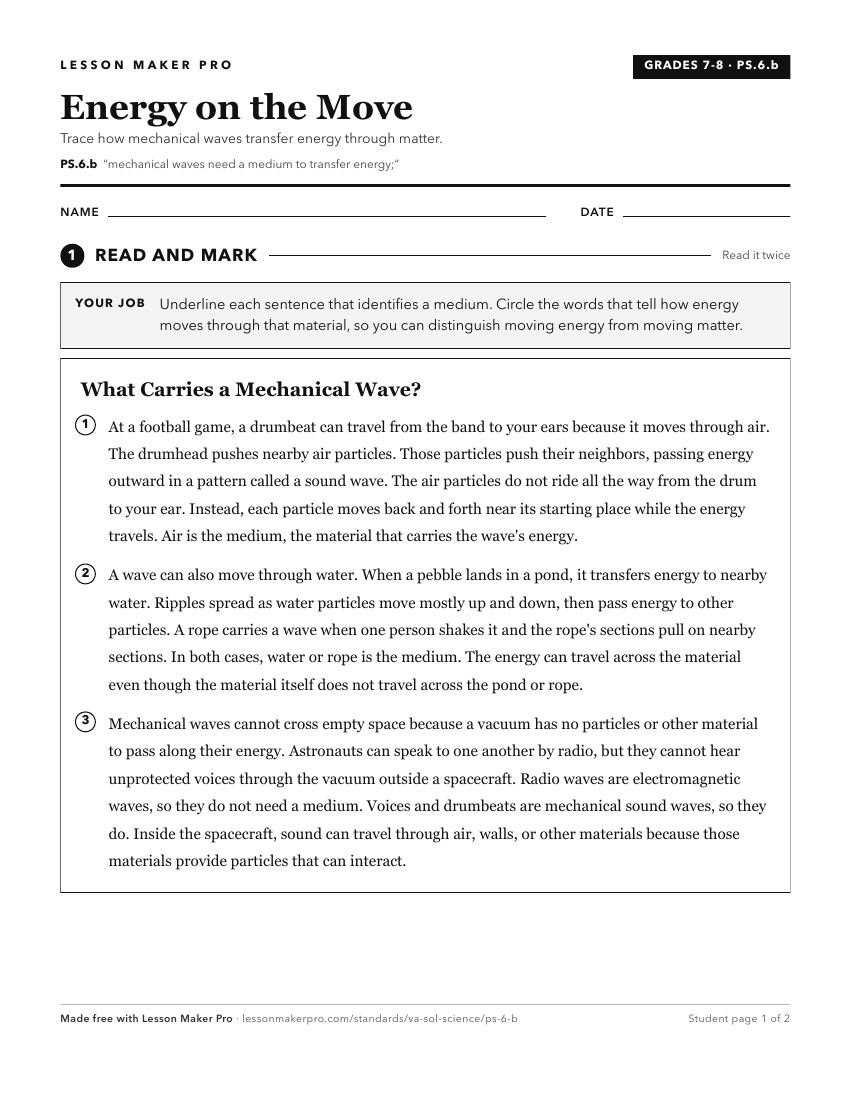
A ready-to-print activity worksheet aligned to PS.6.b, with an answer key for the teacher on its own page. No account needed.
PDF, US Letter, prints cleanly in black and white.
Download the worksheetKeep exploring
Related Standards
Turn this exact standard into a lesson
Grade, subject, topic, and the complete standard are prefilled. Create one free, no account needed.
Also for this standard:Make a WorksheetMake a QuizMake a Sub Lesson