Virginia SOL LS.10
SOL Standard (Key Ideas Cluster)
The student will investigate and understand that organisms reproduce and transmit genetic information to new generations. Key ideas include DNA has a role in making proteins that determine organism traits; the role of meiosis is to transfer traits to the next generation; and Punnett squares are mathematical models used to predict the probability of traits in offspring.
Virginia Standards of Learning for Science
Cluster contents
Key Ideas in This Standard
LS.10 is a Standards of Learning science standard. These are the key ideas and practices under it.
Teacher's field guide
What This Cluster Means
What Students Need to Do
- Students connect DNA instructions to protein production and observable traits. They model how meiosis separates allele pairs into gametes. They use parent genotypes to complete Punnett squares and calculate offspring probabilities.
What Mastery Looks Like
- Given two parent genotypes, students can list possible gametes and build an accurate Punnett square. They can state genotype and phenotype probabilities. They can explain that predicted ratios describe chance, not guaranteed results.
Common Misconceptions
- Students may think DNA turns directly into a visible trait, skipping the role of proteins. They often confuse meiosis with mitosis or assume each gamete receives both alleles. They may treat a 75 percent probability as exactly three of every four offspring.
How to Assess It
- Exit ticket: In peas, T is dominant for tall stems; for Tt × tt, list gametes, draw the square, give probabilities, and link DNA, protein, and height.
Lesson moves
Ways to Teach It
Use colored pipe cleaners and allele tags to model chromosome replication, pairing, and separation into four gametes.
Discuss: Why can four offspring from Bb × Bb fail to show exactly three dominant traits and one recessive trait?
Play Punnett Square Bingo: call parent genotypes, have pairs calculate probabilities, and cover matching genotype or phenotype percentages.
Act as plant breeders choosing pea parents to maximize recessive flowers, then defend the cross with a Punnett square.
Free download
Printable LS.10 Worksheet
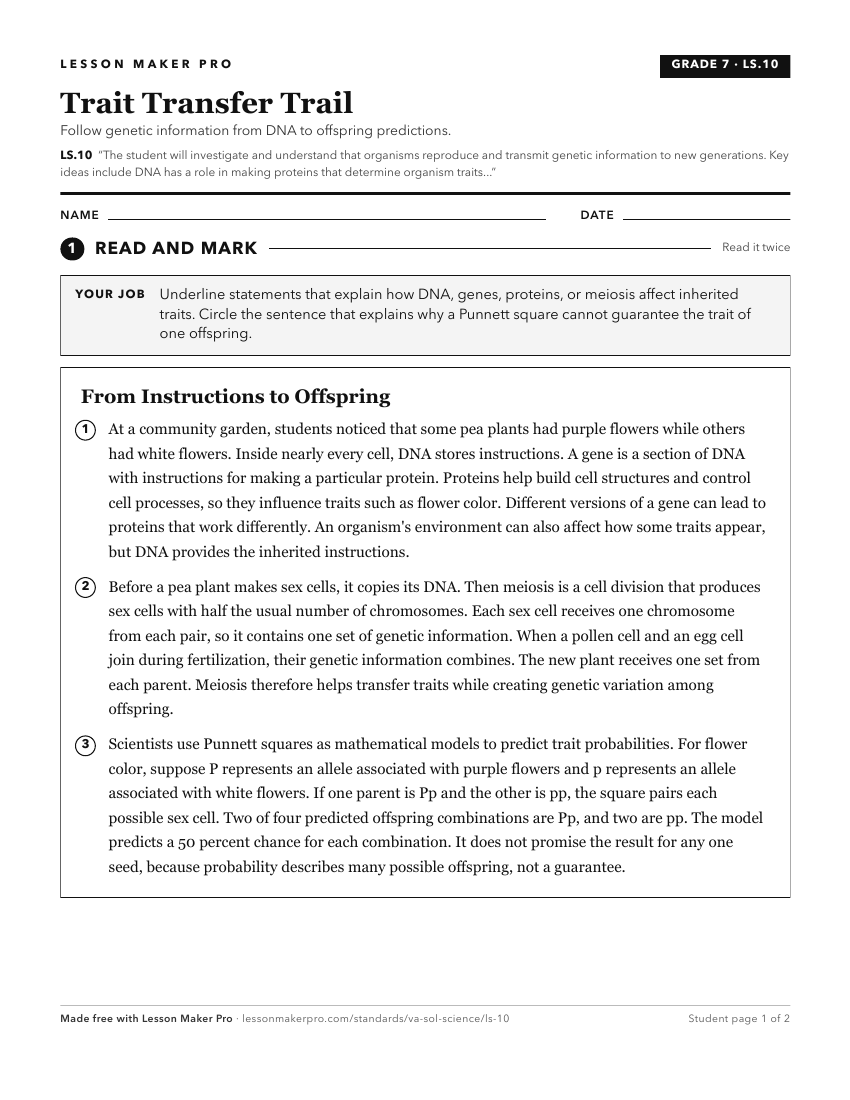
A ready-to-print activity worksheet aligned to LS.10, with an answer key for the teacher on its own page. No account needed.
PDF, US Letter, prints cleanly in black and white.
Download the worksheetKeep exploring
Related Standards
- 4.3
The student will investigate and understand that organisms, including humans, interact with one another and with the nonliving components in the ecosystem. Key ...
- LS.11
The student will investigate and understand that populations of organisms can change over time. Key ideas include
- K.6
The student will investigate and understand that there are differences between living organisms and nonliving objects. Key ideas include
- LS.6
The student will investigate and understand that populations in a biological community interact and are interdependent. Key ideas include
Turn this cluster into a lesson
Grade, subject, topic, and the complete cluster are prefilled. Create one free, no account needed.
Also for this cluster:Make a WorksheetMake a QuizMake a Sub Lesson