Virginia SOL LS.10.c
The Standard
- LS.10
- The student will investigate and understand that organisms reproduce and transmit genetic information to new generations. Key ideas include
Punnett squares are mathematical models used to predict the probability of traits in offspring.
Virginia Standards of Learning for Science · The student will investigate and understand that organisms reproduce and transmit genetic information to new generations. Key ideas include
Teacher's field guide
What This Standard Means
What Students Need to Do
- Students use parent genotypes to place alleles in a Punnett square and find possible offspring genotypes. They calculate genotype and phenotype probabilities and explain that each birth is an independent event.
What Mastery Looks Like
- Given a one-trait cross, a student completes the square and reports each outcome as a fraction, ratio, or percent. The student clearly separates genotype from phenotype.
Common Misconceptions
- Students may think a 25 percent chance means exactly one of every four offspring will have the trait. They may confuse genotype with phenotype or place both parent alleles on the same side. Some think dominant means stronger, better, or more common.
How to Assess It
- Give students this exit ticket: Cross two pea plants with genotypes Pp and Pp. Complete the Punnett square, then state the probability of pp offspring and explain what that probability means.
Lesson moves
Ways to Teach It
Use colored allele cards and a taped floor grid to model how one allele from each parent combines in each box.
Write a response to this prompt: Why can two offspring from the same parents have different traits?
Play Punnett Square Bingo by calling parent crosses while students cover matching offspring genotypes and phenotype probabilities.
Analyze a simplified cystic fibrosis carrier cross and calculate the chance that a child is affected, unaffected, or a carrier.
Free download
Printable LS.10.c Worksheet
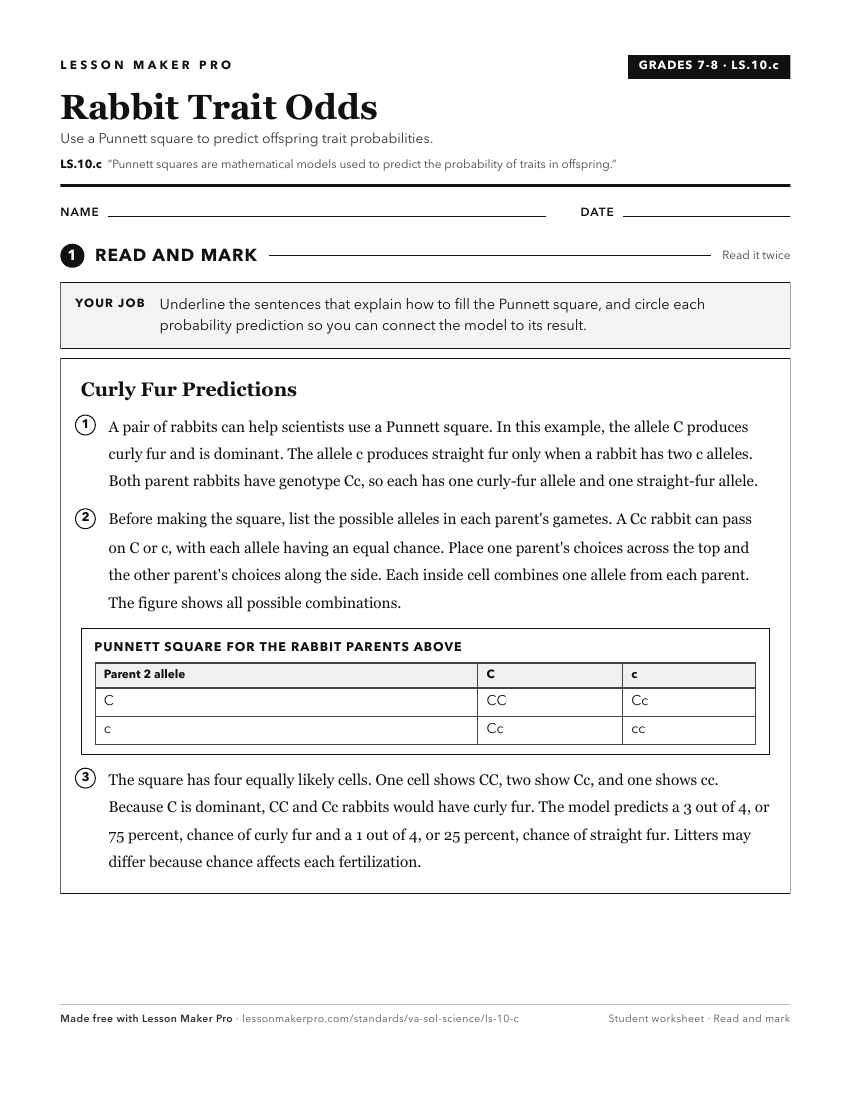
A ready-to-print activity worksheet aligned to LS.10.c, with an answer key for the teacher on its own page. No account needed.
PDF, US Letter, prints cleanly in black and white.
Download the worksheetKeep exploring
Related Standards
- 5.1.a.i
ask testable questions based on observations and predict reasonable outcomes based on patterns
- LS.1.e.i
construct and use models and simulations to illustrate, predict, and/or explain observable and unobservable phenomena, life processes, or mechanisms
- K.1.a.iii
make predictions based on observations
- 6.1.e.ii
use, develop, and revise models to predict and explain phenomena
Turn this exact standard into a lesson
Grade, subject, topic, and the complete standard are prefilled. Create one free, no account needed.
Also for this standard:Make a WorksheetMake a QuizMake a Sub Lesson