Virginia SOL LS.10.b
The Standard
- LS.10
- The student will investigate and understand that organisms reproduce and transmit genetic information to new generations. Key ideas include
the role of meiosis is to transfer traits to the next generation
Virginia Standards of Learning for Science · The student will investigate and understand that organisms reproduce and transmit genetic information to new generations. Key ideas include
Teacher's field guide
What This Standard Means
What Students Need to Do
- Students explain that meiosis makes sex cells with half the usual chromosome number. They track how alleles enter gametes and combine at fertilization to pass traits from both parents.
What Mastery Looks Like
- Students can model one parent cell producing four gametes, each with one chromosome from every pair. They can explain why offspring receive one allele for each gene from each parent.
Common Misconceptions
- Students may confuse meiosis with mitosis or think gametes contain the full chromosome number. They may also think all four gametes are identical or that offspring receive traits from only one parent.
How to Assess It
- Give this exit ticket: “A species has 8 chromosomes in each body cell. How many chromosomes are in each gamete, and how does meiosis help pass traits?”
Lesson moves
Ways to Teach It
Use paired chromosome cards to model meiosis, making four gametes with one chromosome from each pair.
Write a response to: “Why must sex cells have half the chromosome number of body cells?”
Sort scenario cards into meiosis or mitosis, then justify each choice using cell number, chromosome number, and purpose.
Compare possible allele combinations among siblings to explain why children of the same parents can inherit different trait combinations.
Free download
Printable LS.10.b Worksheet
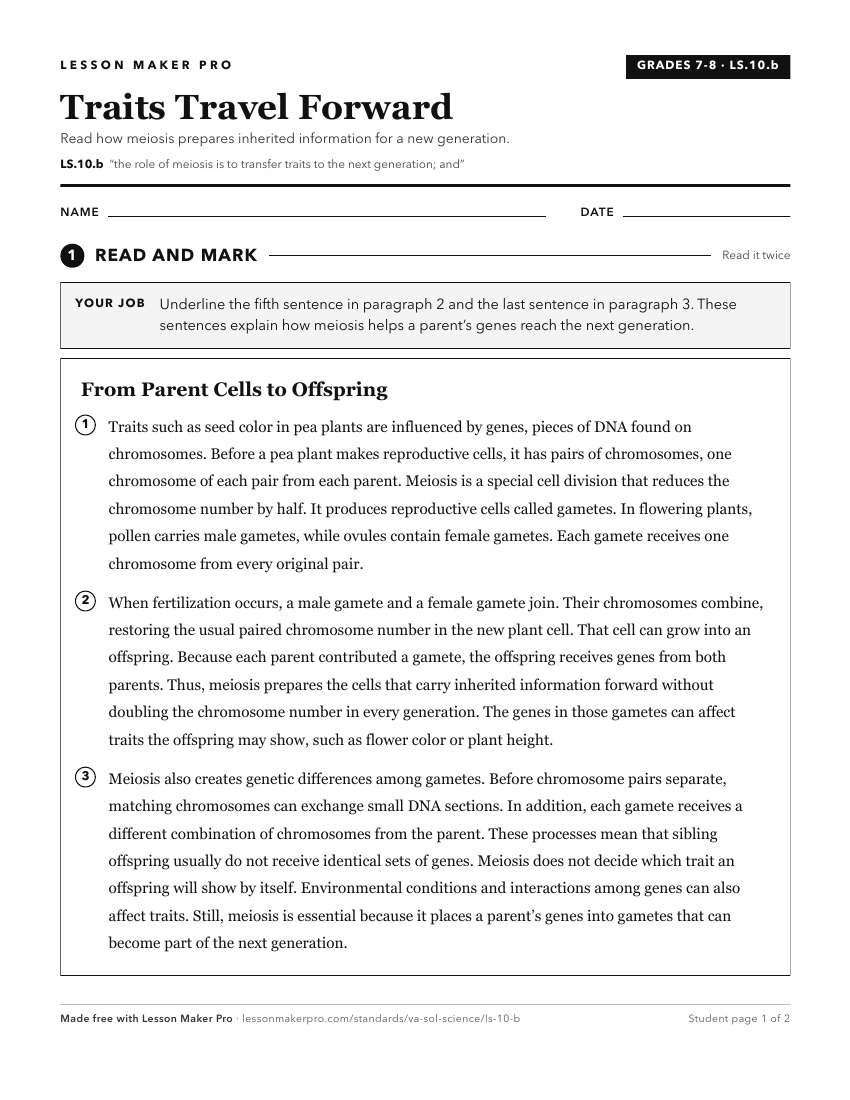
A ready-to-print activity worksheet aligned to LS.10.b, with an answer key for the teacher on its own page. No account needed.
PDF, US Letter, prints cleanly in black and white.
Download the worksheetKeep exploring
Related Standards
- LS.10.a
DNA has a role in making proteins that determine organism traits
- LS.10
The student will investigate and understand that organisms reproduce and transmit genetic information to new generations. Key ideas include
- LS.2.e
cellular transport (osmosis and diffusion) is important for life processes.
- LS.2.d
cell division is the mechanism for growth and reproduction
Turn this exact standard into a lesson
Grade, subject, topic, and the complete standard are prefilled. Create one free, no account needed.
Also for this standard:Make a WorksheetMake a QuizMake a Sub Lesson