Virginia SOL K.1.b.ii
The Standard
- K.1
- The student will demonstrate an understanding of scientific and engineering practices by
planning and carrying out investigations identify characteristics and properties of objects through observations
Virginia Standards of Learning for Science · The student will demonstrate an understanding of scientific and engineering practices by
Teacher's field guide
What This Standard Means
What Students Need to Do
- Students examine objects closely using sight, touch, smell, and safe tools such as hand lenses. They name features such as color, shape, size, texture, and hardness.
What Mastery Looks Like
- A student can describe an object with several accurate details based on direct observation. The student can sort objects by one observable feature and explain the choice.
Common Misconceptions
- Students may name what an object is used for instead of describing its features. They may also guess hidden traits or confuse size words, such as tall, long, and wide.
How to Assess It
- Give each student a classroom object and ask, “What do you notice?” Look for at least three accurate properties based on observation.
Lesson moves
Ways to Teach It
Set out rocks, leaves, and shells for students to examine with hand lenses, then sort by color, shape, or texture.
Show one mystery object and ask students to complete the sentence, “I notice it is ___, so I think ___.”
Play Property Hunt by calling out a feature, such as smooth or round, and having students find a matching classroom object.
Compare classroom materials used for cups, coats, and windows, then discuss which observable properties make each material useful.
Free download
Printable K.1.b.ii Worksheet
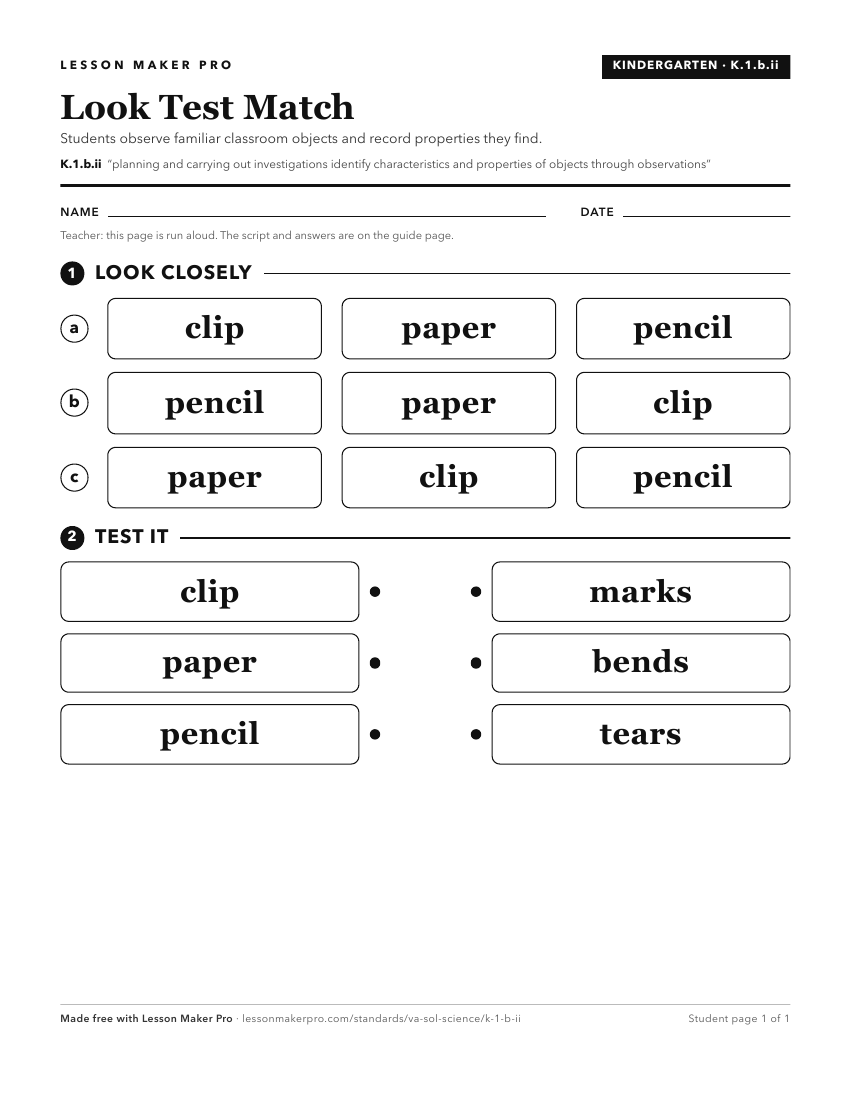
A ready-to-print activity worksheet aligned to K.1.b.ii, with an answer key for the teacher on its own page. No account needed.
PDF, US Letter, prints cleanly in black and white.
Download the worksheetKeep exploring
Related Standards
- 1.3
The student will investigate and understand that objects are made from materials that can be described by their physical properties. Key ideas include
- K.1.a.i
ask questions based on observations
- K.3
The student will investigate and understand that physical properties of an object can be described. Properties include
- 1.1.b.ii
identify characteristics and properties of objects by observations
Turn this exact standard into a lesson
Grade, subject, topic, and the complete standard are prefilled. Create one free, no account needed.
Also for this standard:Make a WorksheetMake a QuizMake a Sub Lesson