Virginia SOL 6.7.e
The Standard
- 6.7
- The student will investigate and understand that air has properties and that Earth's atmosphere has structure and is dynamic. Key ideas include
atmospheric measures are used to predict weather conditions
Virginia Standards of Learning for Science
Teacher's field guide
What This Standard Means
What Students Need to Do
- Students read temperature, air pressure, humidity, wind, and precipitation data from instruments, tables, and maps. They use patterns and changes in those measurements to make and support a short-term forecast.
What Mastery Looks Like
- A student can match each measurement to the correct instrument and unit. Given several days of data, the student identifies a trend, predicts likely conditions, and cites measurements as evidence.
Common Misconceptions
- Students may treat one measurement as proof instead of considering several measurements together. They often confuse anemometers with wind vanes, or think falling air pressure signals fair weather.
How to Assess It
- Exit ticket: Air pressure falls from 1020 mb to 1003 mb while humidity rises from 45 percent to 80 percent. Predict tomorrow’s weather and cite both trends.
Lesson moves
Ways to Teach It
Set up stations with a thermometer, barometer, hygrometer, anemometer, and rain gauge, then have students record a class weather report.
Ask students to write: Which two atmospheric measurements best support tomorrow’s forecast, and why?
Play Forecast Match: teams pair weather-data cards with forecast cards, then earn a point by explaining each match.
Compare a local seven-day forecast with daily measurements from a nearby weather station, then score which predictions were accurate.
Free download
Printable 6.7.e Worksheet
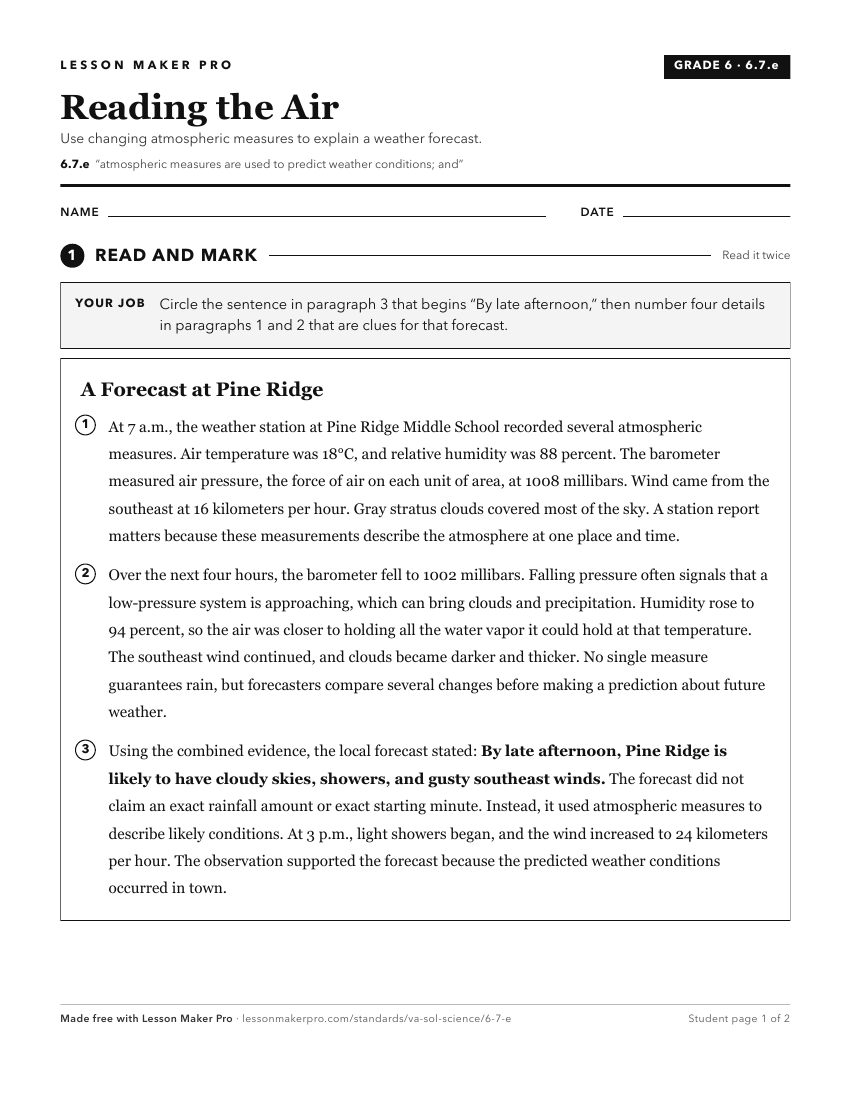
A ready-to-print activity worksheet aligned to 6.7.e, with an answer key for the teacher on its own page. No account needed.
PDF, US Letter, prints cleanly in black and white.
Download the worksheetKeep exploring
Related Standards
- 1.7.b
there are relationships between daily weather and the season
- 6.7.d
there is a relationship between air movement, thermal energy, and weather conditions
- 2.6.b
measuring, recording, and interpreting weather data allows for identification of weather patterns
- 4.4.a
weather measurements create a record that can be used to make weather predictions
Turn this exact standard into a lesson
Grade, subject, topic, and the complete standard are prefilled. Create one free, no account needed.
Also for this standard:Make a WorksheetMake a QuizMake a Sub Lesson