Virginia SOL 6.7.d
The Standard
- 6.7
- The student will investigate and understand that air has properties and that Earth's atmosphere has structure and is dynamic. Key ideas include
there is a relationship between air movement, thermal energy, and weather conditions
Virginia Standards of Learning for Science
Teacher's field guide
What This Standard Means
What Students Need to Do
- Students explain how uneven heating changes air temperature and density, creating pressure differences and wind. They use wind and temperature patterns to predict clouds, storms, or clearing.
What Mastery Looks Like
- A student can read a simple temperature and pressure map, trace air from high pressure toward low pressure, and predict likely weather. The explanation links uneven heating, rising or sinking air, wind, and cloud formation or clearing.
Common Misconceptions
- Students often think wind creates temperature changes, rather than unequal heating creating pressure differences that drive wind. They may also believe warm air always means clear skies, or that air moves from low pressure to high pressure.
How to Assess It
- Give students a diagram of warm land beside a cool lake. Ask them to add air movement arrows and explain how the pattern could affect clouds near the shore.
Lesson moves
Ways to Teach It
Heat equal cups of sand and water under a lamp, record temperatures, and sketch how air would circulate above them.
Ask, “Why can a beach breeze reverse after sunset?” and require students to use heating, pressure, and air movement in their response.
Have pairs match cards showing surface temperature, air pressure, wind direction, and likely weather, then defend each four-card set.
Compare a local hourly forecast before and after a front, noting changes in temperature, wind direction, cloud cover, and precipitation.
Free download
Printable 6.7.d Worksheet
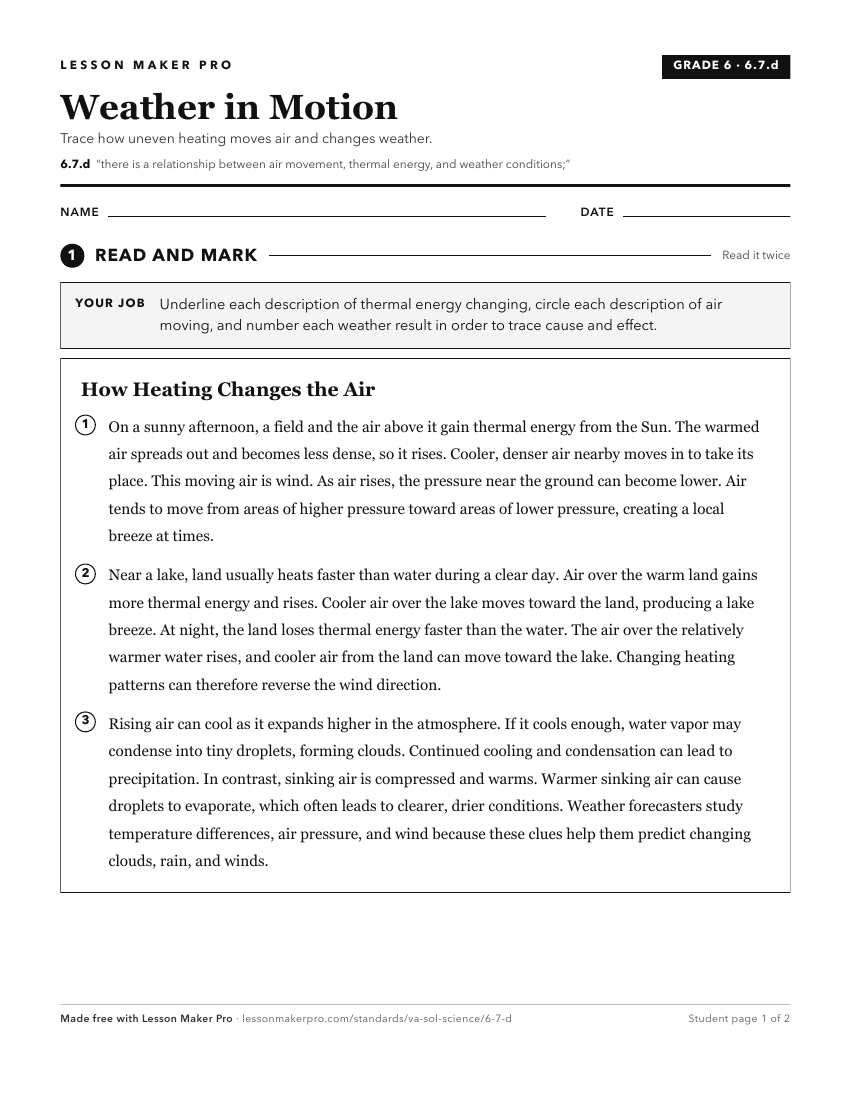
A ready-to-print activity worksheet aligned to 6.7.d, with an answer key for the teacher on its own page. No account needed.
PDF, US Letter, prints cleanly in black and white.
Download the worksheetKeep exploring
Related Standards
Turn this exact standard into a lesson
Grade, subject, topic, and the complete standard are prefilled. Create one free, no account needed.
Also for this standard:Make a WorksheetMake a QuizMake a Sub Lesson