Virginia SOL 6.4.c
The Standard
- 6.4
- The student will investigate and understand that there are basic sources of energy and that energy can be transformed. Key ideas include
radiation, conduction, and convection distribute energy
Virginia Standards of Learning for Science
Teacher's field guide
What This Standard Means
What Students Need to Do
- Students identify how thermal energy moves through direct contact, moving fluids, and electromagnetic waves. They use evidence from a situation to distinguish conduction, convection, and radiation.
What Mastery Looks Like
- Students correctly label each transfer method in diagrams and everyday examples. They explain the direction of energy transfer and identify whether matter must touch, circulate, or is not required.
Common Misconceptions
- Students may think cold moves into warmer objects instead of energy moving toward cooler areas. They may think radiation requires matter, or that convection occurs in solids. They also confuse any movement of warm material with radiation.
How to Assess It
- Give students a diagram of soup heating in a metal pot. Ask them to label one example of each transfer method and draw energy-flow arrows.
Lesson moves
Ways to Teach It
Set up stations with a warm metal spoon, colored water heated from below, and a lamp shining on black paper.
Ask students to explain how energy reaches their hands when they hold them near, but do not touch, a campfire.
Play a sorting game with scenario cards, such as a toaster, boiling water, and an ice cube on a plate.
Trace energy transfer while cooking pizza, including the hot pan, circulating oven air, and glowing heating element.
Free download
Printable 6.4.c Worksheet
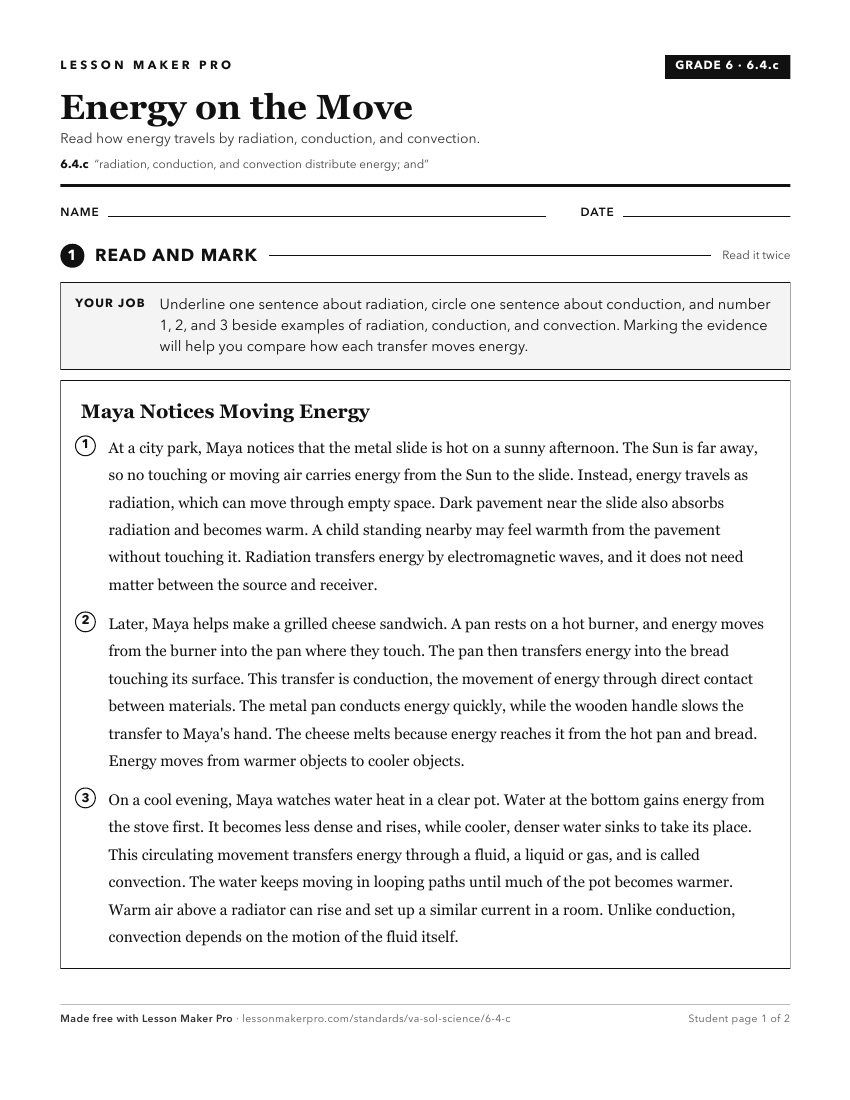
A ready-to-print activity worksheet aligned to 6.4.c, with an answer key for the teacher on its own page. No account needed.
PDF, US Letter, prints cleanly in black and white.
Download the worksheetKeep exploring
Related Standards
Turn this exact standard into a lesson
Grade, subject, topic, and the complete standard are prefilled. Create one free, no account needed.
Also for this standard:Make a WorksheetMake a QuizMake a Sub Lesson