Virginia SOL 5.9.c
The Standard
- 5.9
- The student will investigate and understand that the conservation of energy resources is important. Key ideas include
advances in technology improve the ability to transfer and transform energy.
Virginia Standards of Learning for Science
Teacher's field guide
What This Standard Means
What Students Need to Do
- Students trace where energy starts, how it moves, and which forms it takes in a device or system. They compare older and newer designs using evidence such as energy output, speed, and wasted heat.
What Mastery Looks Like
- A student can label the energy path through devices such as solar panels, batteries, light bulbs, and wind turbines. The student can explain how a newer design transfers or changes energy more efficiently without creating energy.
Common Misconceptions
- Students may confuse moving energy with changing it from one form to another. They may think devices create energy, or that newer technology converts all input energy into useful output with no waste.
How to Assess It
- Show diagrams of an incandescent bulb and an LED. Ask students to label the input and outputs, then explain why the LED uses less electrical energy for the same light.
Lesson moves
Ways to Teach It
Build a foil-lined solar oven and a plain paper oven, then compare temperature changes under the same lamp.
Compare an incandescent bulb and an LED: Where does the electrical energy go, and why does one waste less energy as heat?
Give teams energy-path cards for a solar panel, battery, and wind turbine, then race to arrange each input, transfer, and output.
Use printed appliance energy labels to choose a model, then cite the design feature that reduces wasted energy.
Free download
Printable 5.9.c Worksheet
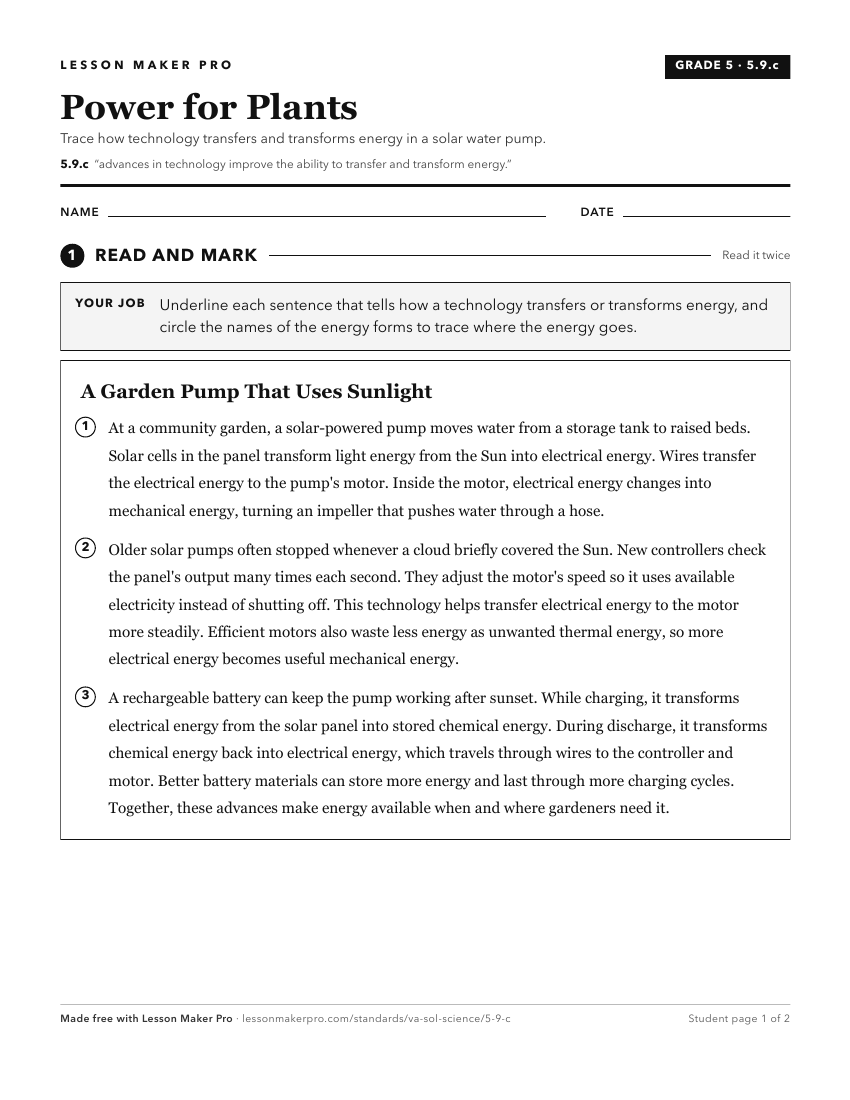
A ready-to-print activity worksheet aligned to 5.9.c, with an answer key for the teacher on its own page. No account needed.
PDF, US Letter, prints cleanly in black and white.
Download the worksheetKeep exploring
Related Standards
Turn this exact standard into a lesson
Grade, subject, topic, and the complete standard are prefilled. Create one free, no account needed.
Also for this standard:Make a WorksheetMake a QuizMake a Sub Lesson