Virginia SOL 5.8.c
The Standard
- 5.8
- The student will investigate and understand that Earth constantly changes. Key ideas include
the rock cycle models the transformation of rocks
Virginia Standards of Learning for Science
Teacher's field guide
What This Standard Means
What Students Need to Do
- Students trace how igneous, sedimentary, and metamorphic rocks can change from one type to another. They connect each change to processes such as weathering, compaction, heat, melting, and cooling.
What Mastery Looks Like
- A student can start with any rock type and draw more than one valid path to another type. The student labels each arrow with the process causing the change and explains that rocks can follow different paths.
Common Misconceptions
- Students often treat the cycle as a fixed circle with one starting point. They may think heat always melts rock or call loose sediment sedimentary rock before compaction and cementation.
How to Assess It
- Exit ticket: Draw and label one path from granite to sandstone, then one from sandstone to an igneous rock. Name each process at every arrow.
Lesson moves
Ways to Teach It
Use crayon shavings in foil to model sediment, compression, heating, melting, and cooling, labeling the rock type after each step.
Write an explanation for how a piece of granite could eventually become sedimentary rock, naming each process in order.
Give pairs process cards and rock cards, then have them build three valid pathways and explain every arrow.
Examine local building stones or photos of Virginia outcrops, then infer which processes formed or changed each rock.
Free download
Printable 5.8.c Worksheet
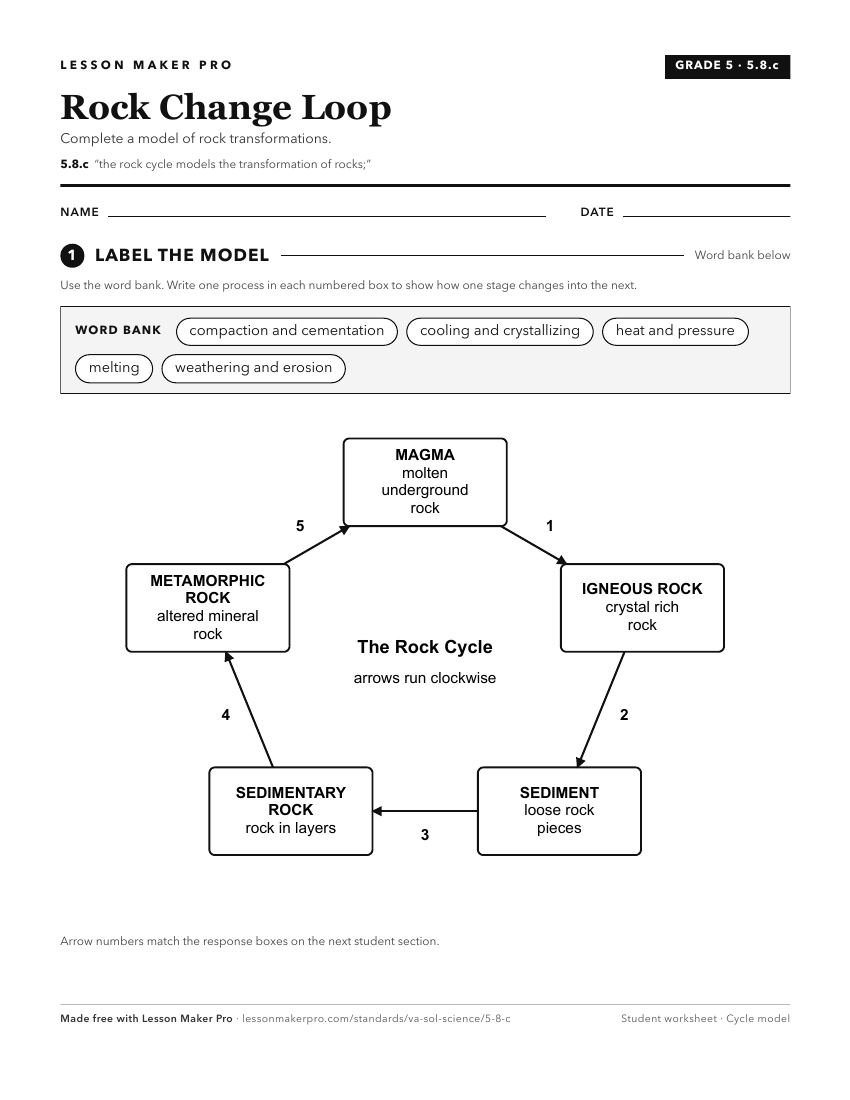
A ready-to-print activity worksheet aligned to 5.8.c, with an answer key for the teacher on its own page. No account needed.
PDF, US Letter, prints cleanly in black and white.
Download the worksheetKeep exploring
Related Standards
Turn this exact standard into a lesson
Grade, subject, topic, and the complete standard are prefilled. Create one free, no account needed.
Also for this standard:Make a WorksheetMake a QuizMake a Sub Lesson