Virginia SOL LS.5.a
The Standard
- LS.5
- The student will investigate and understand that biotic and abiotic factors affect an ecosystem. Key ideas include
matter moves through ecosystems via the carbon, water, and nitrogen cycles
Virginia Standards of Learning for Science · The student will investigate and understand that biotic and abiotic factors affect an ecosystem. Key ideas include
Teacher's field guide
What This Standard Means
What Students Need to Do
- Students trace carbon, water, and nitrogen through organisms, air, water, and soil. They identify storage locations and processes such as photosynthesis, respiration, decomposition, evaporation, and nitrogen fixation. They use models to explain how ecosystem changes affect these movements.
What Mastery Looks Like
- Students can follow a piece of matter through several living and nonliving parts of an ecosystem. They correctly label the processes that move it and explain that matter is reused rather than created or destroyed.
Common Misconceptions
- Students may think matter disappears after decomposition or that cycles follow one fixed path. They often confuse matter with energy, or believe plants get carbon from soil. Some think most organisms can use nitrogen gas directly from the air.
How to Assess It
- On an exit ticket, ask students to trace one carbon atom, one water molecule, and one nitrogen atom through an ecosystem. For each, require two processes and one living and one nonliving storage location.
Lesson moves
Ways to Teach It
Give groups colored beads and organism, air, soil, and water cups; students move each bead using process cards and record its route.
Ask students to write: How could removing all plants change the carbon, water, and nitrogen cycles in one local ecosystem?
Play cycle relay: teams sequence shuffled storage and process cards, then explain why each move is scientifically possible.
Use a lawn fertilizer label and a rainfall map to predict how excess nitrogen could reach a nearby stream.
Free download
Printable LS.5.a Worksheet
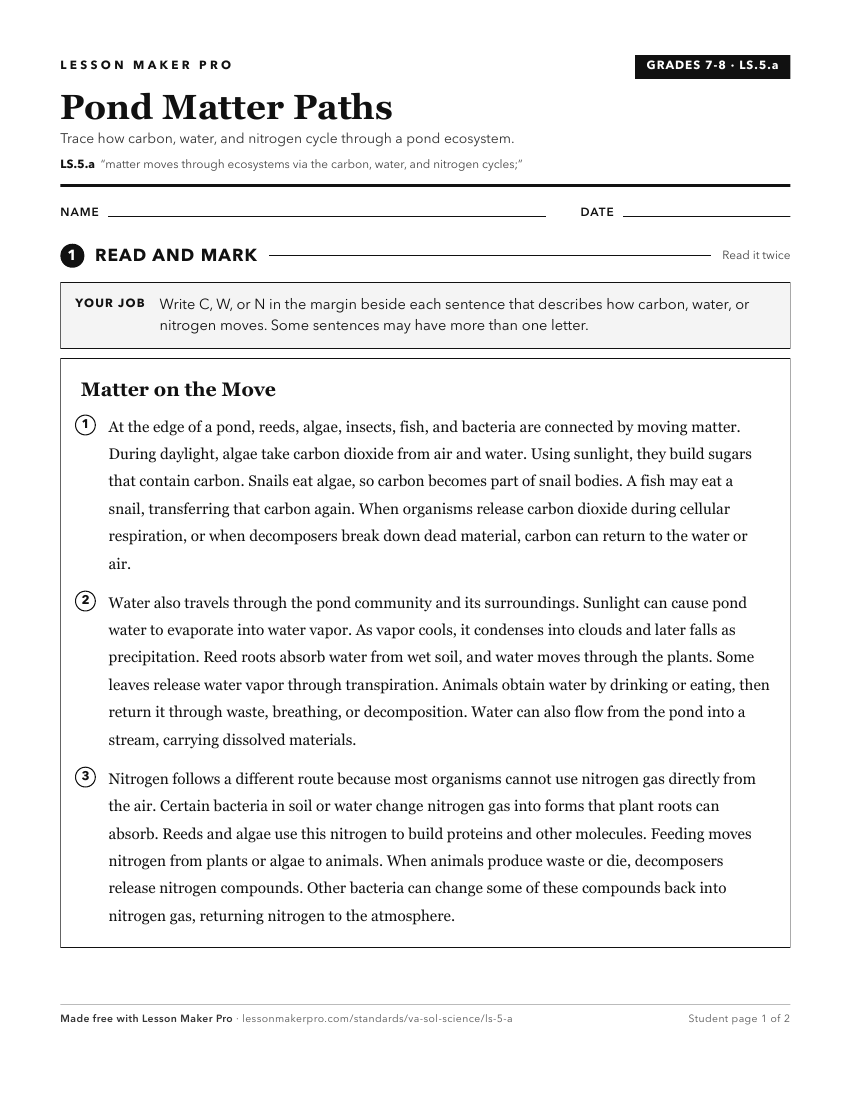
A ready-to-print activity worksheet aligned to LS.5.a, with an answer key for the teacher on its own page. No account needed.
PDF, US Letter, prints cleanly in black and white.
Download the worksheetKeep exploring
Related Standards
Turn this exact standard into a lesson
Grade, subject, topic, and the complete standard are prefilled. Create one free, no account needed.
Also for this standard:Make a WorksheetMake a QuizMake a Sub Lesson