Virginia SOL 3.7.b
The Standard
- 3.7
- The student will investigate and understand that there is a water cycle and water is important to life on Earth. Key ideas include
the energy from the sun drives the water cycle
Virginia Standards of Learning for Science
Teacher's field guide
What This Standard Means
What Students Need to Do
- Students explain how sunlight warms water in oceans, lakes, soil, and puddles. They connect that heating to evaporation and trace the water through the rest of the cycle.
What Mastery Looks Like
- Students can label a water cycle diagram and show where sunlight supplies energy. They can predict that water in a warm, sunny place will evaporate faster than water in shade.
Common Misconceptions
- Students may think evaporated water disappears instead of becoming water vapor. They may think evaporation requires boiling, or that the sun directly creates clouds and rain.
How to Assess It
- Exit ticket: Draw a puddle on a sunny day and show what happens to its water. Add one sentence explaining the sun’s role.
Lesson moves
Ways to Teach It
Set equal shallow dishes of water in sunlight and shade, mark each level, then compare the levels at day’s end.
Write three sentences explaining what would happen to the water cycle if sunlight stopped warming Earth’s surface.
Sort picture cards showing sunlight, evaporation, condensation, precipitation, and collection, then arrange them into a repeating cycle.
Track two playground puddles, one sunny and one shaded, and predict which will dry first and why.
Free download
Printable 3.7.b Worksheet
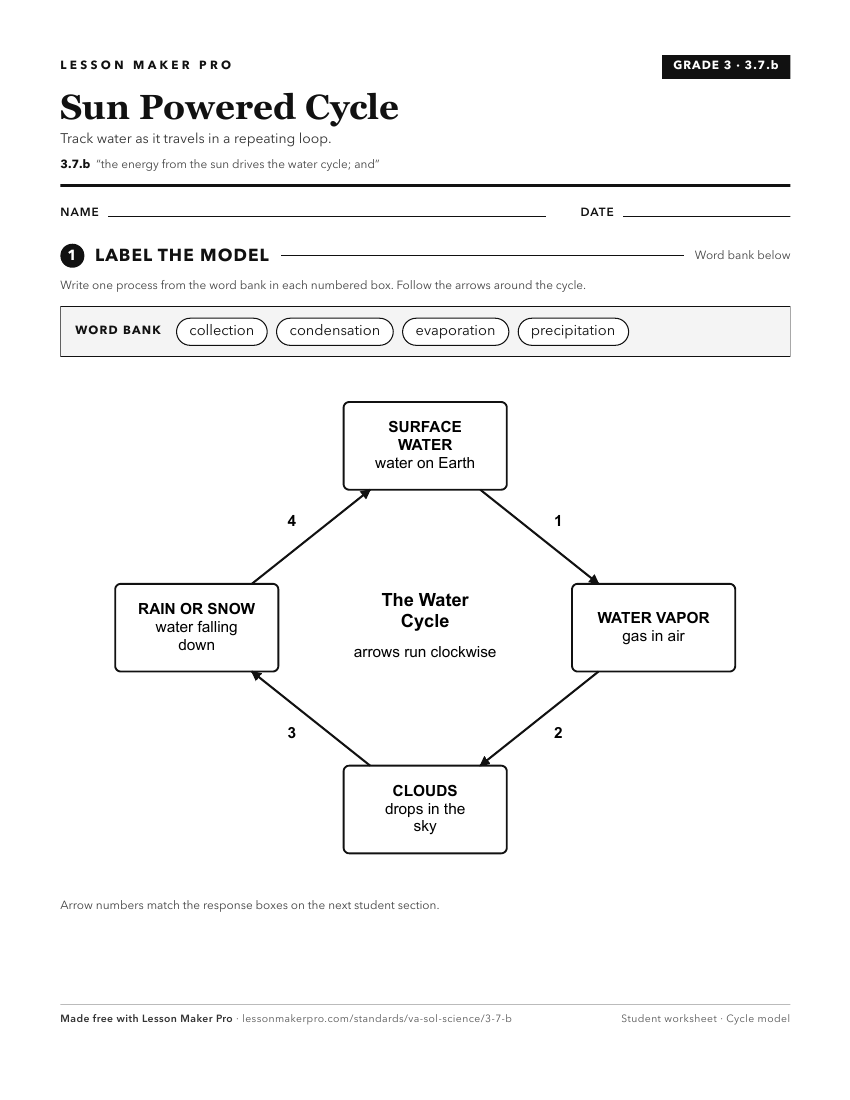
A ready-to-print activity worksheet aligned to 3.7.b, with an answer key for the teacher on its own page. No account needed.
PDF, US Letter, prints cleanly in black and white.
Download the worksheetKeep exploring
Related Standards
Turn this exact standard into a lesson
Grade, subject, topic, and the complete standard are prefilled. Create one free, no account needed.
Also for this standard:Make a WorksheetMake a QuizMake a Sub Lesson