Virginia SOL 5.8.b
The Standard
- 5.8
- The student will investigate and understand that Earth constantly changes. Key ideas include
plate tectonics describe movement of the crust
Virginia Standards of Learning for Science
Teacher's field guide
What This Standard Means
What Students Need to Do
- Students explain that Earth’s crust is broken into large plates that move slowly. They use plate movement to describe changes in the positions of continents and ocean floors.
What Mastery Looks Like
- Students can use a model or diagram to show crustal plates moving toward, away from, or past one another. They can explain that the movement is slow but causes large changes over time.
Common Misconceptions
- Students may think continents move through the ocean while the seafloor stays still. They may also think plates move quickly or include only land, rather than both continental and oceanic crust.
How to Assess It
- Give students a plate boundary diagram with arrows and ask, “How are the crustal plates moving, and what could change over time?”
Lesson moves
Ways to Teach It
Move graham cracker pieces across frosting to model plates pushing together, pulling apart, and sliding past each other.
Ask students to write how Earth’s surface would change if crustal plates stopped moving.
Play a boundary match game using diagram cards, movement descriptions, and labels for toward, apart, and past.
Plot several earthquake locations on a plate map, then explain why many occur near plate edges.
Free download
Printable 5.8.b Worksheet
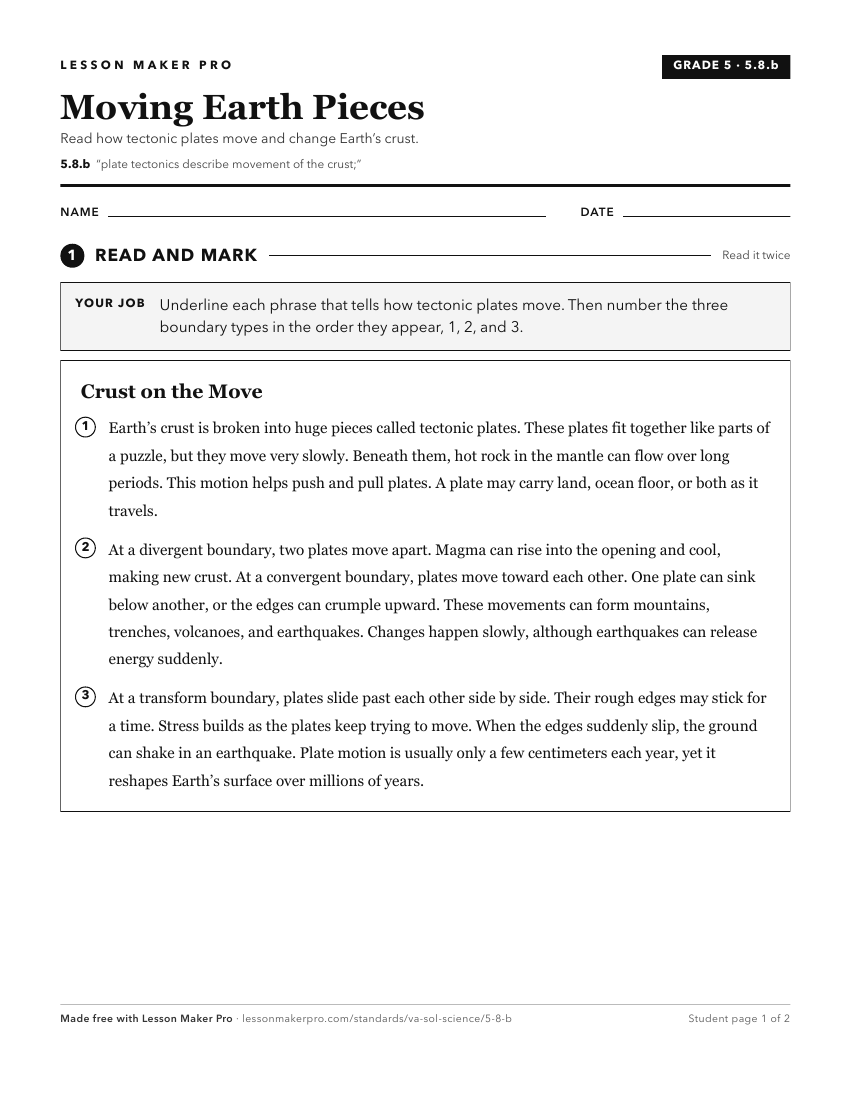
A ready-to-print activity worksheet aligned to 5.8.b, with an answer key for the teacher on its own page. No account needed.
PDF, US Letter, prints cleanly in black and white.
Download the worksheetKeep exploring
Related Standards
Turn this exact standard into a lesson
Grade, subject, topic, and the complete standard are prefilled. Create one free, no account needed.
Also for this standard:Make a WorksheetMake a QuizMake a Sub Lesson