Virginia SOL 5.5.d
The Standard
- 5.5
- The student will investigate and understand that sound can be produced and transmitted. Key ideas include
sound waves have many uses and applications.
Virginia Standards of Learning for Science
Teacher's field guide
What This Standard Means
What Students Need to Do
- Students identify how people use sound to communicate, locate objects, make medical images, and give warnings. They explain whether sound carries information or reflects from an object.
What Mastery Looks Like
- A student can match sonar, medical ultrasound, stethoscopes, microphones, and alarms to their purposes. They can explain how each device sends, receives, or uses reflected sound.
Common Misconceptions
- Students may think ultrasound means very loud sound or that sonar lets people see underwater. They may also think sound can travel through empty space or that an echo has no useful information.
How to Assess It
- Ask: A boat sends sound underwater and detects the returning echo. What can the crew learn, and how does the sound provide that information?
Lesson moves
Ways to Teach It
Build cup-and-string telephones, then test how string tension affects how clearly a spoken message reaches a partner.
Write a claim explaining how sonar and medical ultrasound both use reflected sound, then support it with one example for each.
Play a card sort matching sonar, ultrasound, stethoscopes, microphones, and alarms with their jobs and whether sound is sent, received, or reflected.
Survey the school for sound applications, such as bells, speakers, and alarms, then label what information each sound carries.
Free download
Printable 5.5.d Worksheet
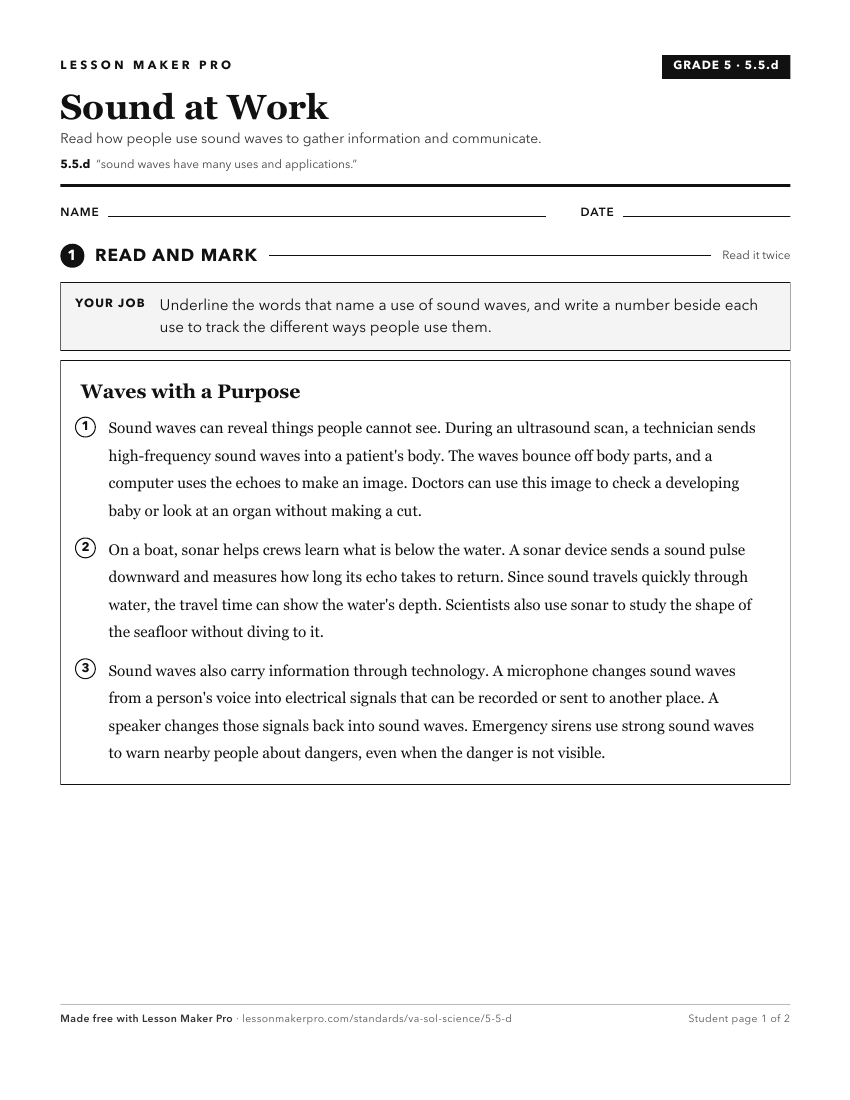
A ready-to-print activity worksheet aligned to 5.5.d, with an answer key for the teacher on its own page. No account needed.
PDF, US Letter, prints cleanly in black and white.
Download the worksheetKeep exploring
Related Standards
Turn this exact standard into a lesson
Grade, subject, topic, and the complete standard are prefilled. Create one free, no account needed.
Also for this standard:Make a WorksheetMake a QuizMake a Sub Lesson