Virginia SOL 5.5.c
The Standard
- 5.5
- The student will investigate and understand that sound can be produced and transmitted. Key ideas include
different media transmit sound differently
Virginia Standards of Learning for Science
Teacher's field guide
What This Standard Means
What Students Need to Do
- Students compare how sound travels through solids, liquids, and gases. They use observations to explain that particles in each medium pass vibrations at different rates.
What Mastery Looks Like
- Students identify the medium carrying a sound and predict how changing that medium affects transmission. They explain that sound generally travels fastest through solids, slower through liquids, and slowest through gases.
Common Misconceptions
- Students may think sound travels only through air or that it can travel through empty space. They may also think sound moves at the same speed through every material.
How to Assess It
- Exit ticket: Rank steel, water, and air from fastest to slowest sound transmission. Explain your ranking in one sentence.
Lesson moves
Ways to Teach It
Build cup phones with equal lengths of yarn, fishing line, and string, then compare sound while keeping each line equally tight.
Ask students to write why a train can be heard through a rail before its sound reaches someone through the air.
Give groups solid, liquid, and gas scenario cards to sort, then have them predict which medium transmits sound fastest.
Examine a stethoscope and trace how its chest piece picks up body sounds and carries them through the air inside its tubing to the doctor's ears.
Free download
Printable 5.5.c Worksheet
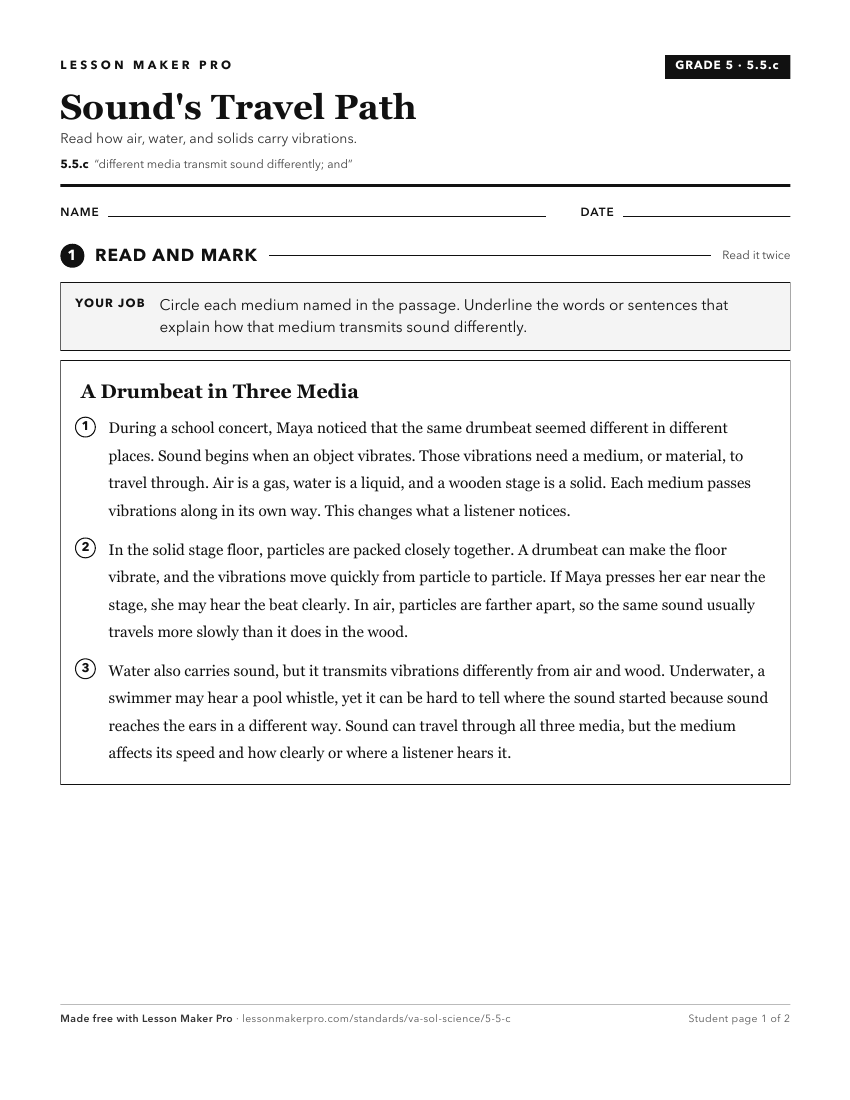
A ready-to-print activity worksheet aligned to 5.5.c, with an answer key for the teacher on its own page. No account needed.
PDF, US Letter, prints cleanly in black and white.
Download the worksheetKeep exploring
Related Standards
Turn this exact standard into a lesson
Grade, subject, topic, and the complete standard are prefilled. Create one free, no account needed.
Also for this standard:Make a WorksheetMake a QuizMake a Sub Lesson