Virginia SOL 3.7.a
The Standard
- 3.7
- The student will investigate and understand that there is a water cycle and water is important to life on Earth. Key ideas include
there are many reservoirs of water on Earth
Virginia Standards of Learning for Science
Teacher's field guide
What This Standard Means
What Students Need to Do
- Students identify places where water is stored on Earth. They recognize oceans, lakes, rivers, glaciers, groundwater, and the atmosphere as water reservoirs.
What Mastery Looks Like
- Students can name several water reservoirs and sort them by location. They can explain that reservoirs may hold fresh water, salt water, liquid water, ice, or water vapor.
Common Misconceptions
- Students may think a reservoir is only a human-made lake behind a dam. They may also think groundwater is an underground river or forget that ice and the atmosphere store water.
How to Assess It
- Exit ticket: Name four water reservoirs on Earth. Label each as above ground, below ground, or in the atmosphere.
Lesson moves
Ways to Teach It
Give pairs photo cards of oceans, rivers, lakes, glaciers, clouds, and wells, then have them sort and label each water reservoir.
Ask students to write: Where can one drop of water be stored on Earth, and what form could it take?
Play Reservoir Relay by calling out a water location while teams hold up cards for surface, underground, ice, or atmosphere.
Use a local map to find nearby rivers, lakes, wetlands, wells, or reservoirs, then discuss where the community gets its water.
Free download
Printable 3.7.a Worksheet
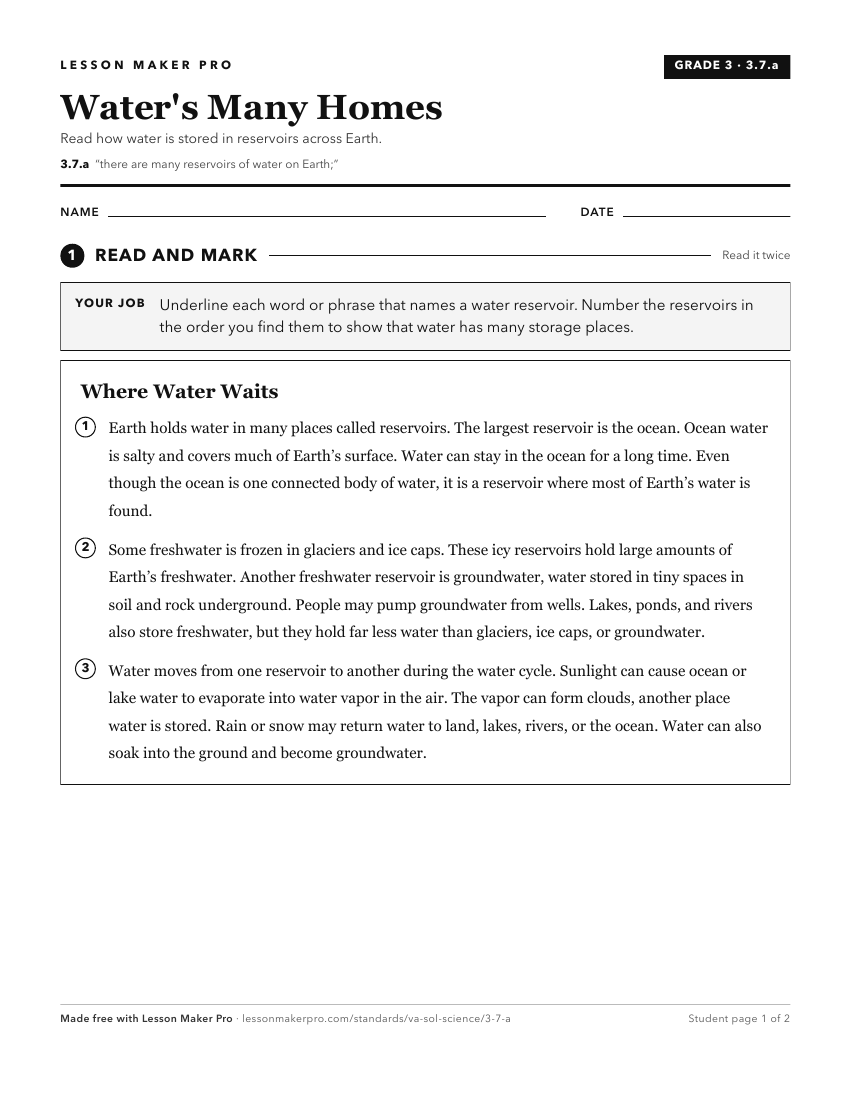
A ready-to-print activity worksheet aligned to 3.7.a, with an answer key for the teacher on its own page. No account needed.
PDF, US Letter, prints cleanly in black and white.
Download the worksheetKeep exploring
Related Standards
Turn this exact standard into a lesson
Grade, subject, topic, and the complete standard are prefilled. Create one free, no account needed.
Also for this standard:Make a WorksheetMake a QuizMake a Sub Lesson