Virginia SOL 3.3.b
The Standard
- 3.3
- The student will investigate and understand how materials interact with water. Key ideas include
many solids dissolve more easily in hot water than in cold water.
Virginia Standards of Learning for Science
Teacher's field guide
What This Standard Means
What Students Need to Do
- Students compare equal amounts of a solid in equal amounts of water at different temperatures. They observe and explain how temperature affects dissolving.
What Mastery Looks Like
- A student keeps the water amount, solid amount, and stirring the same while changing temperature. The student identifies which sample dissolved faster and recognizes that materials may behave differently.
Common Misconceptions
- Students may say the solid disappeared, rather than mixed evenly through the water. They often confuse dissolving with melting. They may assume warmer water makes every solid dissolve faster.
How to Assess It
- Exit ticket: Add 5 grams of sugar to equal cups of water at 10°C and 50°C, then stir each ten times. Ask what changed, what stayed the same, and which cup should dissolve the sugar faster.
Lesson moves
Ways to Teach It
Test equal teaspoons of sugar in equal cups of cold and warm water, stirring each ten times and recording what remains.
Write a claim answering, "How did water temperature affect dissolving?" and support it with two observations from the cup test.
Play Fair Test Fix: teams revise experiment cards that change stirring, water amount, or solid amount along with temperature.
Compare hot cocoa package directions with classroom test results, then explain why the directions call for warm milk or water.
Free download
Printable 3.3.b Worksheet
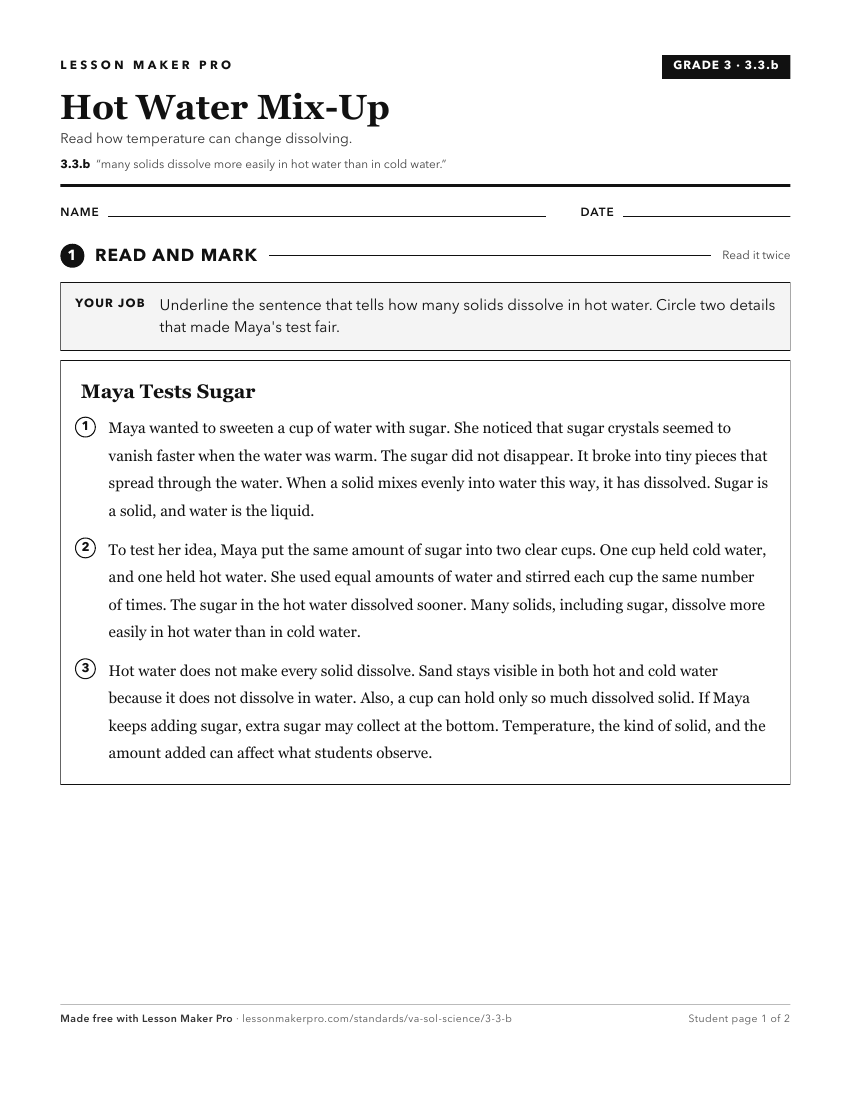
A ready-to-print activity worksheet aligned to 3.3.b, with an answer key for the teacher on its own page. No account needed.
PDF, US Letter, prints cleanly in black and white.
Download the worksheetKeep exploring
Related Standards
Turn this exact standard into a lesson
Grade, subject, topic, and the complete standard are prefilled. Create one free, no account needed.
Also for this standard:Make a WorksheetMake a QuizMake a Sub Lesson