Virginia SOL 3.3.a
The Standard
- 3.3
- The student will investigate and understand how materials interact with water. Key ideas include
solids and liquids mix with water in different ways
Virginia Standards of Learning for Science
Teacher's field guide
What This Standard Means
What Students Need to Do
- Students predict, test, and compare what happens when different materials are added to water. They describe whether each material dissolves, remains visible, settles, floats, or forms a layer.
What Mastery Looks Like
- Students can distinguish dissolved salt from settled sand and a layer of oil. They use observations from the cup to explain each result.
Common Misconceptions
- Students may say a dissolved substance disappeared or became water. They may think stirring makes every material dissolve, or that all liquids blend evenly with water.
How to Assess It
- Exit ticket: Draw and label what happens when salt, sand, and oil are added to separate cups of water.
Lesson moves
Ways to Teach It
In clear cups, students stir salt, sand, and vegetable oil into water, then record whether each dissolves, settles, floats, or forms a layer.
Students answer the prompt, “What evidence shows that salt dissolved while sand did not?” using two observations.
Play a matching game where students pair sample cards with result cards labeled dissolves, forms a layer, floats, or settles.
Test drink mix and cooking oil to explain why one blends into water while the other separates.
Free download
Printable 3.3.a Worksheet
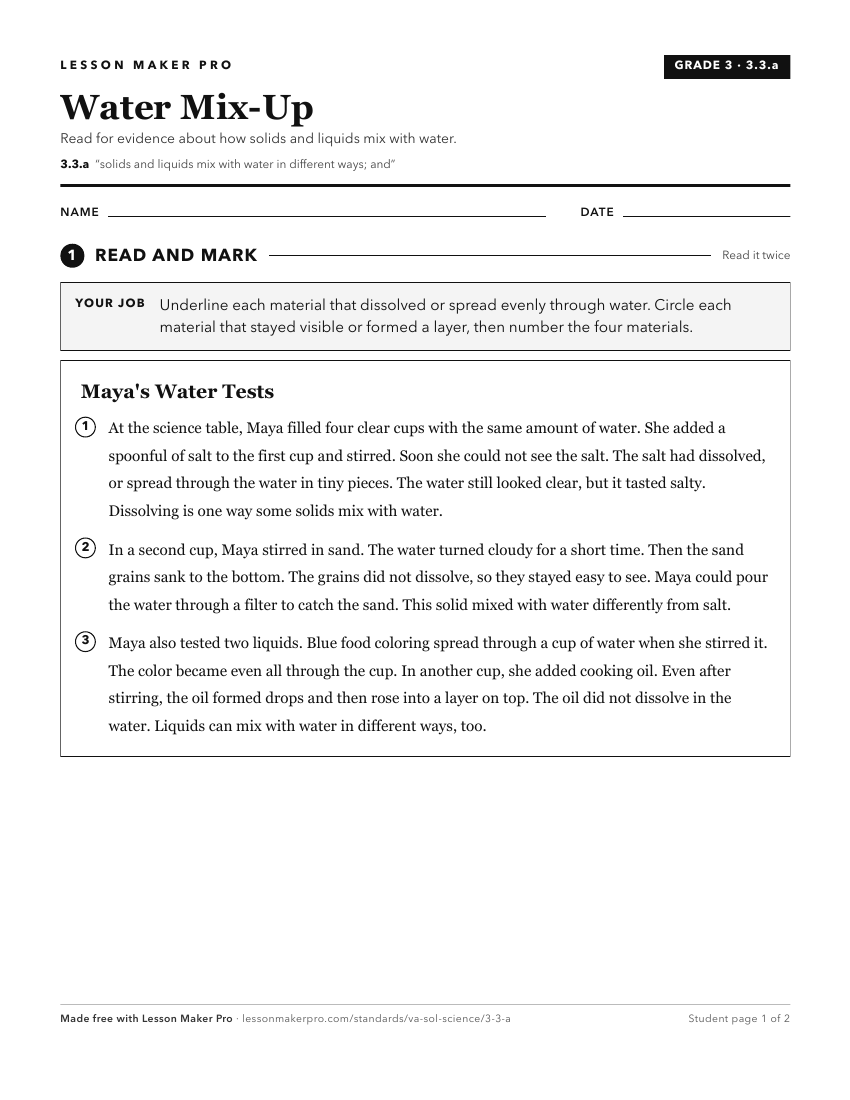
A ready-to-print activity worksheet aligned to 3.3.a, with an answer key for the teacher on its own page. No account needed.
PDF, US Letter, prints cleanly in black and white.
Download the worksheetKeep exploring
Related Standards
Turn this exact standard into a lesson
Grade, subject, topic, and the complete standard are prefilled. Create one free, no account needed.
Also for this standard:Make a WorksheetMake a QuizMake a Sub Lesson