Virginia SOL 3.2.d
The Standard
- 3.2
- The student will investigate and understand that the direction and size of force affects the motion of an object. Key ideas include
simple and compound machines have many applications.
Virginia Standards of Learning for Science
Teacher's field guide
What This Standard Means
What Students Need to Do
- Students identify simple machines in familiar tools and explain the job each one does. They recognize that some tools combine two or more simple machines.
What Mastery Looks Like
- Students can examine an object, name its simple machine parts, and explain how those parts make a task easier. They can support their answer using visible features of the object.
Common Misconceptions
- Students may think a machine must use electricity or have a motor. They may label a compound tool as only one machine or confuse a wedge with an inclined plane.
How to Assess It
- Exit ticket: Draw a wheelbarrow, label two simple machines in it, and explain how each part helps move a load.
Lesson moves
Ways to Teach It
Give groups a stapler, scissors, jar lid, and toy car to inspect, then label each simple machine they find.
Ask, "Which tool would help move a heavy box into a truck, and why?" Students write and defend one choice.
Play a picture sort where teams classify tool cards as levers, pulleys, wheels and axles, inclined planes, wedges, screws, or compound machines.
Walk through the school to sketch ramps, doorknobs, flagpole pulleys, and carts, then explain the job each machine makes easier.
Free download
Printable 3.2.d Worksheet
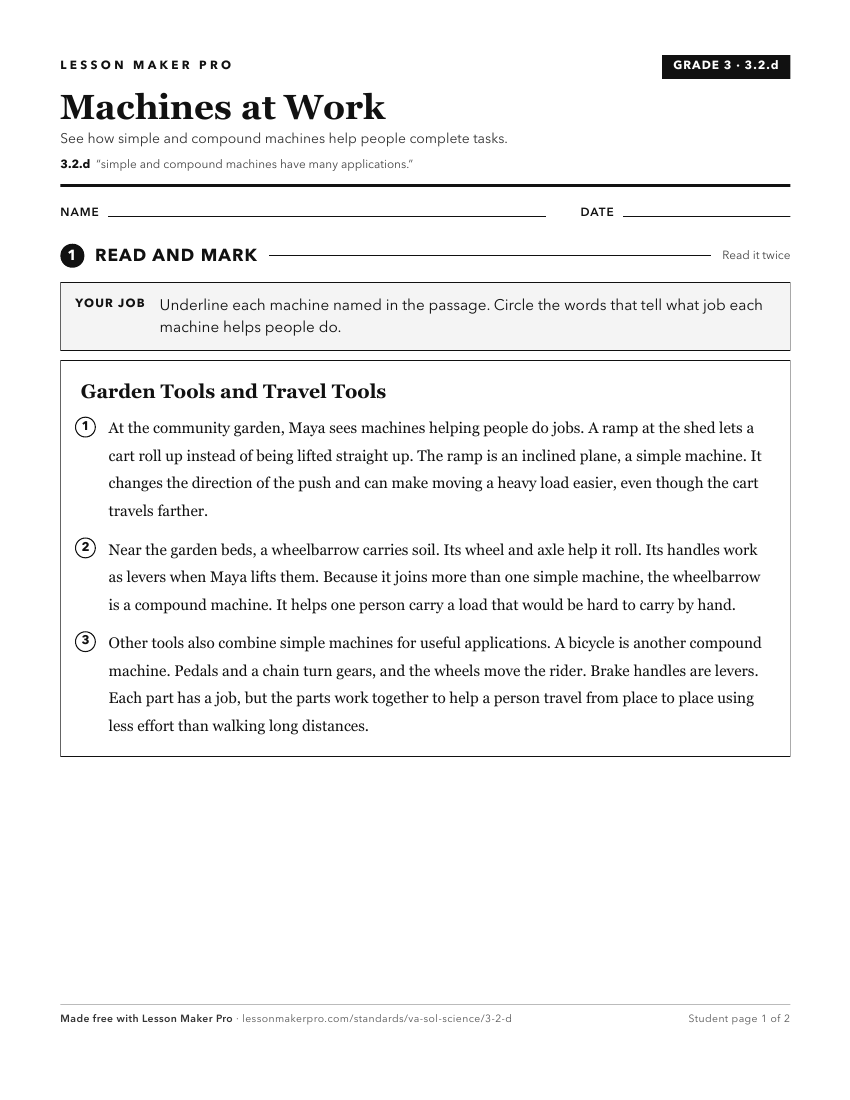
A ready-to-print activity worksheet aligned to 3.2.d, with an answer key for the teacher on its own page. No account needed.
PDF, US Letter, prints cleanly in black and white.
Download the worksheetKeep exploring
Related Standards
Turn this exact standard into a lesson
Grade, subject, topic, and the complete standard are prefilled. Create one free, no account needed.
Also for this standard:Make a WorksheetMake a QuizMake a Sub Lesson