Virginia SOL 2.2.c
The Standard
- 2.2
- The student will investigate and understand that different types of forces may cause an object's motion to change. Key ideas include
forces have applications in our lives.
Virginia Standards of Learning for Science
Teacher's field guide
What This Standard Means
What Students Need to Do
- Students identify pushes, pulls, gravity, and magnetism in everyday objects and actions. They explain how each force starts, stops, speeds up, slows down, or turns an object.
What Mastery Looks Like
- Given a door, wagon, swing, or refrigerator magnet, a student names the force being used and describes its effect. The student supports the explanation with an observation.
Common Misconceptions
- Students may think a force occurs only when an object moves, or that every moving object needs a continuing push. They may think magnets attract every metal or gravity acts only while something falls.
How to Assess It
- Exit ticket: Draw a door, bicycle brake, swing, or refrigerator magnet in use. Label the force and write how it changes an object's motion.
Lesson moves
Ways to Teach It
Use toy cars, cardboard ramps, string tow ropes, and sponge brakes; students test how each item starts, stops, or redirects a car.
Show pictures of a swing, bicycle brake, wagon, and refrigerator magnet; students explain where a push, pull, gravity, or magnetism acts.
Play Force Match with picture cards; students pair each everyday object with start, stop, speed up, slow down, or turn.
Take a school force walk; students sketch one door, cart, slide, or magnet and label the force and motion change.
Free download
Printable 2.2.c Worksheet
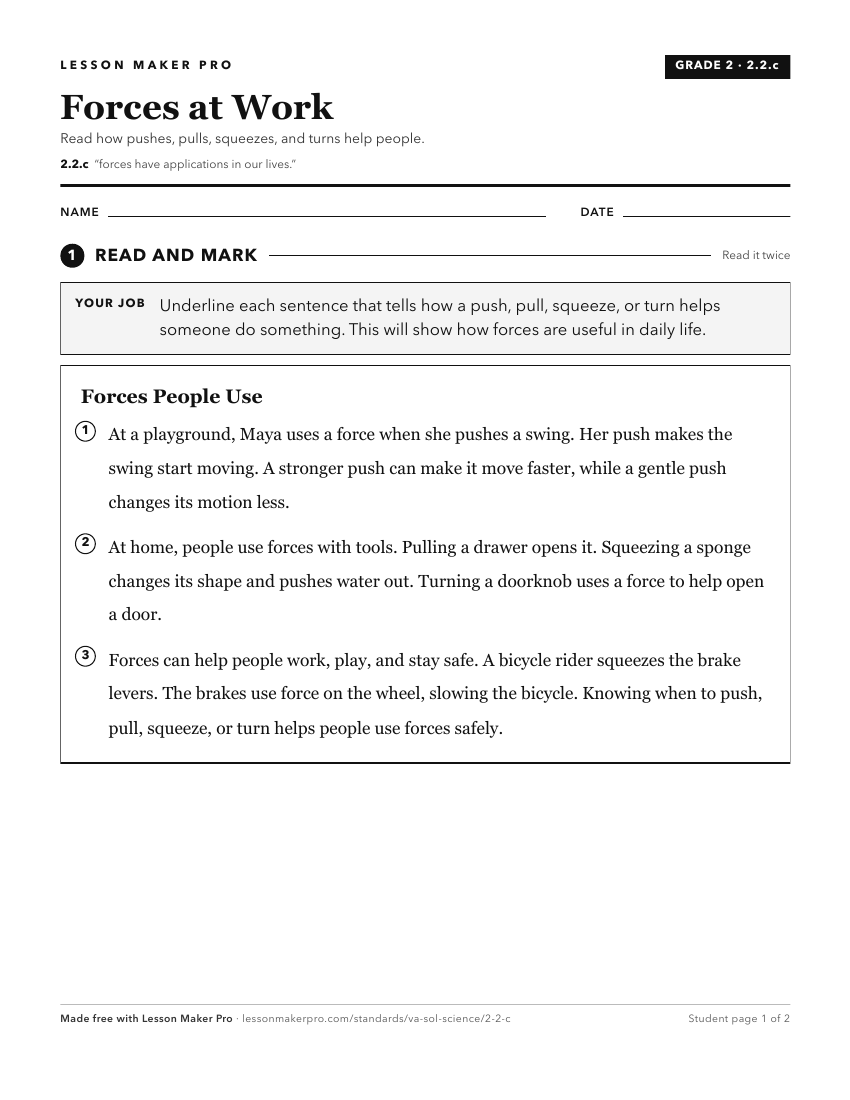
A ready-to-print activity worksheet aligned to 2.2.c, with an answer key for the teacher on its own page. No account needed.
PDF, US Letter, prints cleanly in black and white.
Download the worksheetKeep exploring
Related Standards
Turn this exact standard into a lesson
Grade, subject, topic, and the complete standard are prefilled. Create one free, no account needed.
Also for this standard:Make a WorksheetMake a QuizMake a Sub Lesson