Virginia SOL 2.5.a
The Standard
- 2.5
- The student will investigate and understand that living things are part of a system. Key ideas include
plants and animals are interdependent with their living and nonliving surroundings
Virginia Standards of Learning for Science
Teacher's field guide
What This Standard Means
What Students Need to Do
- Students identify living and nonliving parts of a habitat and explain how organisms depend on them. They use examples such as bees pollinating flowers, birds eating seeds, and plants using sunlight, water, and air to grow.
What Mastery Looks Like
- Given a habitat picture, a student can label living and nonliving parts and connect them with arrows. The student can explain each connection and predict what could happen if one part disappeared.
Common Misconceptions
- Students may think plants get food directly from soil or sunlight. They may overlook air, water, and sunlight because these parts are not alive. They may also think dependence works only one way, such as animals needing plants but plants never benefiting from animals.
How to Assess It
- Show a pond scene and ask students to circle one living part, box one nonliving part, and draw two connections. For each connection, they complete, “The ___ needs ___ because ___.”
Lesson moves
Ways to Teach It
Build a tray habitat with toy animals, plants, rocks, water, and soil, then connect each organism to two needed parts with yarn.
Write how a pond would change if all water plants disappeared, using two specific connections as evidence.
Play Habitat Match with picture cards, pairing each organism with a living or nonliving habitat part it uses and explaining the match.
Visit the school garden and record how one insect, one plant, sunlight, water, and soil connect.
Free download
Printable 2.5.a Worksheet
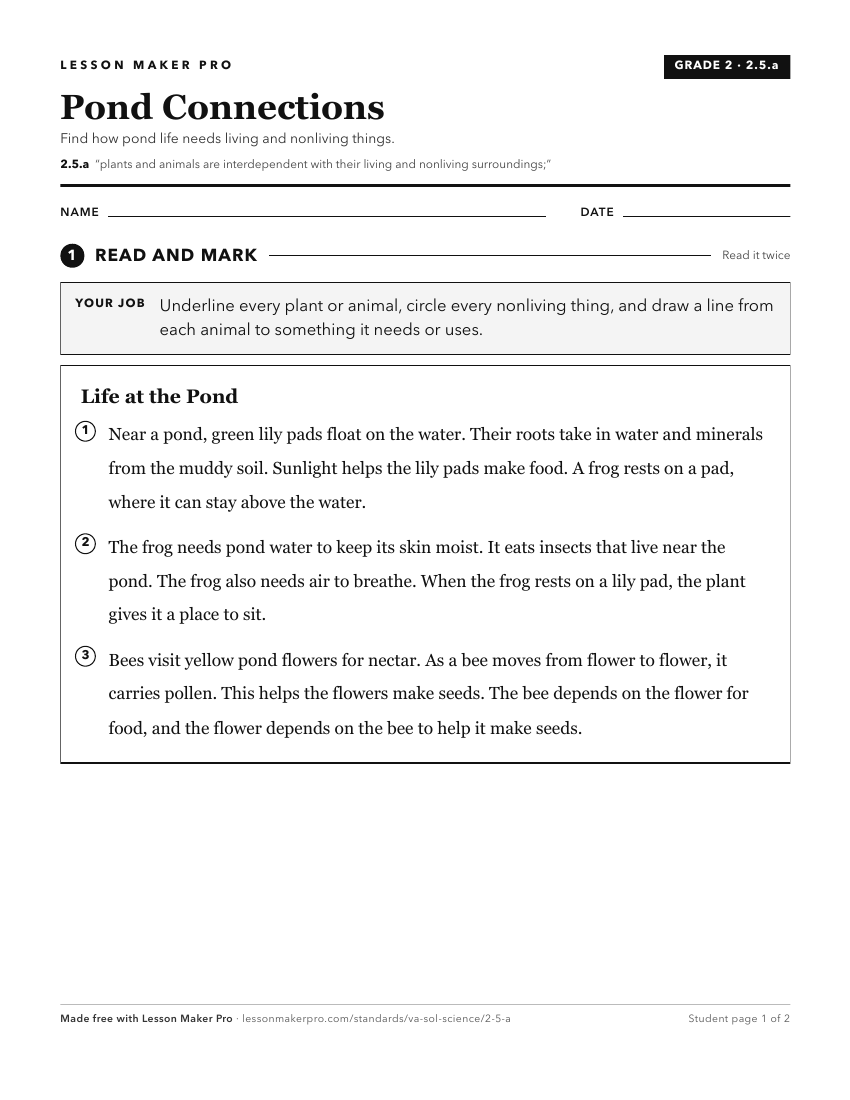
A ready-to-print activity worksheet aligned to 2.5.a, with an answer key for the teacher on its own page. No account needed.
PDF, US Letter, prints cleanly in black and white.
Download the worksheetKeep exploring
Related Standards
- 4.3
The student will investigate and understand that organisms, including humans, interact with one another and with the nonliving components in the ecosystem. Key ...
- 2.5
The student will investigate and understand that living things are part of a system. Key ideas include
- 4.8.b
plants and animals
- K.7.b
plants and animals have life cycles
Turn this exact standard into a lesson
Grade, subject, topic, and the complete standard are prefilled. Create one free, no account needed.
Also for this standard:Make a WorksheetMake a QuizMake a Sub Lesson