Virginia SOL 1.2.b
The Standard
- 1.2
- The student will investigate and understand that objects can move in different ways. Key ideas include
objects may vibrate and produce sound.
Virginia Standards of Learning for Science
Teacher's field guide
What This Standard Means
What Students Need to Do
- Students observe that quick back-and-forth movement can make a sound. They identify the moving part of a familiar sound source, such as a rubber band, ruler, or drumhead.
What Mastery Looks Like
- A student can make a sound with an object and point to the part moving back and forth. The student can explain that stopping the movement stops the sound.
Common Misconceptions
- Students may think the tap or pluck alone makes sound, rather than the movement that follows. They may also think vibration must be easy to see. Some confuse vibration with an object moving across a surface.
How to Assess It
- Stretch a rubber band around a box and pluck it. Ask students to draw what moves and complete: “I hear sound because the rubber band _____.”
Lesson moves
Ways to Teach It
Set up stations with rubber bands, rulers, and drums so students can make sounds, watch closely, and gently feel each moving part.
Ask students to draw a sound source and answer, “Which part moves when you hear the sound?”
Play Sound Detective by making sounds behind a screen, then have students name the source and identify the likely moving part.
Have students hum with fingers on their throats, then describe what they feel and connect it to speaking and singing.
Free download
Printable 1.2.b Worksheet
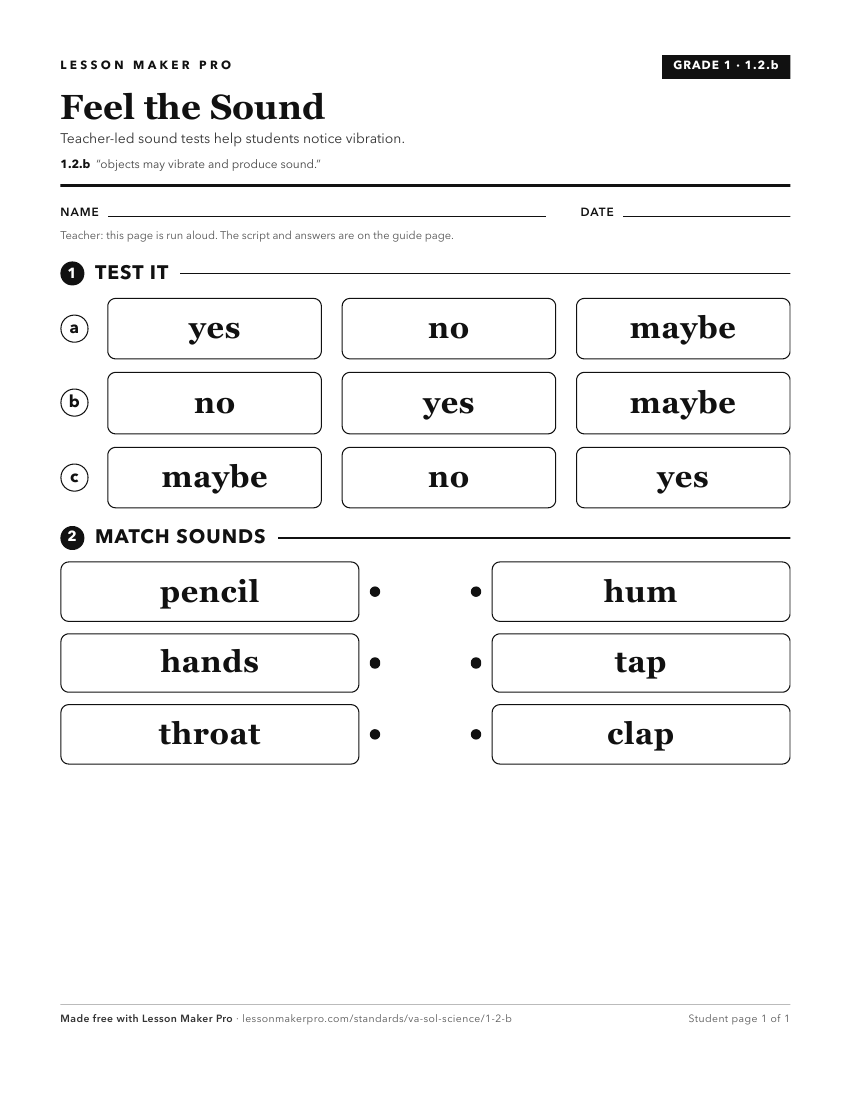
A ready-to-print activity worksheet aligned to 1.2.b, with an answer key for the teacher on its own page. No account needed.
PDF, US Letter, prints cleanly in black and white.
Download the worksheetKeep exploring
Related Standards
Turn this exact standard into a lesson
Grade, subject, topic, and the complete standard are prefilled. Create one free, no account needed.
Also for this standard:Make a WorksheetMake a QuizMake a Sub Lesson