Virginia SOL 1.2.a
The Standard
- 1.2
- The student will investigate and understand that objects can move in different ways. Key ideas include
objects may have straight, circular, spinning, and back-and-forth motions
Virginia Standards of Learning for Science
Teacher's field guide
What This Standard Means
What Students Need to Do
- Students observe how objects move and name the motion pattern. They sort, compare, and demonstrate motions such as moving in a line, turning around, rotating, or swinging.
What Mastery Looks Like
- A student can watch an object move and correctly describe its motion. The student can also make an object show a named motion and explain how it moved.
Common Misconceptions
- Students may confuse moving around a circle with rotating in one place. They may also call every repeated motion back-and-forth, even when an object is spinning.
How to Assess It
- Give each student a toy car, top, or pendulum. Ask the student to demonstrate one motion and name a different motion shown by a classmate.
Lesson moves
Ways to Teach It
Set up stations with toy cars, tops, balls, and pendulums, then have students move each object and record its motion with a picture.
Show a rolling wheel and a spinning top, then ask students to explain how their motions are alike and different.
Play Motion Charades by calling out a motion for students to act out while classmates identify and describe it.
Observe a swing, ceiling fan, rolling cart, and clock hands, then match each object to a labeled motion card.
Free download
Printable 1.2.a Worksheet
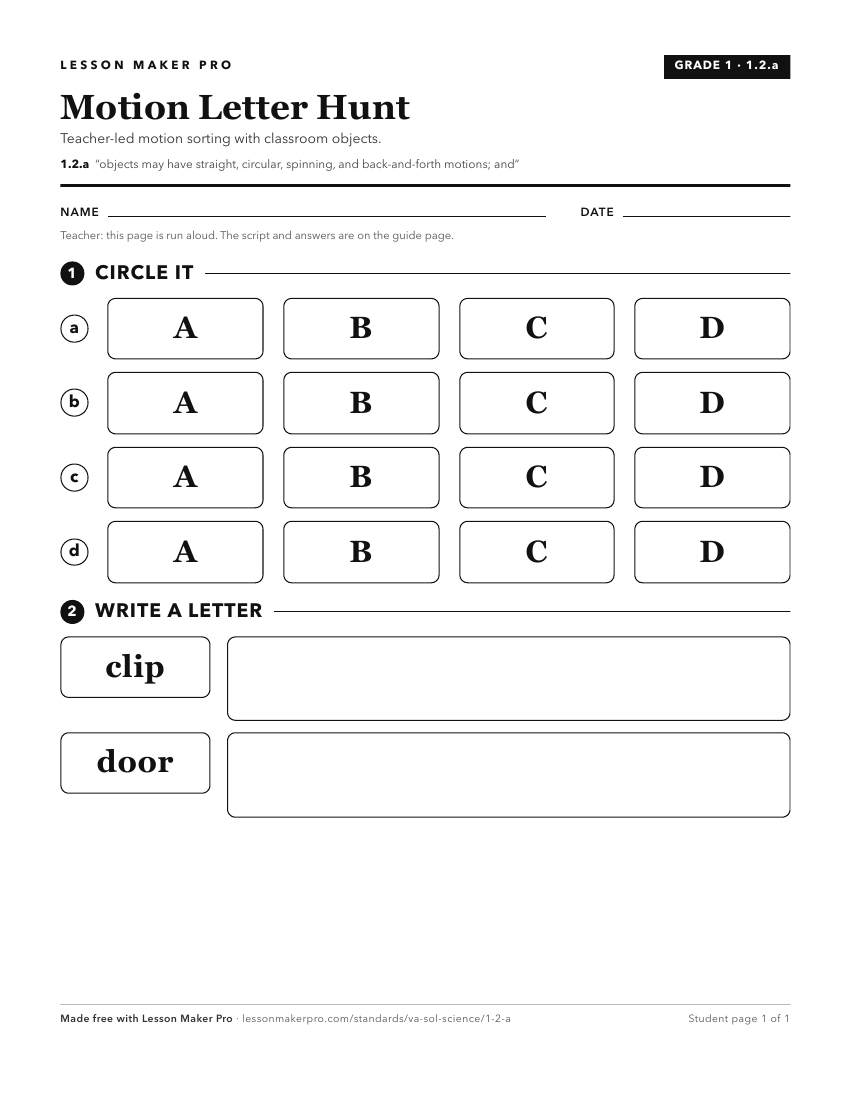
A ready-to-print activity worksheet aligned to 1.2.a, with an answer key for the teacher on its own page. No account needed.
PDF, US Letter, prints cleanly in black and white.
Download the worksheetKeep exploring
Related Standards
Turn this exact standard into a lesson
Grade, subject, topic, and the complete standard are prefilled. Create one free, no account needed.
Also for this standard:Make a WorksheetMake a QuizMake a Sub Lesson