Virginia SOL K.NS.1.b
The Standard
Recognize and explain that the number of objects remains the same regardless of the arrangement or the order in which the objects are counted.
Virginia Standards of Learning for Mathematics · The student will utilize flexible counting strategies to determine and describe quantities up to 100.
Teacher's field guide
What This Standard Means
What Students Need to Do
- Students count a group of objects, then count the same group after it is moved or rearranged. They explain why the total does not change when every object is counted once.
What Mastery Looks Like
- A student counts a set, watches it being rearranged, and states that the total stays the same. The student can count in another order and explain that each object was counted once.
Common Misconceptions
- Students may think a spread-out row has more objects than a close-together row. They may also think starting at a different object changes the total.
How to Assess It
- Place eight counters in a row, then spread them into a circle. Ask, “How many are there now, and how do you know?”
Lesson moves
Ways to Teach It
Give pairs ten counters to count, rearrange into different shapes, and recount while recording each total.
Show two arrangements of the same six objects and ask, “Did the amount change? Explain how you know.”
Play Count It Again by moving counters after each count and having students predict the total before recounting.
Rearrange eight classroom supplies on a table and discuss why moving them does not change how many supplies there are.
Free download
Printable K.NS.1.b Worksheet
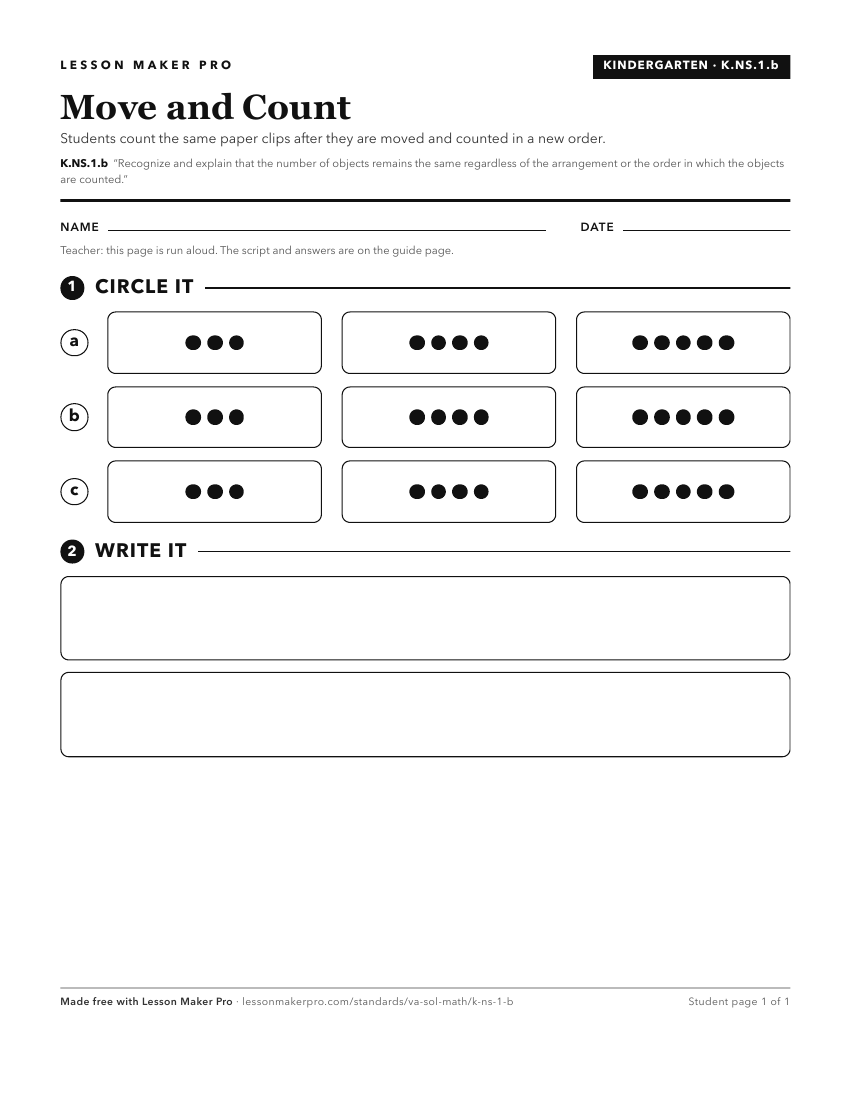
A ready-to-print activity worksheet aligned to K.NS.1.b, with an answer key for the teacher on its own page. No account needed.
PDF, US Letter, prints cleanly in black and white.
Download the worksheetKeep exploring
Related Standards
- K.NS.2.c
Determine and write the numeral that corresponds to the total number of objects in a given set of 30 or fewer concrete objects or pictorial models.
- 1.NS.2.b
Estimate the number of objects (up to 120) in a given collection and justify the reasonableness of an answer.
- 1.NS.1.e
Group a collection of up to 120 objects into tens and ones, and count to determine the total (e.g., 5 groups of ten and 6 ones is equal to 56 total objects).
- K.NS.1.a
Use one-to-one correspondence to determine how many are in a given set containing 30 or fewer concrete objects (e.g., cubes, pennies, balls), and describe the l...
Turn this exact standard into a lesson
Grade, subject, topic, and the complete standard are prefilled. Create one free, no account needed.
Also for this standard:Make a WorksheetMake a QuizMake a Sub Lesson