Virginia SOL 5.PS.3.b
The Standard
Determine the number of possible outcomes by using the Fundamental (Basic) Counting Principle.
Virginia Standards of Learning for Mathematics · The student will determine the probability of an outcome by constructing a model of a sample space and using the Fundamental (Basic) Counting Principle.
Teacher's field guide
What This Standard Means
What Students Need to Do
- Students find how many combinations are possible when an event has two or more stages. They multiply the number of choices at each stage.
What Mastery Looks Like
- Students multiply the number of choices at each step and get the correct total. They can justify the product with an organized list, table, or tree diagram.
Common Misconceptions
- Students may add the numbers of choices instead of multiplying them. They may miss combinations, repeat combinations, or include choices that are not allowed.
How to Assess It
- Give this exit ticket: “A lunch has 3 sandwich choices, 2 fruit choices, and 2 drink choices. How many lunches are possible? Explain.”
Lesson moves
Ways to Teach It
Give pairs shirts, pants, and hat cards, then have them build outfits and compare the count with a multiplication equation.
Ask students to explain why three ice cream flavors and four toppings make 12 combinations, not seven.
Play Combination Race by showing choice cards and having teams write the matching multiplication equation and total.
Use a restaurant menu with meal, side, and drink options to calculate how many different orders a customer can make.
Free download
Printable 5.PS.3.b Worksheet
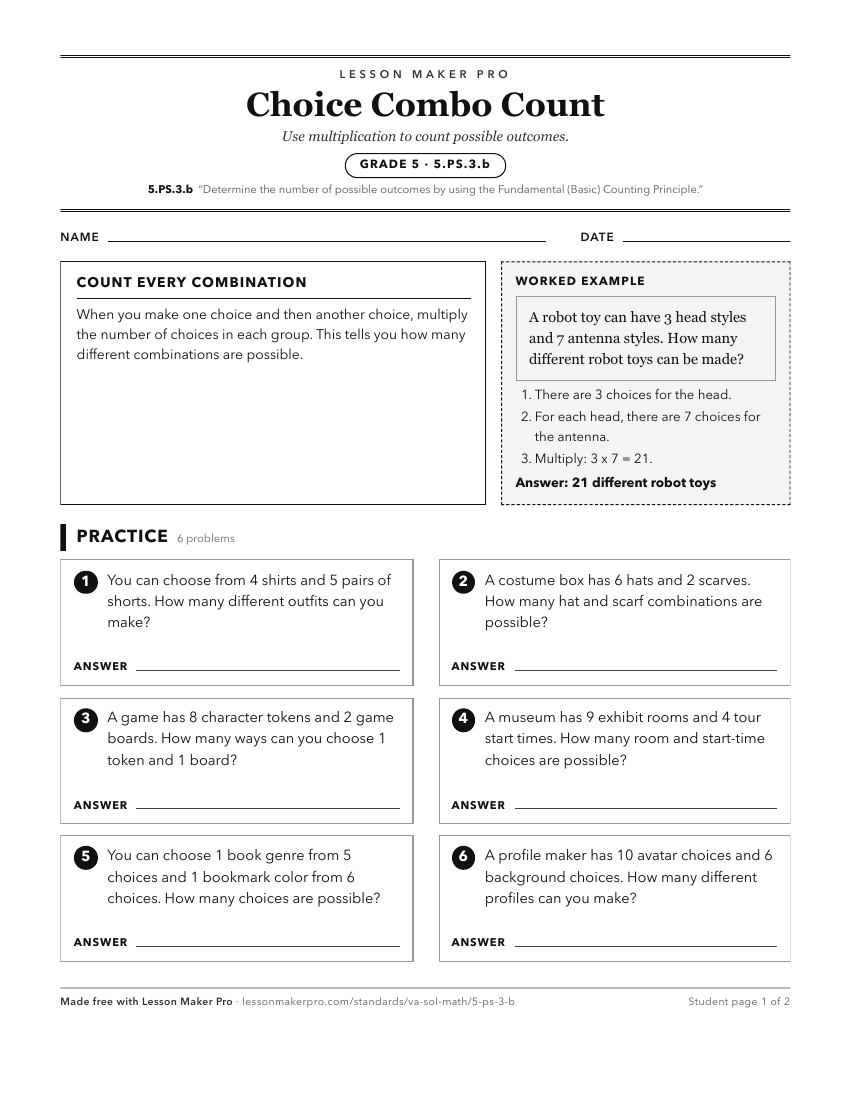
A ready-to-print activity worksheet aligned to 5.PS.3.b, with an answer key for the teacher on its own page. No account needed.
PDF, US Letter, prints cleanly in black and white.
Download the worksheetKeep exploring
Related Standards
- 4.PS.2.d
Determine the likelihood of an event occurring and relate it to its whole number or fractional representation (e.g., impossible or zero; equally likely; certain...
- 5.PS.3
The student will determine the probability of an outcome by constructing a model of a sample space and using the Fundamental (Basic) Counting Principle.
- 5.PS.3.a
Determine the probability of an outcome by constructing a sample space (with a total of 24 or fewer equally likely possible outcomes), using a tree diagram, lis...
- 4.PS.2.b
Model and determine all possible outcomes of a given simple event where there are no more than 24 possible outcomes, using a variety of manipulatives (e.g., coi...
Turn this exact standard into a lesson
Grade, subject, topic, and the complete standard are prefilled. Create one free, no account needed.
Also for this standard:Make a WorksheetMake a QuizMake a Sub Lesson