Virginia SOL 4.PS.2.b
The Standard
Model and determine all possible outcomes of a given simple event where there are no more than 24 possible outcomes, using a variety of manipulatives (e.g., coins, two-sided counters, number cubes, spinners).
Virginia Standards of Learning for Mathematics · The student will model and determine the probability of an outcome of a simple event.
Teacher's field guide
What This Standard Means
What Students Need to Do
- Students use coins, counters, number cubes, and spinners to identify every result that could occur. They organize up to 24 outcomes and check that none are missing or repeated.
What Mastery Looks Like
- Students can inspect a coin, counter, number cube, or spinner and make a complete outcome list. They match each face or section to their list without omissions or extra results.
Common Misconceptions
- Students may list only the result they expect or the results seen during a few trials. They may skip a face or section, repeat an outcome, or confuse possible outcomes with favorable outcomes.
How to Assess It
- Show an eight-section spinner labeled 1 through 8. Ask students to list every possible outcome and explain how they know the list is complete.
Lesson moves
Ways to Teach It
Set up stations with a coin, two-sided counter, number cube, and eight-section spinner; students handle each tool and record every possible result.
Ask students to write how they can prove an outcome list is complete, pointing to each face or spinner section as evidence.
Play Outcome Hunt: pairs receive a coin, cube, or spinner, list its outcomes, then trade materials and check another pair’s list.
Use a prize wheel with eight labeled sections, and have students list every prize that could result before the wheel is spun.
Free download
Printable 4.PS.2.b Worksheet
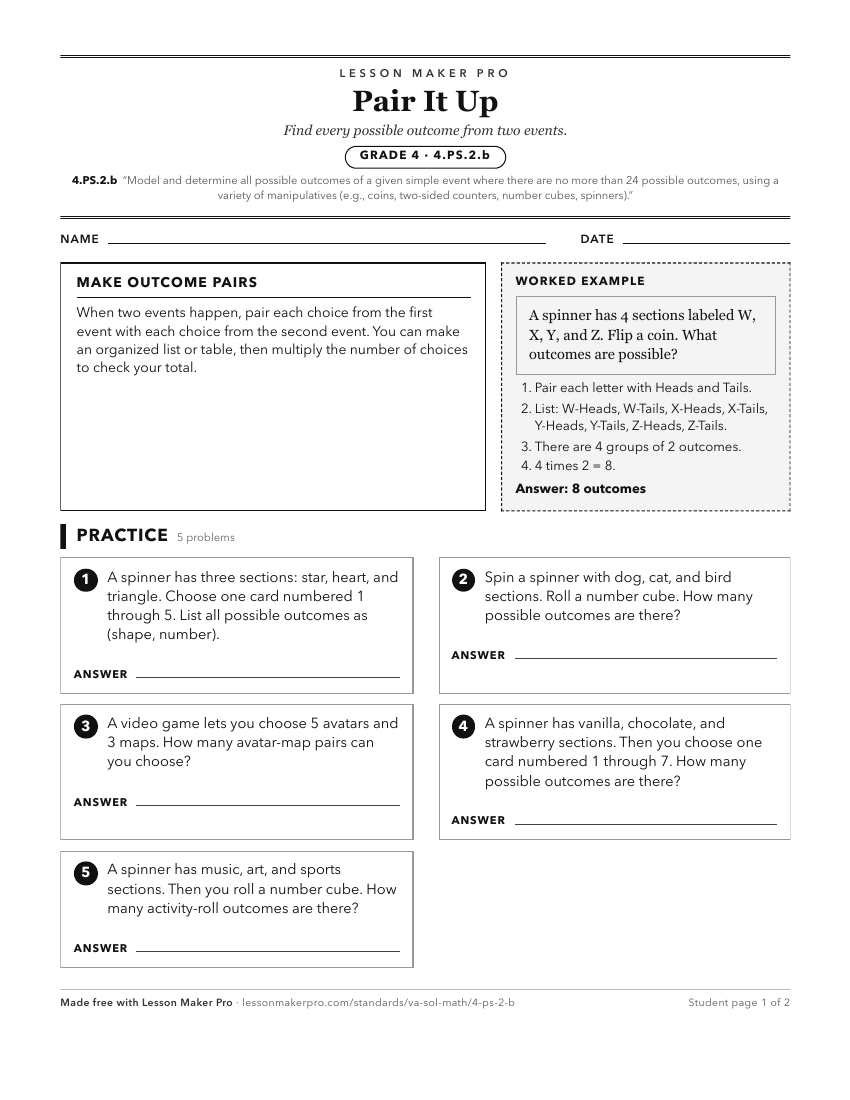
A ready-to-print activity worksheet aligned to 4.PS.2.b, with an answer key for the teacher on its own page. No account needed.
PDF, US Letter, prints cleanly in black and white.
Download the worksheetKeep exploring
Related Standards
- 5.PS.3.b
Determine the number of possible outcomes by using the Fundamental (Basic) Counting Principle.
- 5.PS.3
The student will determine the probability of an outcome by constructing a model of a sample space and using the Fundamental (Basic) Counting Principle.
- 5.PS.3.a
Determine the probability of an outcome by constructing a sample space (with a total of 24 or fewer equally likely possible outcomes), using a tree diagram, lis...
- 4.PS.2
The student will model and determine the probability of an outcome of a simple event.
Turn this exact standard into a lesson
Grade, subject, topic, and the complete standard are prefilled. Create one free, no account needed.
Also for this standard:Make a WorksheetMake a QuizMake a Sub Lesson